AGENTIC WORKFLOWS GUIDE
AI in Action: Inside Maritime Workflows
Human judgment and AI execution across chartering, operations, and claims
AI can’t do your job… and it’s not supposed to. See how an effective partnership between humans and agentic AI cuts manual work so human judgment goes further.
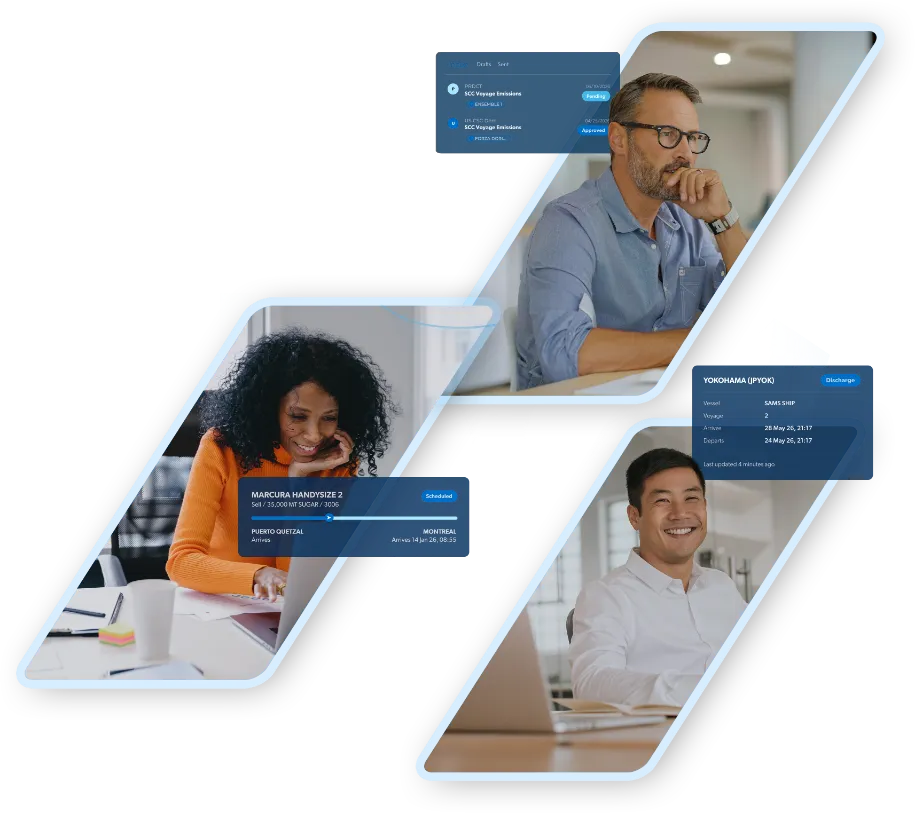
Maritime shipping relies heavily on relationships, experience, and human judgment that no model can replicate. But most of a charterer or operator’s day gets consumed by reading, re-keying, and reconciling – repeat tasks that don’t make the best use of human expertise, but that agentic workflows can handle in seconds.
The real value comes when people and AI each focus on what they do best.
This guide shows how the right balance between human expertise and AI execution helps teams win better fixtures, protect voyage margins, and recover more from claims.
What you’ll get
Put agentic workflows to work in the right places
After reading this guide, you’ll be able to:
1
Know where people lead and where AI executes.
See where commercial judgment matters most and where agentic AI can carry the load across chartering, operations, and claims.
2
Explore agentic workflows in practice.
Follow three real scenarios that pair AI execution with human judgment: a broker email turned into a pre-calculated estimate, a revised ETA that updates the P&L automatically, and a statement of facts turned into a traceable laytime timeline.
3
Understand the shift from system of record to system of action.
Learn why AI is only as effective as the data and context behind it, and how a trusted system of record makes agentic workflows reliable.
4
Build AI governance that keeps people in control.
See how business rules and approval thresholds can help you decide what agentic AI can handle on its own and what needs human review.
Access the guide
Fill out the form below for full access to the AI in Action guide.
Frequently asked questions on agentic workflows in maritime
AI can process broker emails, organize cargo offers and vessel positions, assess possible cargo-vessel matches, and pre-populate voyage estimates with extracted terms. It can also capture recap and charter party details and pass fixture information into operational records. That leaves charterers free to focus on the work that needs human judgment: choosing which opportunities to pursue, setting pricing and bid strategy, and negotiating terms with counterparties.
In voyage operations, AI can match incoming emails to the right voyage, process ETA and ETD changes, prepare itinerary and P&L updates, help with agent nominations, and draft freight invoices from existing voyage data. For example, when a vessel reports a revised ETA, an agentic workflow can identify the voyage and prepare a schedule update with the P&L impact already calculated. The operator then approves it, or it goes through automatically under preset rules. Operators keep ownership of routing, bunker, and optimization decisions and of handling exceptions.
AI can surface incoming statements of facts (SOFs), match them to the correct claim, and extract activities into a structured timeline that stays traceable to the source document. It can also pull out relevant charter party terms, flag potential deductions, and check counterparty invoices against claim calculations. Claims analysts review and validate the data, then concentrate on judging claim validity and negotiating settlements.
A system of record, such as IMOS for voyage management, stores the trusted commercial and operational data for each voyage. A system of action builds on that data with AI workflows that capture and update information as work happens. Broker emails become structured estimates, revised ETAs flow into the P&L, and SOFs arrive ready for calculation. The system of record keeps AI outputs accurate, and the system of action turns that data into timely decisions.
Through governance. Business rules and approval requirements set what AI can do on its own and where a person must sign off. A routine ETA update might be processed automatically, while a change with significant commercial implications is flagged for an operator to review. Traceable actions and clear approvals keep AI within company standards and leave people accountable for decisions.