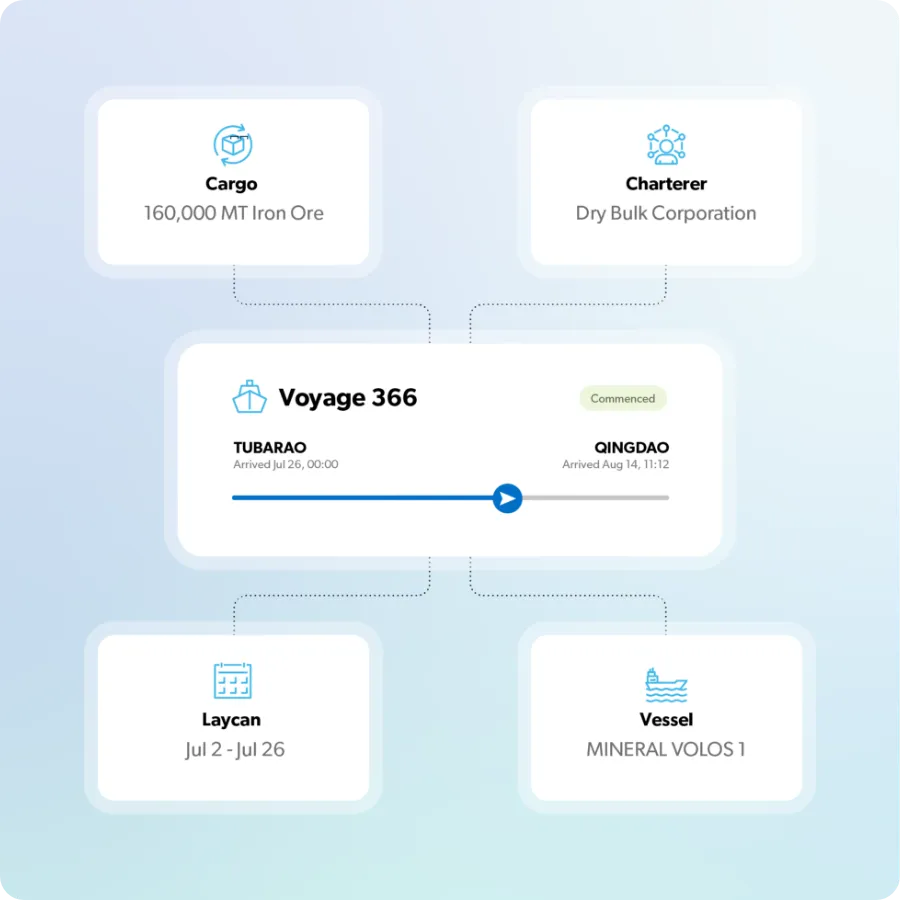
Veson centralizes voyage details in one interface so operators and counterparties can work from the same source of truth.
Standardize how voyage instructions are created, distributed, and tracked from one system.
Maintain a centralized view of cargo details, itineraries, and special instructions.
Enable seamless handovers between operators and other team members with complete, accessible voyage records.
Build rules to enforce process consistency across operators and regions.
Track costs and protect margins
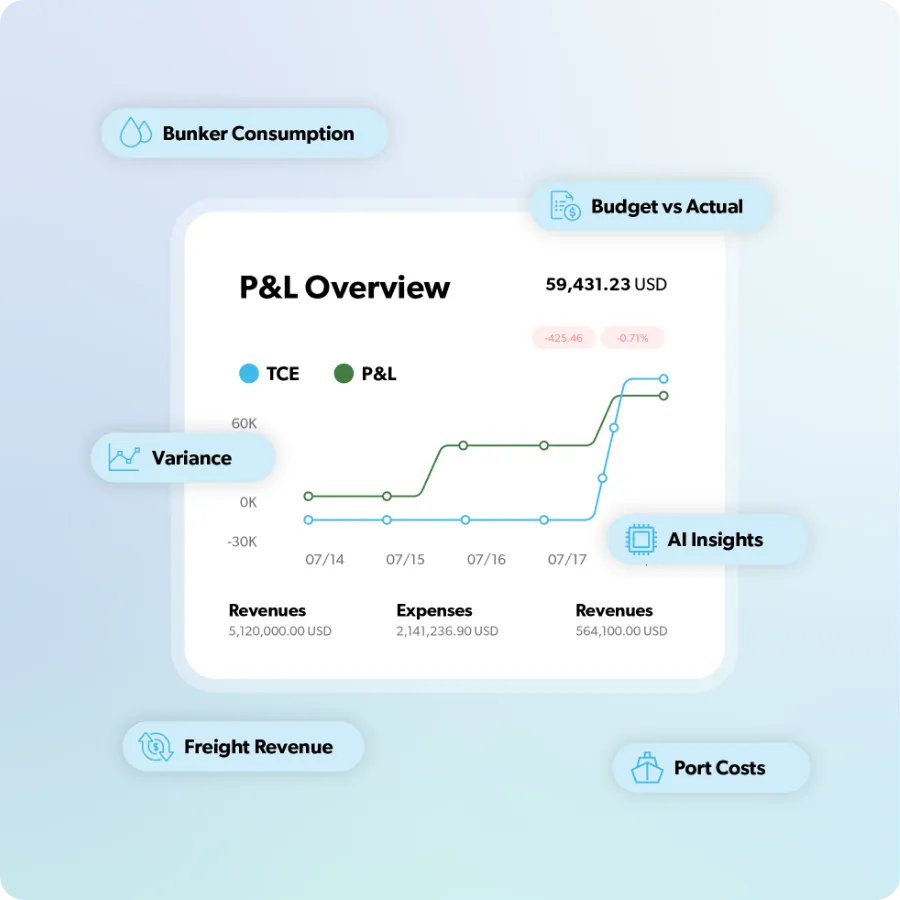
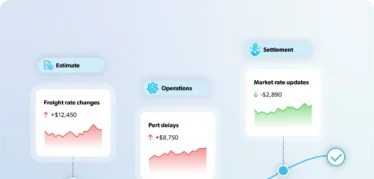
Every delay or deviation can influence overall profitability. Veson provides real-time P&L visibility so you can see the impact of every vessel action and decision.
Monitor voyage-related expenses against budget as they occur.
Track port costs, bunker consumption, and other costs against original estimates.
Instantly surface variance drivers with CoCaptain AI to understand and control P&L shifts.
Maintain a fleet-level view of costs and variations across active voyages.
Measure and improve voyage performance
Timely, actionable data drives better voyage execution. Veson gives your team real-time operational visibility to optimize both current performance and future outcomes.
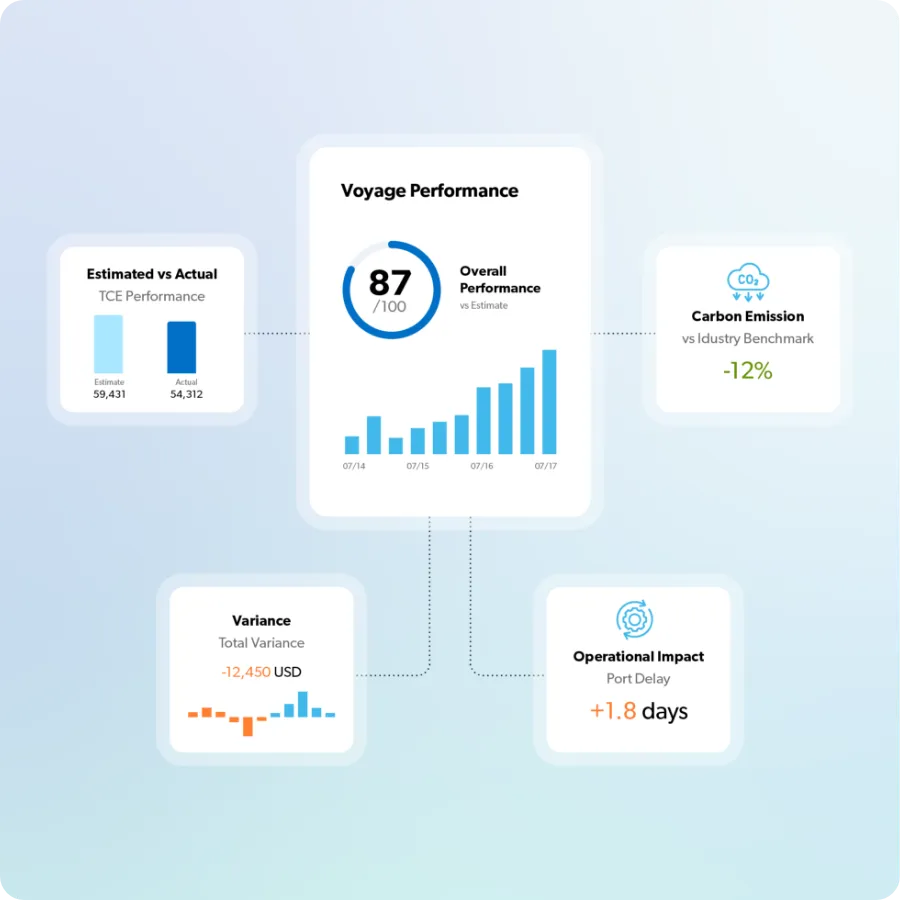
Access real-time performance data from a centralized view.
Compare estimated vs. actual TCE and understand drivers of underperformance.
Identify and track sources of variance before they compound.
Monitor carbon emissions alongside commercial performance to satisfy strategic and regulatory objectives.
Keep teams aligned
With the Veson P&L snapshots, your team gains a clear view of where voyage economics stand at any point in time, allowing you to see the impact of every decision.
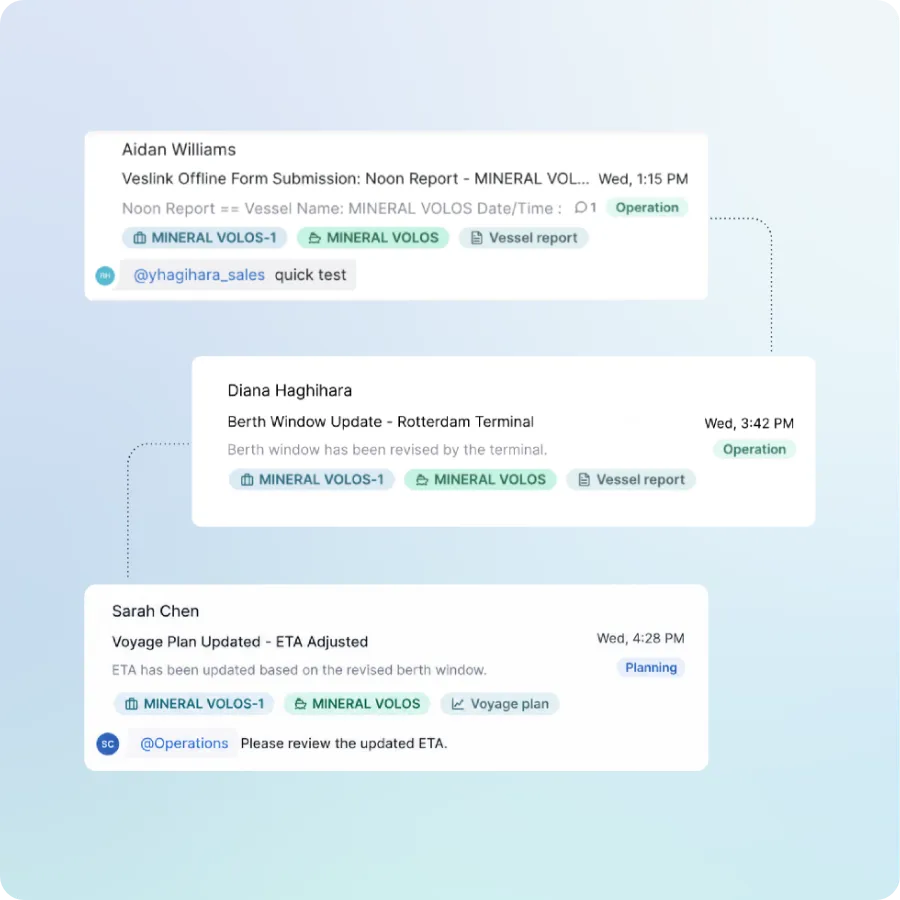
Automatically tag emails by voyage, vessel, and port so that no detail gets missed.
Surface critical messages and counterparty communications with intelligent AI-powered parsing.
Tag teammates with @mentions to simplify coordination and avoid knowledge gaps.
Extract certificate and document details from attachments to avoid manual data entry and improve accuracy.
“IMOS is a platform I probably spend half of my day looking at and working in, and it’s integral to what I do on a day-to-day basis.”
Marc Radulovic Senior Fleet Manager, Star Bulk
More resources on voyage operations
Blog
The Value of a Digital Solution for Voyage Operators
Read more
Web page
Managing P&L
Read more
Web page
Insights
Read more
See efficient voyage operations in action.
Explore the interactive demo.
Are your voyages running as profitably as possible?
See how Veson helps you understand cost drivers, reduce manual effort, and execute voyages with confidence.
Frequently asked questions on maritime operations with Veson
What causes estimate-to-actual variance in voyage P&L, and how do operators catch it earlier?
The most common drivers of estimate-to-actual variance are bunker price or consumption changes, port delays and associated costs, schedule deviations that affect cargo performance, and demurrage that was not accrued early enough. Operators typically catch these late because the tools they use, like spreadsheets, email updates, and separate cost systems, are not connected to the original estimate in a way that surfaces variance automatically.
The Veson Platform addresses this by maintaining a dynamic P&L that updates continuously as voyage conditions change, with variance drivers identified in real time. When a number shifts, the team knows why it shifted and can respond accordingly, rather than discovering the gap at voyage close.
How does Veson help maritime operations leaders ensure process consistency across distributed teams?
IMOS provides a configurable rules engine that allows operations leaders to standardize workflows, checklists, and voyage instruction templates across their entire team. This reduces the variation that comes from individual habits or regional differences, and it gives the Head of Operations visibility into how processes are being followed.
Can Veson track vessel performance and TCE management throughout the voyage lifecycle?
Yes. The Veson Platform provides continuous access to voyage performance data, including estimated vs. actual TCE, speed and consumption monitoring, and off-hire tracking, at every stage of the voyage lifecycle. Historical performance data is also accessible, enabling teams to benchmark current voyages against past performance and build more accurate estimates over time.
Can operators see the carbon emissions impact of a voyage or routing decision with Veson?
Yes, Veson surfaces carbon emissions data alongside commercial performance metrics throughout the voyage lifecycle, allowing operations leaders to see a full emissions picture alongside the financial picture. This is increasingly critical as regulatory expectations evolve and counterparties expect emissions transparency as part of the reporting process.
How does Veson support documentation accuracy for NORs, SOFs, and other voyage documents?
Veson centralizes voyage document management so NORs, SOFs, and other operational documents are created, tracked, and updated in one place. Configurable tasks and alerts prompt operators when documents are due or incomplete, reducing the risk of missing or inaccurate records that create downstream claims expenses or compliance issues.
How does Veson’s Dynamic P&L update as voyage conditions change?
Veson’s Dynamic P&L updates in real-time as enterprise-wide actions like bunker adjustments, port delays, and schedule changes flow through the platform. Operators and operations leaders see where each voyage stands financially without manual updates, and variance drivers are surfaced immediately with CoCaptain AI so the team can respond to the issue rather than spend time diagnosing it.
How does Veson reduce manual work and re-entry for voyage operations teams?
With Veson’s connected platform, data entered at one stage of the voyage lifecycle flows automatically into downstream workflows. Chartering, operations, financials, and claims share a single source of truth, which eliminates the reformatting, re-entry, and reconciliation that consumes time and creates errors in fragmented systems.
Additionally, automated email parsing and tagging transforms a cluttered inbox into a driver of collaboration and insight.