Markets change rapidly, and Veson keeps your P&L synchronized, connecting estimates to live market rates so your team always has an accurate view of where each voyage stands.
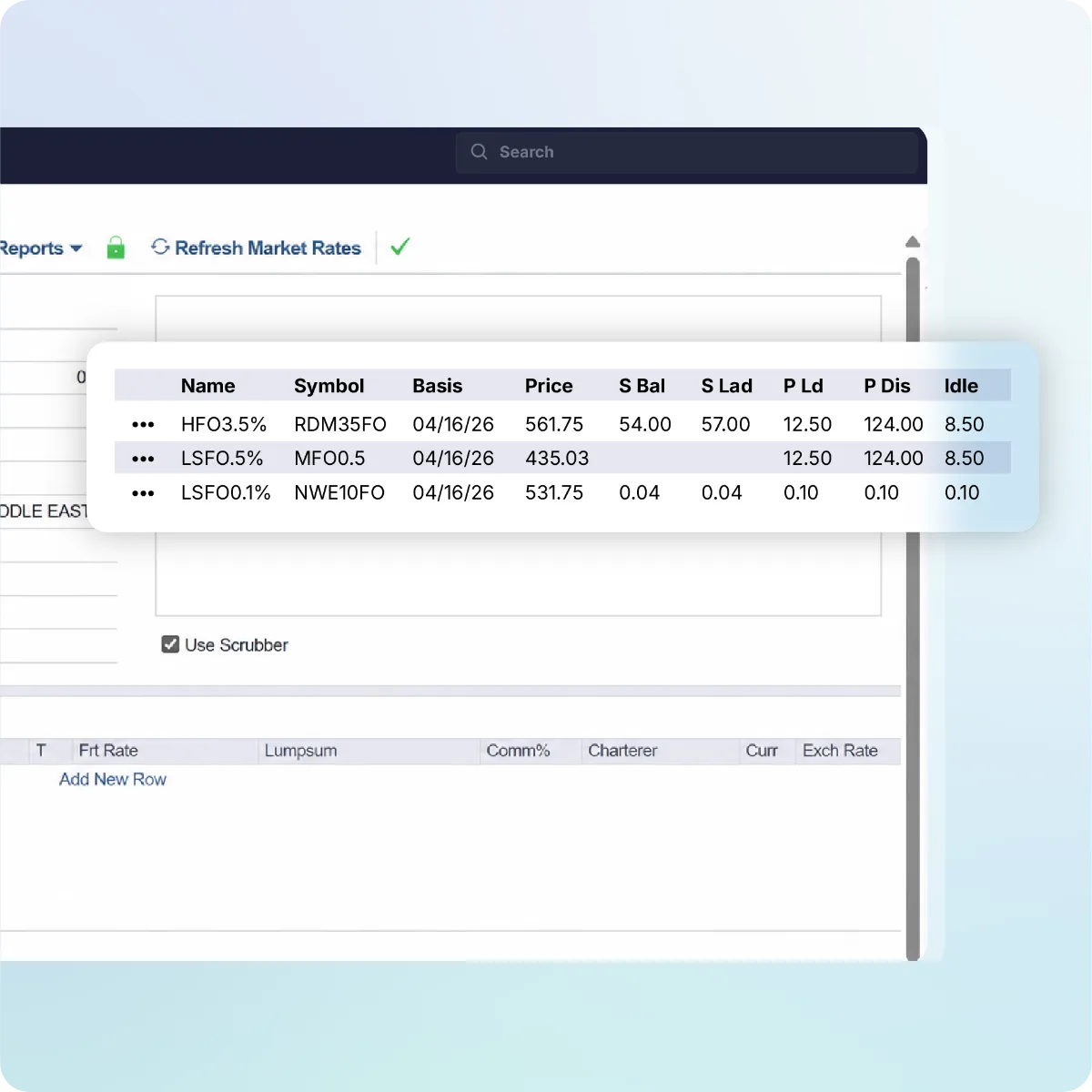
Connect voyage estimates to market data sources so they reflect current market conditions.
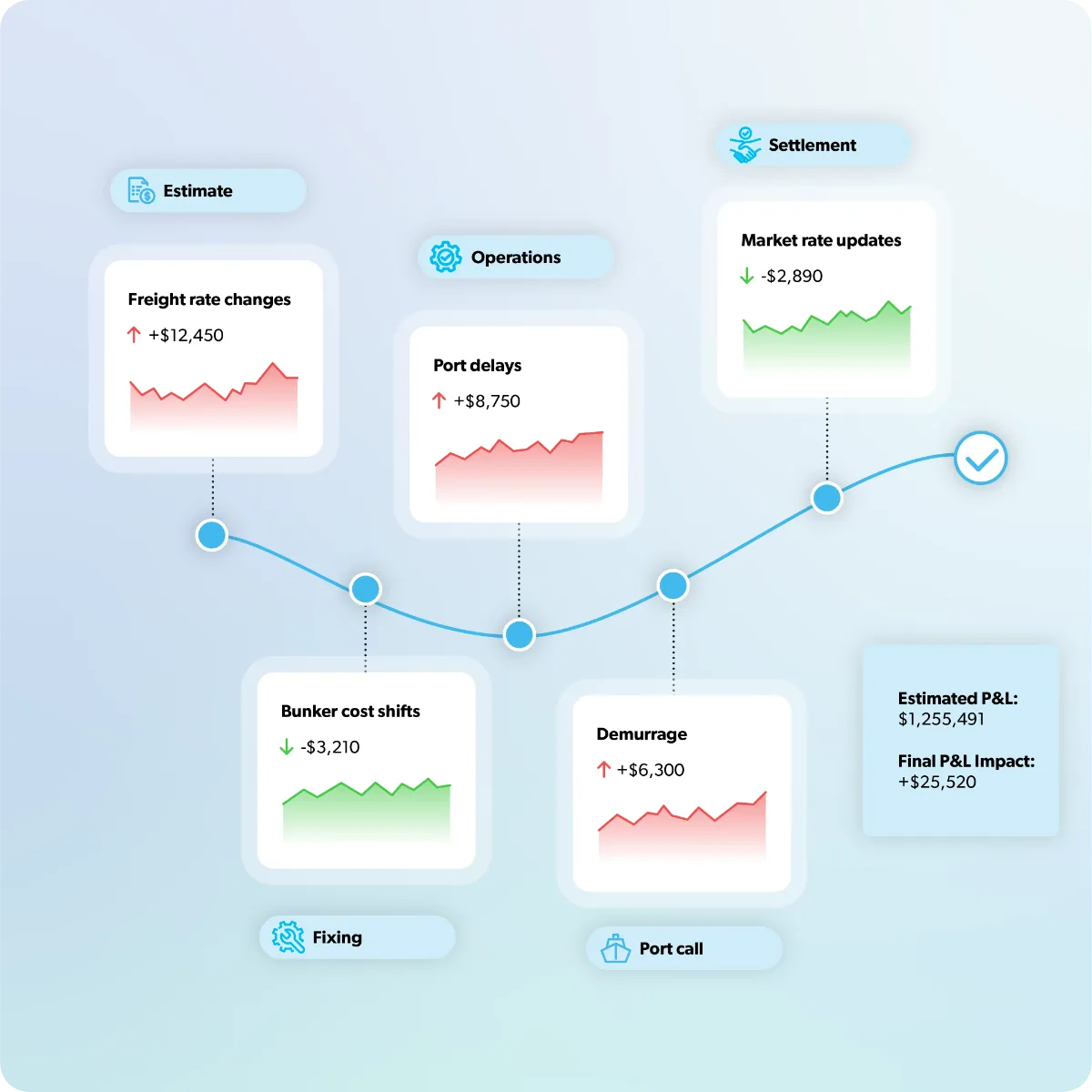
See your P&L update as conditions like fuel costs, port delays, and schedule adjustments evolve.
Identify and understand P&L variance drivers proactively.
Build and compare estimates before fixing a voyage.
Model routing decisions before you commit
Routing decisions are ultimately P&L decisions. Veson gives your team the ability to evaluate options side by side based on live market data, so that every decision is grounded in real-time insight.
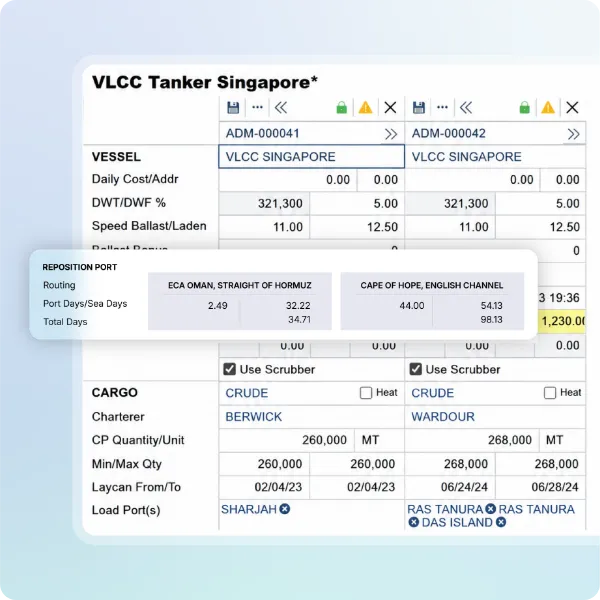
Run scenarios side by side to compare TCE and margin outcomes.
Model downstream impacts of each routing decision before you commit.
See exactly when cash moves over the course of a voyage for a complete financial picture.
Maintain continuity by feeding scenario analysis directly into operational and financial workflows.
Protect against exposure and bunker risk
From fleet-level exposure to individual voyage fuel positions, Veson gives your team a complete understanding of risk along with the tools necessary to address it.
Configure automated rules to surface exposure the moment it arises.
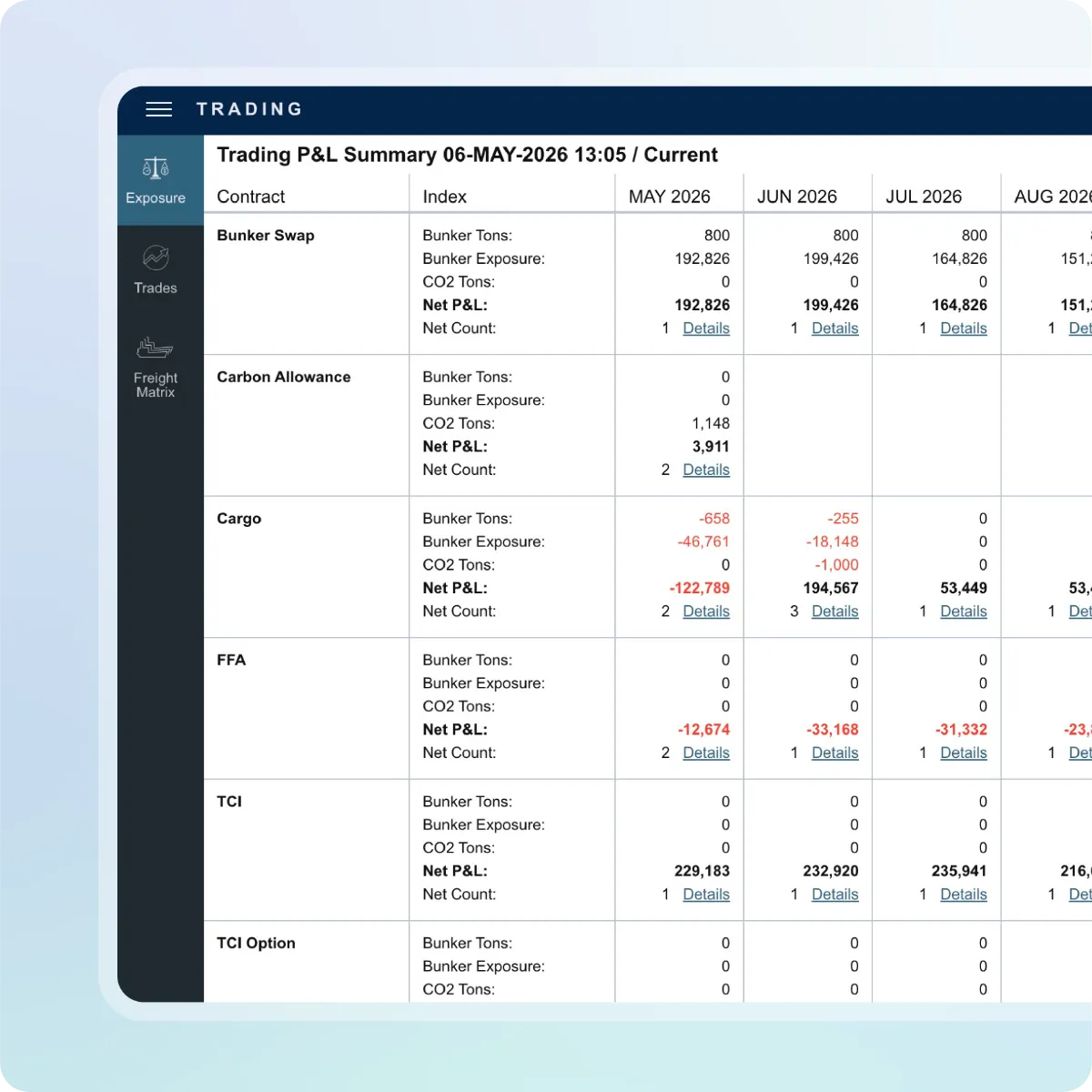
View exposure across your fleet in a single, consolidated view.
Manage and mark-to-market bunker swaps to understand hedge effectiveness.
Capture EU ETS and FuelEU compliance costs directly in your voyage P&L, accounting for regulatory costs alongside exposure.
Capture and compare P&L baselines
With the Veson P&L snapshots, your team gains a clear view of where voyage economics stand at any point in time, allowing you to see the impact of every decision.
Preserve a snapshot of P&L at any stage, creating a reliable record of performance over time.
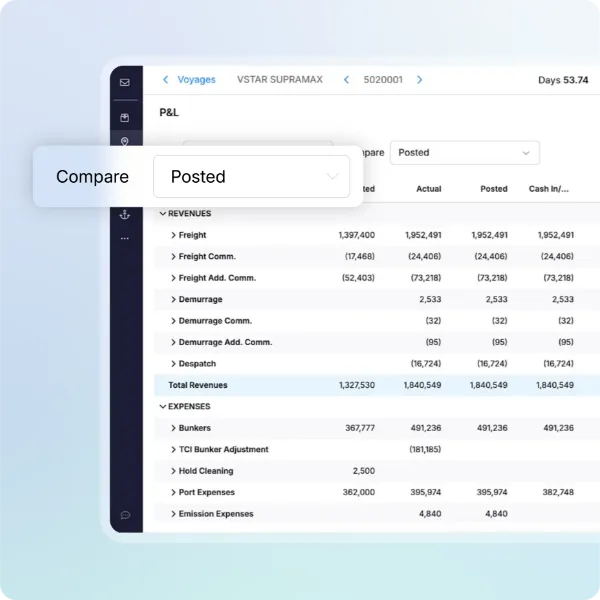
See Estimate, Actual, and Variance in a single view for immediate clarity.
Generate accrual snapshots and maintain full continuity between pre- and post-fixture teams.
Gain an evidence-based foundation for claims, negotiations, and reporting.
Explain P&L variances instantly
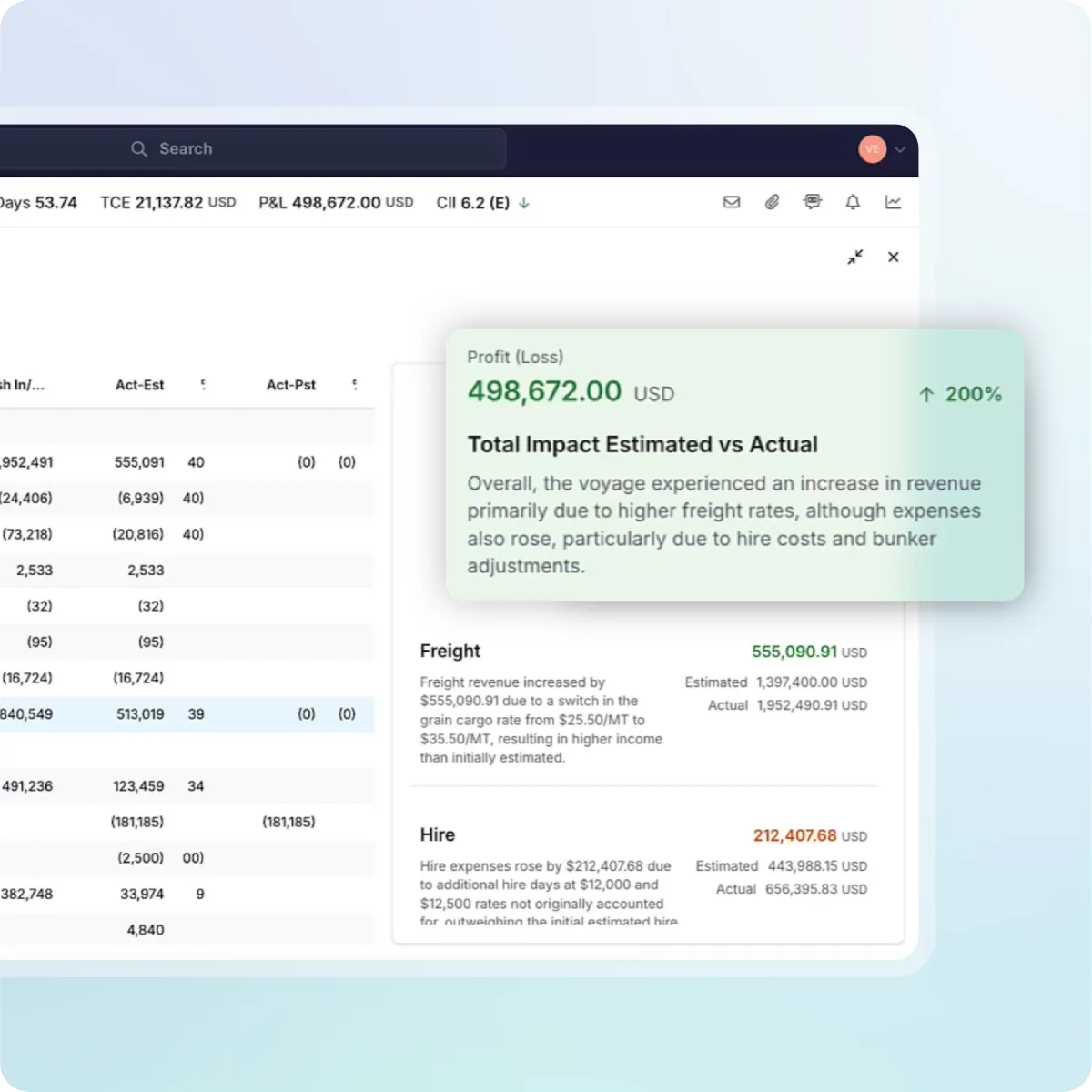
When a number changes, CoCaptain AI explains why so that your team can move rapidly from variance to cause to action.
Surface underlying causes of each variance, including route deviations, bunker consumption changes, and operational decisions.
Analyze every change recorded on the voyage for more accurate variance explanations.
Uncover recommendations like potential performance claims that used to take hours of manual analysis.
Compare estimated vs. actual or P&L snapshots throughout the voyage to understand impact at any point.
Automate voyage close
Veson automates your entire accounting workflow, from invoice generation to period close, so that your team can focus on strategy instead of manual reconciliation.
Automatically generate invoices for all physical contracts with full visibility into financial impact.
Connect Veson with your ERP and corporate accounting systems to ensure full continuity.
See claim accruals alongside the P&L in real time for an accurate view of voyage outcome prior to settlement.
Generate reports on P&L, receivables, cash flow summaries, and more, all from one platform.
“Voyage economics and performance visibility are critical, and IMOS is central to how we manage both at South32. The system allows us to calculate freight costs and voyage economics upfront, compare vessel options, and optimize both chartering and operational expenses.”
Elaine Yu Senior Freight Charterer, South32
More resources on P&L management
Brochure
IMOS Release Voyage P&L Capability Spotlight
Read now
Webinar
Protect Your P&L: IMOS Strategies for Navigating Market Volatility
Watch now
Webinar
The IMOS Voyage Lifecycle
Watch now
When the trade moves, does your P&L move with it?
See how Veson helps your team protect margins and close the gap between estimates and actuals.
Frequently asked questions on managing voyage P&L with Veson
How does the Dynamic Voyage P&L in IMOS update as conditions change?
The Dynamic Voyage P&L in IMOS updates automatically as enterprise-wide actions flow through the platform — fuel costs, port delays, schedule changes, invoice postings, and demurrage accruals all feed into the P&L in real time. Chartering, operations, and finance see where a voyage stands financially without manual updates or data reconciliation between systems.
How does Veson help document the financial impact of a disruption?
P&L snapshots capture a point-in-time view of voyage P&L — Estimate, Actual, and Variance columns — at any stage of the voyage lifecycle, creating a defensible audit trail for insurance claims, charterer negotiations, and internal reporting. They’re particularly useful before and after significant routing decisions, at month-end close, and when a route closes, a port congests, or force majeure is invoked and counterparties need evidence of what changed.
How does the Veson integrate with ERP and accounting systems?
Veson connects directly with ERPs and corporate accounting systems at the general ledger level, maintaining a single source of truth for accounts receivable and accounts payable. This eliminates duplicate data entry, ensures continuity between voyage and corporate accounting, and supports standard coding for all contract types.
How does Veson keep voyage P&L estimates accurate when markets move suddenly?
The IMOS Trading & Risk module connects voyage estimates directly to live trade route indices and bunker price symbols, so estimates pull current market pricing rather than the rates in place at fixture. This matters most for teams managing rerouting decisions, open bunker positions, or voyages priced before a significant market move.
When should demurrage exposure show up in voyage P&L?
Demurrage exposure should show up in voyage P&L the moment laytime exceeds contractual limits — not at month-end close. Real-time visibility matters because it gives chartering and finance an accurate cash forecast, an honest TCE, and a basis for charterer negotiations that survives audit.
Veson includes a dedicated laytime and demurrage workspace that allows teams to automatically calculate laytime, accrue demurrage claims against voyage P&L in real time, and manage the full claims workflow through to settlement. Because demurrage accruals flow directly into the voyage P&L, teams see the expected recovery alongside costs, even when the claim will not settle for weeks or months. This provides a more accurate picture of the voyage’s eventual financial outcome.
What is CoCaptain AI and how does it help with P&L variance analysis?
CoCaptain is the AI layer embedded directly within IMOS. Its P&L Variance Analysis capability automatically compares any two versions of a voyage P&L — estimated vs. actual, or between any two P&L snapshots — and delivers a plain-language explanation of what changed and why.
Rather than showing dollar variances alone, CoCaptain identifies underlying drivers like route deviations and bunker consumption, and surfaces actionable recommendations such as potential performance claims. Because CoCaptain draws on the full voyage history, its explanations are richer and more accurate than a manual before-and-after comparison.
How does Veson enable me to model the P&L impact of a potential routing decision?
Veson lets your team run scenarios side by side, comparing TCE and margin outcomes across routing options using live market data — so routing decisions are grounded in current reality rather than yesterday’s assumptions. This matters most when a strait closes, a port congests, or geopolitical events force a route change, and the question is which option preserves the most margin. You can model downstream impacts on cash flow, voyage close, and counterparty exposure before you commit.