Guide
Maritime Decarbonization in Practice
Navigating IMO, EU ETS, UK ETS, FuelEU Maritime & EEXI: what bulk shipping decision-makers need to know now.
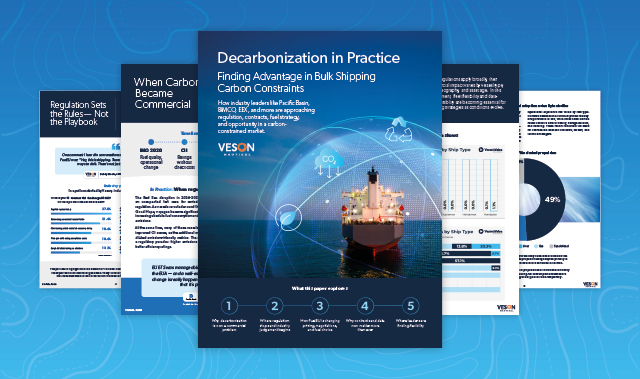
Decarbonization is no longer a future consideration in shipping. It’s shaping commercial decisions today.
With regulations like FuelEU Maritime now in force, carbon has moved directly into voyage economics, contract negotiations, fuel strategy, and risk management. Shipping companies are being asked to make decisions without any single prescribed path, navigating multiple compliance options and trade-offs in real time.
Decarbonization in Practice brings together industry perspectives, polls, and market data to explore how bulk shipping organizations are responding — and where flexibility, coordination, and informed decision-making are becoming critical.
What you’ll learn:

How decarbonization is affecting commercial decision-making in bulk shipping today

What maritime emissions regulations like FuelEU are changing in voyage pricing, contract negotiations, and fuel selection

Why FuelEU’s flexibility is leading to multiple compliance approaches

How operators are evaluating fuel choices, abatement, and incremental technologies in practice

Where contracts, data, and market infrastructure are becoming essential to managing risk
Fill out the form to get the full guide.
Download the Report
The maritime carbon regulation landscape at a glance
IMO, EU ETS, UK ETS, FuelEU Maritime, and EEXI each set different requirements for maritime shipping organizations. Here’s how they fit together.
EU ETS (EU Emissions Trading System)
Requires shipping companies to monitor carbon emissions and surrender allowances for voyages into, out of, and within the EU/EEA.
UK ETS
A separate carbon-pricing scheme covering UK domestic maritime emissions, running alongside the EU ETS.
FuelEU Maritime
Sets annually tightening limits on the greenhouse gas intensity of energy used onboard the vessel, with a credit-and-penalty system for over or under-compliance.
EEXI (Energy Efficiency Existing Ship Index)
An IMO technical measure requiring existing ships to meet a minimum energy efficiency standard, verified against a ship’s design and installed power.
IMO Decarbonization Targets & CII
The IMO’s broader strategy targets net-zero GHG emissions from shipping by or around 2050, with the Carbon Intensity Indicator (CII) used to rate ships annually on operational efficiency.
Frequently asked questions on maritime decarbonization and emissions regulations
FuelEU sets well-to-wake greenhouse gas intensity limits that tighten annually. Ships that outperform the required target can build a positive compliance balance, while ships that underperform may need to use compliance flexibility mechanisms or pay a penalty. As a result, fuel choice becomes an active commercial decision rather than a fixed cost.
The UK ETS is a separate carbon-pricing scheme with its own rules, allowances, and scope for maritime emissions. It runs in parallel to the EU ETS, so operators that serve both regions must track compliance with both of these systems.
The IMO has set a strategy that targets net-zero international shipping emissions by or around 2050. It is supported by measures like EEXI and the Carbon Intensity Indicator (CII), which rate vessels on their efficiency and emissions intensity.
Common approaches to sustainable shipping include voyage optimization and speed management, efficiency upgrades, alternative fuels, and better real-time visibility into fuel consumption for each voyage.
Verified emissions and fuel efficiency data are increasingly shaping vessel selection and pricing. Transparent and traceable emissions data has become not only a compliance asset, but a key commercial consideration.
Yes, commercial platforms that connect voyage, fuel, emissions, and market data can calculate CII and EEXI status, EU ETS and UK ETS allowance exposure, and FuelEU intensity together, rather than requiring organizations to track them in separate spreadsheets or systems.