
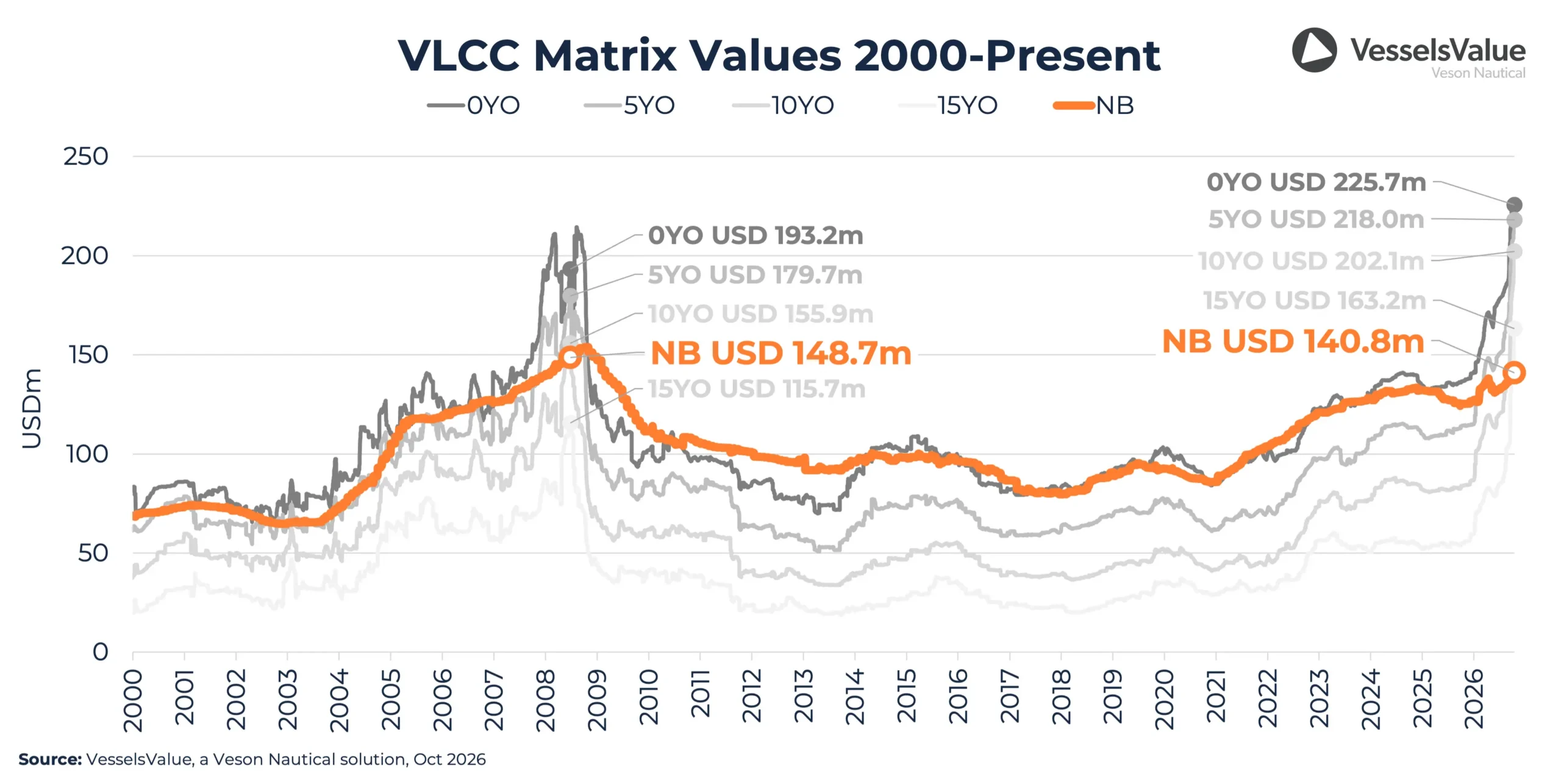
At the end of September, a 15-year-old VLCC was valued above a newbuilding for the first time at USD 139.2 mil for 310,000 DWT, compared to USD 138.7 mil for newbuilding vessels.
The move is part of a wider inversion of the age curve; a five-year-old VLCC is now valued 55% above a newbuilding (USD 218.0 mil against USD 140.6 mil), the widest gap on record and well ahead of the previous peak of 21% in December 2007.
Newbuilding activity has reached remarkable levels
The VLCC orderbook now stands at 38% of the fleet, more than double the 15% in 2025, and new tonnage set to hit the water is more sophisticated than the vessels it will join.
Even so, newbuilding values are up only 12.4% year on year, from USD 125.27 mil to USD 140.8 mil, while a 15-year-old VLCC is valued up 196.35%, from USD 55.07 mil to USD 163.2 mil, according to VesselsValue data.
The main driver is earnings. The situation in Hormuz has pushed spot earnings on the Middle East to China route to exceptional levels, and one-year timecharter rates are at a record high, more than tripling year on year. Older vessels give owners an immediate way to capture those earnings, and buyers are paying up for that.
The impact on sales activity
VLCC sales in the 15-to-20-year age category have risen 87.5% year on year, from 32 to 60 vessels over the same period. One notable sale is VLCC Eurospirit (320,100 DWT, Dec 2011, Daewoo) sold to Middle Easter buyers for USD 153 mil, VV value USD 165.75 mil. The vessel last changed hands in 2020 for USD 46 mil, so the seller has seen the value rise by USD 107 mil, up c.223%, more than tripling their initial investment.
Buyers are concentrated with South Korea being the largest buyer this year, accounting for c.67% of all sales, driven by Sinokor’s large acquisition of VLCCs. The UAE is second place with 8%, followed by Greece with c.5%.
Newbuilding is not a quick alternative. There have been 215 VLCC newbuilding orders placed this year, up 84% on the same point last year, but deliveries stretch into the 2030s. Anyone wanting to trade in the current market has to buy existing tonnage.
With record earnings, an active sale and purchase market, and a long wait for new vessels, the demand for older tonnage looks set to continue. The key question is whether the 15-year-old premium over newbuilding holds if Hormuz-driven earnings ease.