
A regularly updated blog of Veson analysis related to ongoing disruptions in the Middle East. Last updated September 15, 2026
Onex DMCC’s buying spree amid tight tonnage supply
By Rebecca Galanopoulos | September 15, 2026
Onex DMCC’s appetite has continued beyond the Pinios deal, with the trading house now linked to six VLCC and Suezmax purchases in recent weeks. Another VLCC, the Ashoka (302,600 DWT, Mar 2010, Universal), has also changed hands to Middle Eastern buyers at USD 130 mil. The deals rank among the highest ever seen for VLCC tonnage and highlight the breadth of regional demand for immediately available tonnage.
Onex’s willingness to pay up for prompt tonnage has become a driving force behind current values, setting a new reference point for future sales.
That demand coincides with VLCC earnings surging to unprecedented levels, with rates on the benchmark Middle East Gulf to China route pushing past 1,000,000 USD /day for the first time. The move follows drone strikes on Saudi Arabia’s East-West pipeline, which had been carrying a significant share of the kingdom’s crude exports to the Red Sea as an alternative to the still-disrupted Strait of Hormuz.
With that bypass route now compromised, the pool of viable options for moving Middle Eastern crude has narrowed further, adding fresh upward pressure to an already tight Tanker market.
VLCC sale values surge as market strains to keep oil flowing out of Middle East
By Rebecca Galanopoulos | September 11, 2026
Middle Eastern oil majors have shown growing interest in VLCC purchases recently, with S&P activity increasingly shaped by the Strait of Hormuz crisis. The VLCC Pinios (306,000 DWT, Feb 2026, Hengli), delivered to Dynacom earlier this year, has reportedly been resold to UAE based Onex DMCC for nearly USD 200 mil, a record price for a resale.
Positioning is vital in this market: delivery to Fujairah alone is estimated to be worth around USD 10 mil to Onex, with the price also reflecting a discount tied to the vessel’s yard. This premium is driven by strong spot charter earnings, the risk attached to Strait of Hormuz transits, and the priority of enabling Iraqi oil to leave the Gulf. Premiums of this scale appear most pronounced where delivery into the Gulf is a firm requirement, reflecting how few owners remain willing to trade in the area. Whether such levels hold for wider market sales rather than this narrow pool of national buyers remains to be seen.
UAE-based ADNOC Logistics has acquired nine VLCCs since late June, worth around USD 1.1 bil in total, a move that points to a Middle East producer strengthening its own Tanker fleet as fewer open market vessels are willing to face the risk of trading in the Gulf. For national oil companies, owning tonnage outright has become less a commercial decision and more a means of securing tonnage so that crude and money can keep moving.
Could the Middle East crisis turn positive for MRs this fall?
By Thomas Zwick | September 1, 2026
Roughly 70 LR2s, equivalent to 154 MR2s in dwt terms, have reportedly dirtied up so far this year, as the crude market considerably outperformed the oil products market.
The predominant market for product carrying LR2s is out of the Middle East Gulf, but with the region’s cargo availability constrained and waters risky, earnings potential for LR2s should have logically been deteriorating. However, they have held up remarkably well since the conflict began in late February.
The LR2s that remained in clean trade have recently benefited from the roughly 70 vessels that switched to dirty, according to TORM’s most recent earnings call, tightening the market for larger product tankers over the past couple of weeks.
While the broader market is currently supported by inefficiencies stemming from the Middle East conflict and the ongoing ship-to-ship operations it has triggered, a scenario where the Strait of Hormuz becomes increasingly viable as a safe transit route could see regional refineries offer a growing volume of LR2 cargoes. If that materializes, the pool of available LR2s may prove limited or poorly positioned geographically to absorb the demand rebound, creating a potential tailwind for MRs, whose availability has risen and rates have been under pressure lately.
The net effect could be a new, if temporary, market opening for medium-sized vessels in the region, arriving just as MR2s typically exit a subdued summer and head into the stronger market ahead of winter.
Six months into disruption, why aren’t global gas prices skyrocketing?
By Jarl Milford | August 13, 2026
We are in the sixth month of vessel disruption in the Strait of Hormuz, and despite weekly hints of a possible resolution to the conflict, vessel activity remains at a standstill. According to AIS tracking, larger-size LNG vessels out of Qatar have declined 93% on average during the conflict compared to the 2025 monthly average. Given the circumstances, vessels have managed to sail through the strait with their AIS turned off as a precautionary measure to avoid being targeted, but even accounting for this, the disruption’s impact is significant.
Why then haven’t global gas prices gone through the roof? JKM prices have doubled since the conflict began but remain well below the levels seen during the 2022 gas shock. The picture is, of course, shaped by several factors, including inventory draws, demand rationing, and increased coal fired generation.
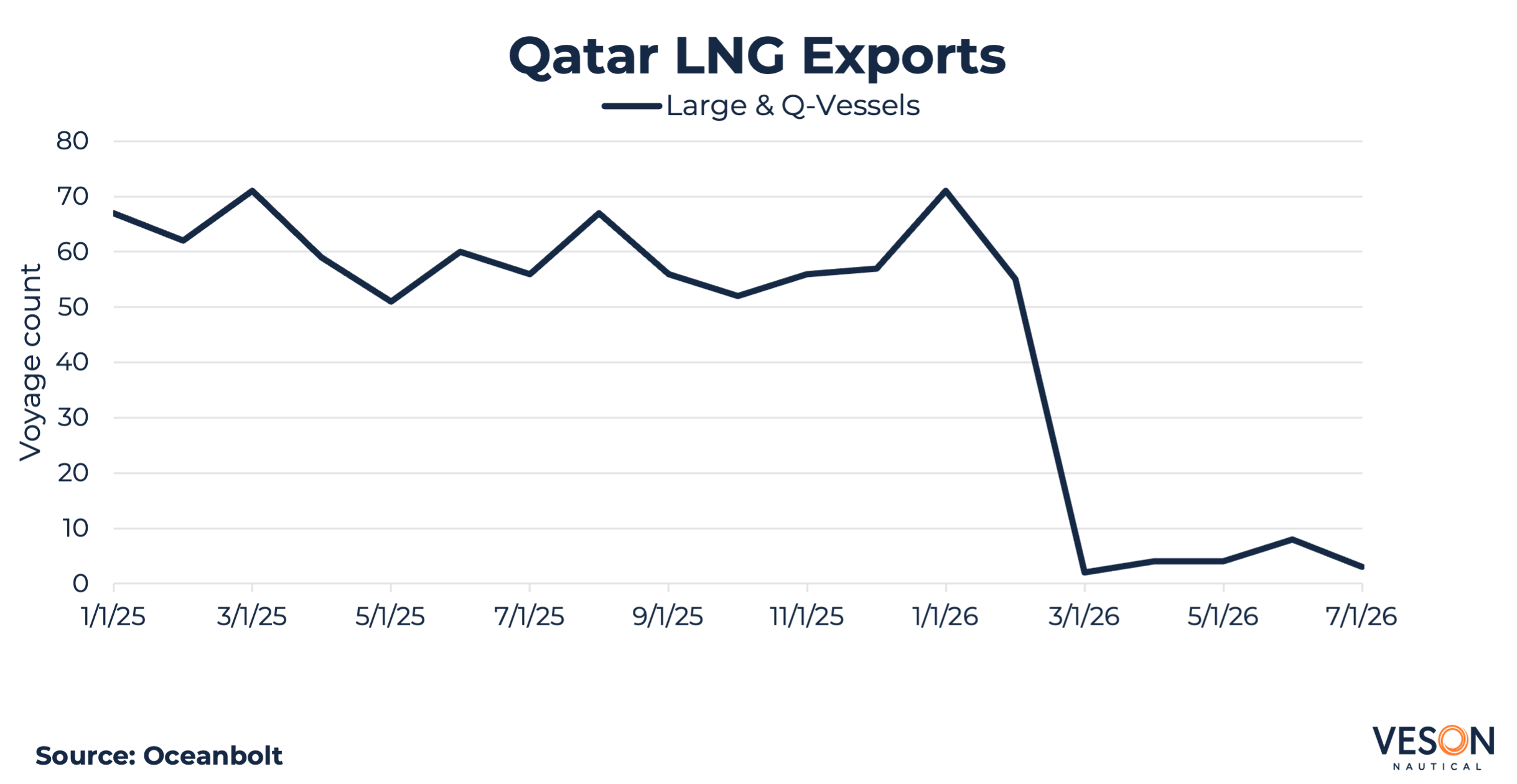
But the factor that stands out most is the surge in North American export volumes: US LNG exports are up 22% YTD, according to customs data. Canada, which only began LNG exports in mid-2025, has already shipped 5.5 Mt in the first of the year, more than double its full-year 2025 total of 2.3 Mt.
Much of this growth comes from new LNG capacity, particularly Golden Pass and LNG Canada, both ramping up this year. Combined, this additional North American supply has offset a meaningful share of the lost Qatari volumes, tempering what could otherwise have been a much sharper price spike. The outlook for the second half of the year remains uncertain given the unresolved Middle East situation. While the gas market has proven resilient so far, if the disruption drags on, we could see conditions tighten heading into winter.
Bab el-Mandeb Transits Slide as Risks Mount
By Rebecca Galanopoulos | August 3, 2026
Bab el-Mandeb Strait transits fell by around a third week-on-week, according to Veson Nautical’s VesselsValue trade data, from the week of 16-22 July to the week of 23-29 July, amid continued Houthi threats, including a Saudi-flagged Tanker that multiple sources reported was struck on 28 July. All three vessels involved in the earlier reroute were VLCCs, which turned back toward the Suez Canal rather than continue through Bab el-Mandeb in the days after the blockade declaration. The decline follows major insurers suspending war-risk cargo cover for Saudi-linked vessels, prompting some operators to avoid direct calls at Saudi Red Sea ports while others bypass the Red Sea entirely in favour of the Cape of Good Hope, despite the considerably longer voyage.
Bab el-Mandeb still carries a meaningfully larger share of global trade than the effectively closed Strait of Hormuz, as it remains the primary gateway linking the Suez Canal to Asia-Europe Container flows as well as continued Saudi crude exports, though volumes are down from pre-crisis norms. The route remains functional but increasingly strained, standing in contrast to Hormuz’s near-total shutdown.
Bab al-Mandeb Closes, Hormuz Still Falling: Tanker Data Update
By Rebecca Galanopoulos | July 24, 2026
On 20 July, Houthi forces declared a full maritime blockade against Saudi Arabia, closing the Bab al-Mandab Strait to vessels servicing Saudi ports. Following this move, Tanker Xin Long Yang, a Chinese VLCC carrying Saudi crude, turned back towards Suez rather than cross the Yemeni border, and two more Tankers followed suit. Within days, the Houthis said they had gone further, striking two Saudi-flagged Tankers.with missiles and drones and causing fires
The Bab al-Mandeb Strait carries around 7% of global oil output. The Strait of Hormuz has been under severe strain since the US-Israel war on Iran began in late February, and our own transit data below shows it accelerating towards a halt rather than recovering, down around 95% since the ceasefire collapsed in early July.
A sustained Bab al-Mandeb shutdown would compound that; the two chokepoints could remove a significant volume of the world’s oil and gas supply. While the two straits are separate, they have become increasingly linked, with Saudi Arabia routing up to 7mbd of crude oil via the Red Sea to work around the Hormuz disruption.
Taking a look at VesselsValue trade data, transit volumes for the Strait of Hormuz have continued falling across the last three weeks amid the back-and-forth policies. Tanker and LNG volumes transiting the strait were down around 62% from the Monday the ceasefire broke down to the following Monday. They then fell a further 87% into this Monday, leaving transit volume down around 95% versus the pre-breakdown baseline overall, enough to suggest a real pause in movement rather than simply week-week variation.
The sharpest day-to-day swings seen in the days immediately after the ceasefire broke down have eased since, though volumes are still suppressed relative to the pre-breakdown baseline. Transit dates are marked by first known position past the tripwire, a fixed line drawn using VesselsValue Trade search across the strait that flags a transit once a vessel reappears on the far side, consistent with the tripwire search logic. Since vessels typically go dark crossing the strait, it is worth flagging that this likely lags actual transits somewhat, so current-week figures may still tick up as more positions resolve.
TC rates moved only modestly week on week, continuing the gentle drift seen since the announcement and reversal rather than reacting freshly to it, consistent with a market that had already priced in Gulf risk. TC rates have risen week-on-week for most sectors with VLCCs up from 110,139 USD/day to 113,310 USD/day, an increase of c. 3%. Suezmaxes were also up c.3%, while Afras dipped slightly. Product Tankers were flatter and LR1 and MR1 each nudged up roughly 1%. VLCC’s current week average is now running about 48% above the one year average of 76,485 USD/day.
Oil prices have moved on the Red Sea news: Following 13 consecutive nights of US and Iranian strikes in the Middle East conflict, oil prices broke 100 USD/bbl on Thursday for the first time since May. The key signals to watch: whether the Houthis follow through with further attacks beyond Encelia and Layla, if any more Tankers reroute away from Bab al-Mandeb entirely, and whether transit volumes and TC rates in the Hormuz data above start reflecting this second chokepoint risk on top of the existing Iran-related disruption.