
VLCC supply is starting to arrive. After a sharp rise in ordering, the first of the new tonnage is reaching the water, with deliveries already well ahead of last year. Using VesselsValue data, we look at what is on order, who is building it, and why owners keep ordering at near-record prices.
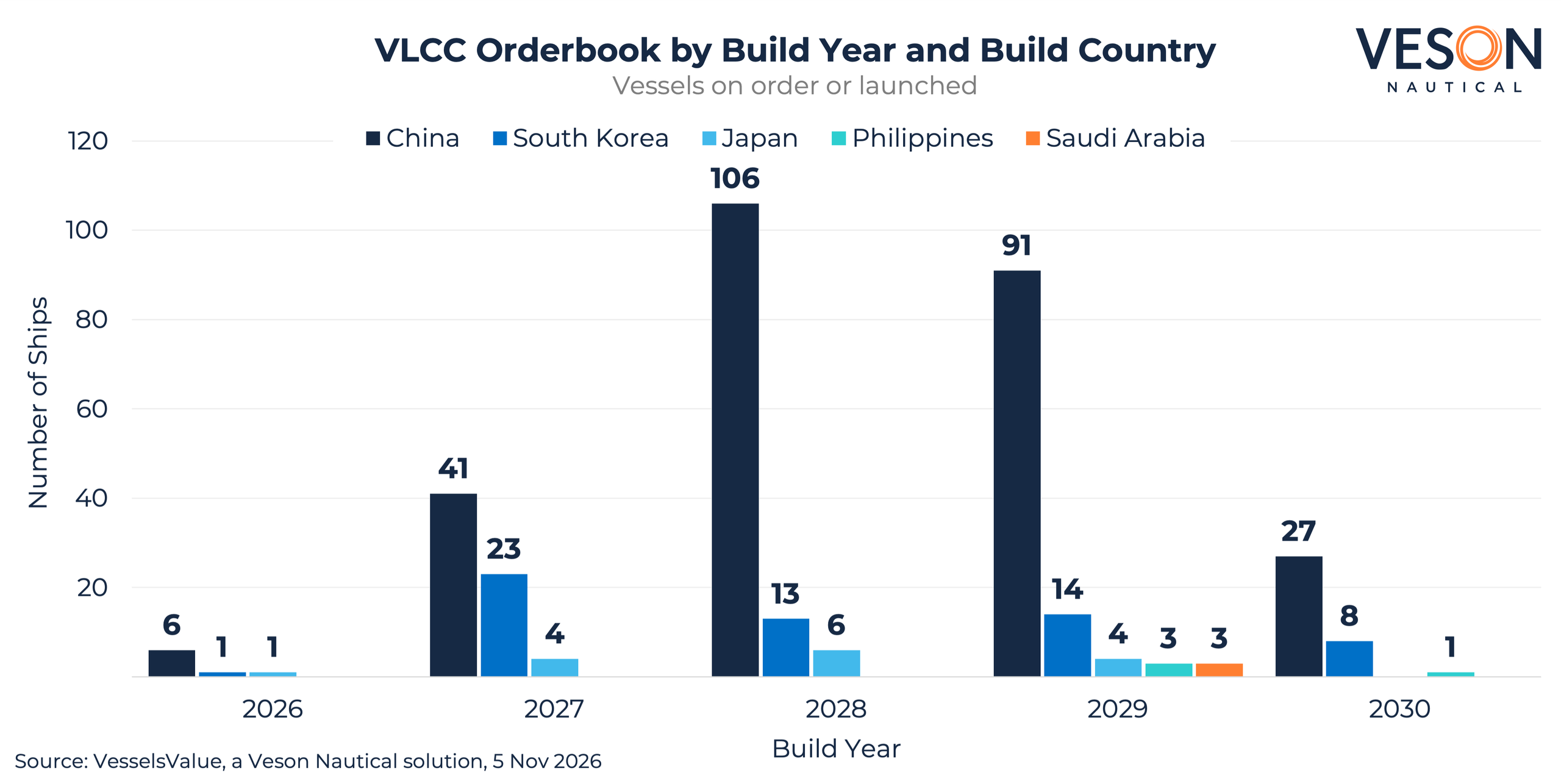
VLCC deliveries have moved significantly higher. There were just seven VLCCs delivered across the whole of 2025, while 35 have already delivered this year, five times the 2025 total. The pipeline behind them is substantial, with 349 VLCCs on order or launched, and the delivery schedule is heavily weighted to the next few years, with 125 due in 2028 and 113 in 2029. Overall, 27.3% of the VLCC fleet is on order.
China sits at the centre of VLCC deliveries
China holds 268 of the VLCCs on order, c.77% of the orderbook, and builds 106 of the 125 units, due in 2028. South Korea accounts for 59 and Japan for 15, so the build programme is firmly concentrated in one country. Our recent market chat on new and established yards entering the Tanker market looks at how this capacity is being added.
Notable recent orders include three 320,000 DWT VLCCs ordered by Bahri, set to be built at International Maritime Industries (IMI) and set for delivery in 2029, contracted at USD 150.3 mil each en bloc, VV Value USD 127.69 mil. IMI is Saudi Arabia’s first large-scale shipbuilding project, and these are the only VLCCs on order at a Saudi yard.
219 VLCCs have been ordered this year to date, compared to just 85 in 2025, and newbuilding values have risen with it. Prices are up 15% year-on-year, from USD 125.59 mil to USD 144.51 mil, close to the all-time high of USD 154 mil in Oct 2008.
Why demand is holding up despite high prices and a large orderbook
Replacement alone does not explain it, as the 349 VLCCs on order or launched compares with 183 vessels aged 20 years and above. Tankers have been in short supply in recent years because of sanctions and geopolitics, and the situation in the Strait of Hormuz has tightened availability further. Earnings have reached levels that were previously unthinkable, which strengthens the case for newbuilding even at current prices.
Middle Eastern producers are also a factor. With shipowners reluctant to transit the Strait of Hormuz since the disruption began, some producers have looked to buy or build their own VLCCs so that they have vessels available to move their crude whatever the conditions. This moves them from relying on the open market for tonnage to owning the capacity they need to get barrels out, and it adds a further source of newbuilding demand alongside strong earnings.
The age profile shows where supply could be removed if conditions change. Of the 932 VLCCs in the fleet, 45.8% are 15 years or older, including 183 vessels aged 20 years and above. That leaves a sizeable pool of tonnage that could be considered for demolition should the market weaken.
VLCC deliveries continue to build
Taken together, the data points to a VLCC fleet that is about to grow at a pace not seen in recent years, with the build programme concentrated in China and delivery volumes weighted to 2028 and 2029. Demand for newbuildings has held up so far because earnings, tight tonnage availability, and energy security concerns have outweighed the cost of ordering at near-record prices. Should conditions change, the ageing fleet offers a sizeable pool of tonnage that could leave the market, so the balance between deliveries and demolition will be one to watch.
Download the Shipping Market Outlook: Q4 2026 Executive Summary to get the full Tanker forecast, or visit the Market Data & Analysis page to learn more about Veson’s Analysts and the latest market updates.