
The regulatory landscape: FuelEU, EU ETS, and now UK ETS
Maritime decarbonization compliance has moved fast over the past two years. FuelEU Maritime set GHG intensity limits on fuel used by ships calling at EU ports. EU ETS extended a cap-and-trade carbon price to shipping, requiring operators to manage an expanded definition of exposure that now includes EU Allowances (EUAs) alongside physical freight and fuel risk. And as of 1 July 2026, the UK ETS (Emissions Trading Scheme) introduces a new emissions-based regulation, extending carbon pricing to maritime roughly two and a half years after EU ETS took effect for shipping.
Each regulation has its own scope, its own timeline, and now its own allowance type. For operators trading in and around the UK, that means a third exposure to track — one that can’t simply be folded into existing EU ETS workflows.
What is UK ETS?
Scope of the UK ETS regulation
UK ETS applies to cargo and passenger vessels of 5,000 gross tonnage (GT) and above, with offshore ships excluded until 1 January 2027. It covers domestic UK voyages — meaning any voyage between two UK ports, as well as round trips that start and end at the same UK port — along with all emissions generated during those voyages, whether at sea, at anchor, or moored. The first compliance year runs 1 July through 31 December 2026, with subsequent years following the calendar year. Because that first year is only six months, a one-off “double surrender” applies, with allowances for both 2026 and 2027 due together by 30 April 2028.
UK ETS vs. EU ETS: what’s the same
The underlying mechanism will feel familiar: UK ETS runs on the same cap-and-trade principle as EU ETS, requiring operators to monitor emissions, submit a verified Annual Emissions Report, and surrender allowances against actual activity. Responsibility for compliance defaults to the registered owner, with the option to transfer that responsibility to the ISM company by written agreement — mirroring the polluter-pays structure operators already navigate under EU ETS.
UK ETS vs. EU ETS
There are important distinctions that set UK ETS apart from EU ETS:
- Domestic scope only, for now. Unlike EU ETS, which captures a share of voyages between the EU and non-EU ports, UK ETS at launch covers only domestic UK-to-UK voyages and UK in-port emissions. Voyages to or from non-UK ports, UK Overseas Territories, and Crown Dependencies fall outside scope. The UK government is consulting on extending coverage to international voyages from 2028, but that scope doesn’t exist today.
- A Northern Ireland provision. Voyages between Northern Ireland and Great Britain receive a 50% reduction in surrender obligation, while port stays in both Northern Ireland and Great Britain still carry a full 100% obligation.
- A different compliance calendar. The short first “year,” the double-surrender mechanic, and the separate UK Registry and reporting system (METS) all run independently of the EU’s EU ETS registry and timeline.
A new allowance type: UKA
EU ETS compliance is denominated in EU Allowances (EUAs). UK ETS introduces its own instrument — UK Allowances (UKAs) — priced and traded separately in the UK carbon market. Operators exposed to both schemes now need to track two distinct allowance types, each with its own market dynamics, rather than treating carbon exposure as a single line item.
UK ETS commercial calculation
To help clients manage this new layer of exposure without adding operational overhead, IMOS now includes a dedicated UK ETS commercial calculation:
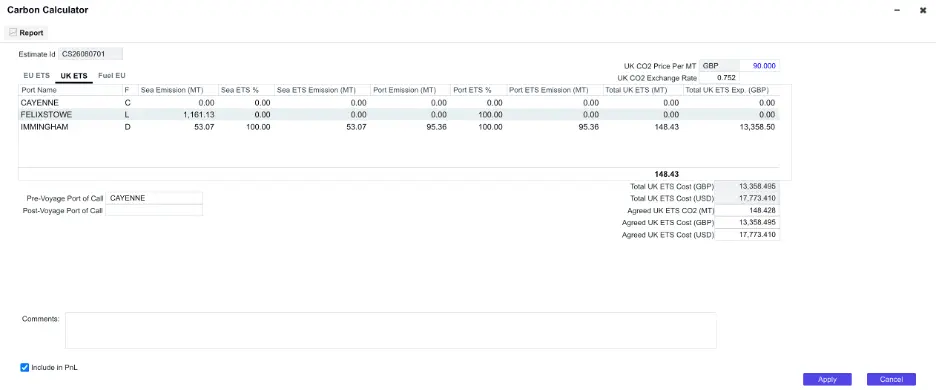
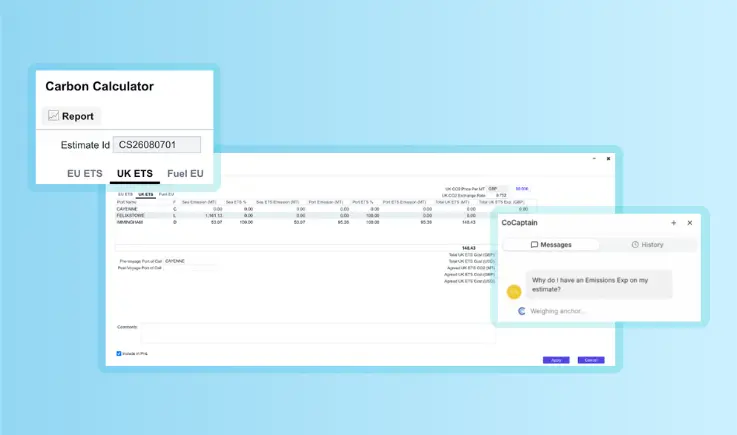
- A precise UK ETS calculation embedded directly in the IMOS Estimate and Voyage Carbon Calculator, sitting side by side with the existing EU ETS and FuelEU calculations. This gives operators one place to see all three exposures distinctly, rather than three disconnected views.
- Including UK ETS cost in the Estimate and Voyage P&L, so costs show up where the commercial decision is actually made — on the estimate, before the voyage is fixed — rather than a downstream reporting adjustment.
- Covers the specified scope of UK ETS: Northern Ireland provisions, berth consumption, and domestic voyages are all reflected, with no exposure calculated on international voyages, consistent with the regulation’s current scope.
Teams can also leverage CoCaptain, Veson’s contextual AI in IMOS and accessible across the Veson Platform, to get fast answers grounded in their live operational data. For UK ETS, that means asking whether a voyage falls in scope, how its allowance exposure breaks down, or how it compares with EU ETS — all without leaving the workflow.
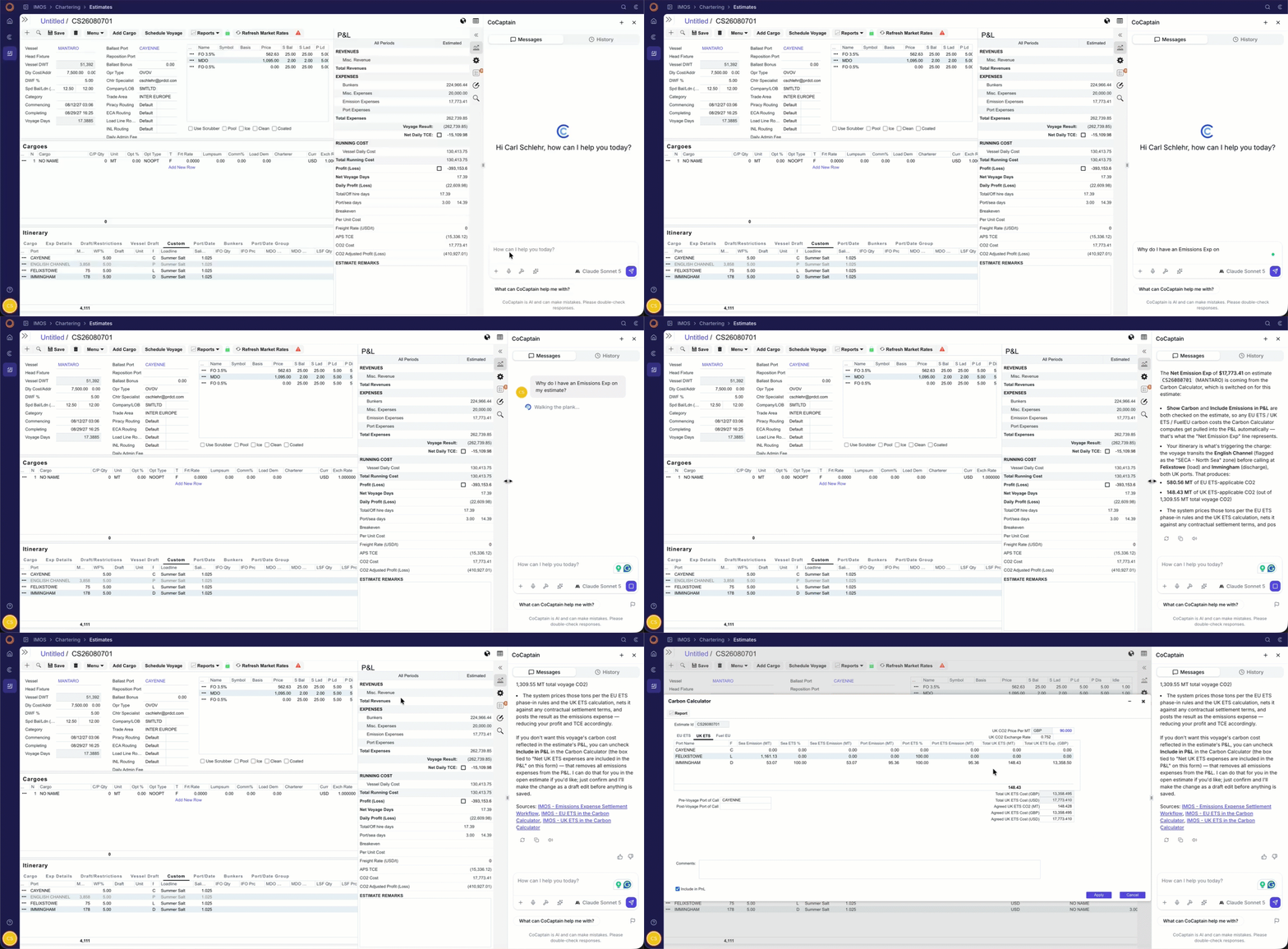
Below, we asked CoCaptain why the estimate shows UK ETS exposure. CoCaptain traced the expense back to the itinerary’s call at Immingham and Felixstowe, walks through the qualifying conditions due to the domestic UK voyage, and provides a reasoning for inclusion in the PnL, pointing to the to the Carbon Calculator for add context or the ability to adjust the configuration:
Continued commitment to building out UK ETS
This initial calculation is a great starting point to support you with UK ETS, and it will continue to be built on. We’re currently working to expand UK ETS coverage throughout IMOS as the regulation itself evolves — including any future extension to international voyages defined in scope starting 2028. If you operate vessels touching UK ports, now is the time to get UK ETS exposure into your commercial workflow.
Reach out to us to get a personalized walkthrough of how IMOS handles UK ETS, EU ETS, and FuelEU side by side.
WEBINAR