
This post is part of a series exploring the Veson Platform, a new experience for IMOS that brings contextual AI, email, and validated market data together in one place. Read the rest of the series: CoCaptain AI, Connect, and Bunker Insights.
The ability to manage a single database of current, accurate vessel data you can trust is one of the most overlooked problems in maritime. Most organizations pay two-to-four vendors that have conflicting data for the same vessel, forcing teams to manually reconcile it themselves. Meanwhile, the consequences show up later as wrong data at the estimate stage cascades through bunker projections, port costs, and demurrage — errors that are typically only discovered post-fixture, when commercial flexibility is gone.
Vessel Insights solves this by bringing together Veson’s proprietary data solutions into a single, validated picture of any vessel, refreshed daily, and available where your teams work. Leading the Data Science team, here is how we built Vessel Insights to address the common data challenges that impact every fixture and fleet decision.
Building a single source of truth from the best of Veson solutions
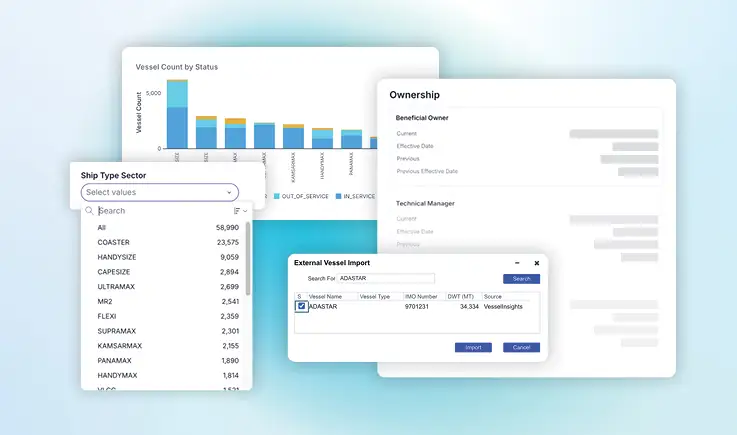
Vessel Insights pulls from the best of Veson’s data solutions: Q88 for vessel particulars, Shipfix for commercial data, and VesselsValue for industry-leading valuations and ownership history. Together, they feed a validation pipeline that reconciles all three sources every day, tracking beneficial owner, commercial controller, operator, ISM manager, and technical manager across effective dates and roles changes.
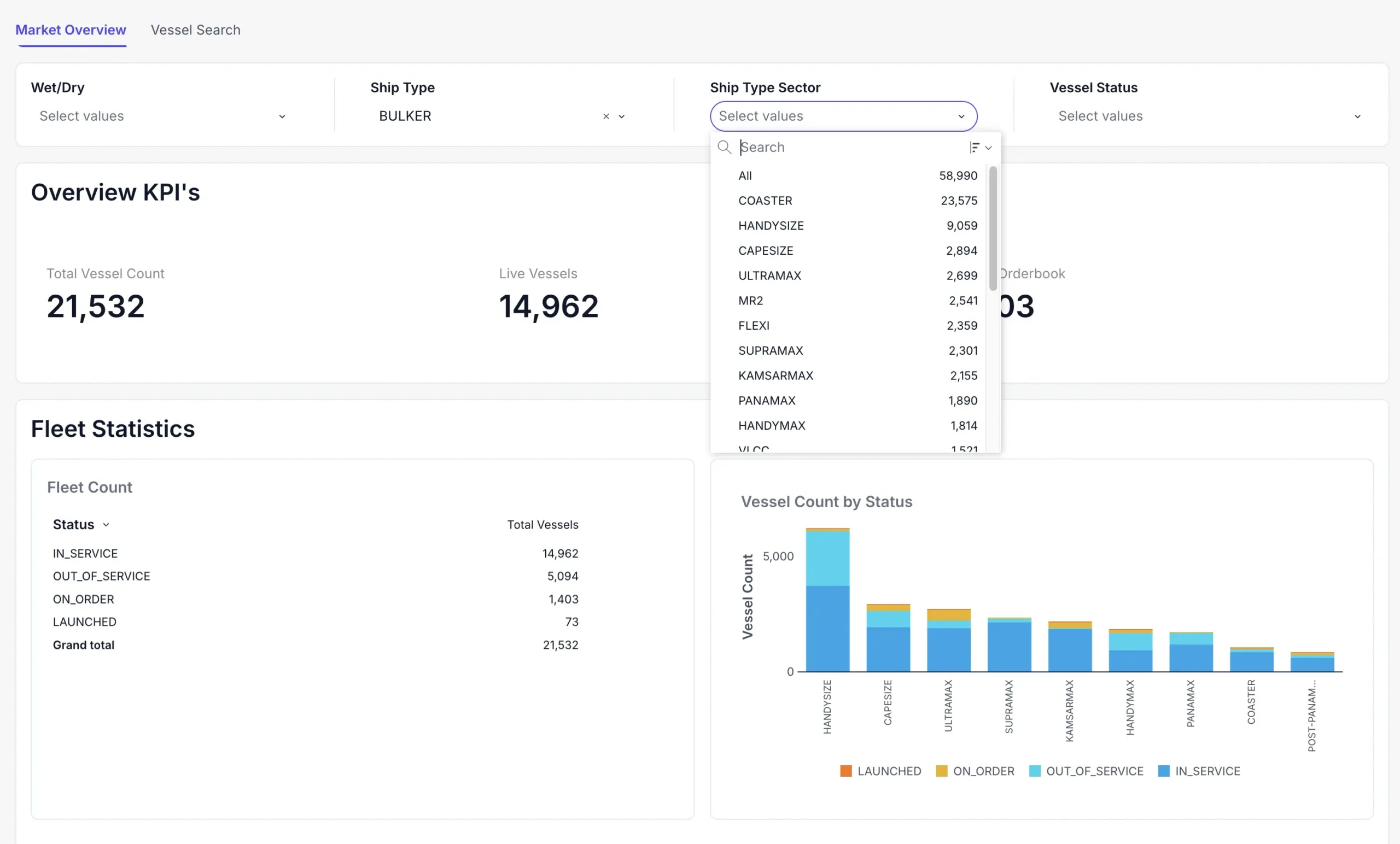
What that means in practice is that for every field, our data science team runs type checks, range checks, and business-rule validation to determine the correct value. Where sources overlap, disagree, or data is missing, our models produce a validated output rather than leaving a gap for teams to resolve. Across more than 300 data fields and 65,000 vessels, this process is continually improved upon so we can ensure teams are always working with the most current, up-to-date answers.
But having accurate data in a single view is only part of the equation — it also needs to be accessible in the tools and workflows where commercial and operational decisions are actually being made.
Want to see what Vessel Insights can do for your teams?
Available where you work, across IMOS, APIs, and dashboards
Once the data is reconciled, the next challenge is making sure it is accessible without adding steps to an already demanding workflow. Vessel Insights is the only vessel data product available natively in the Veson Platform, which means it is already inside IMOS where estimates are built and fleet records are maintained.
A Head of Chartering can pull validated particulars, draft variants, gear specifications, and speed and consumption curves directly into the voyage estimate without leaving the platform.
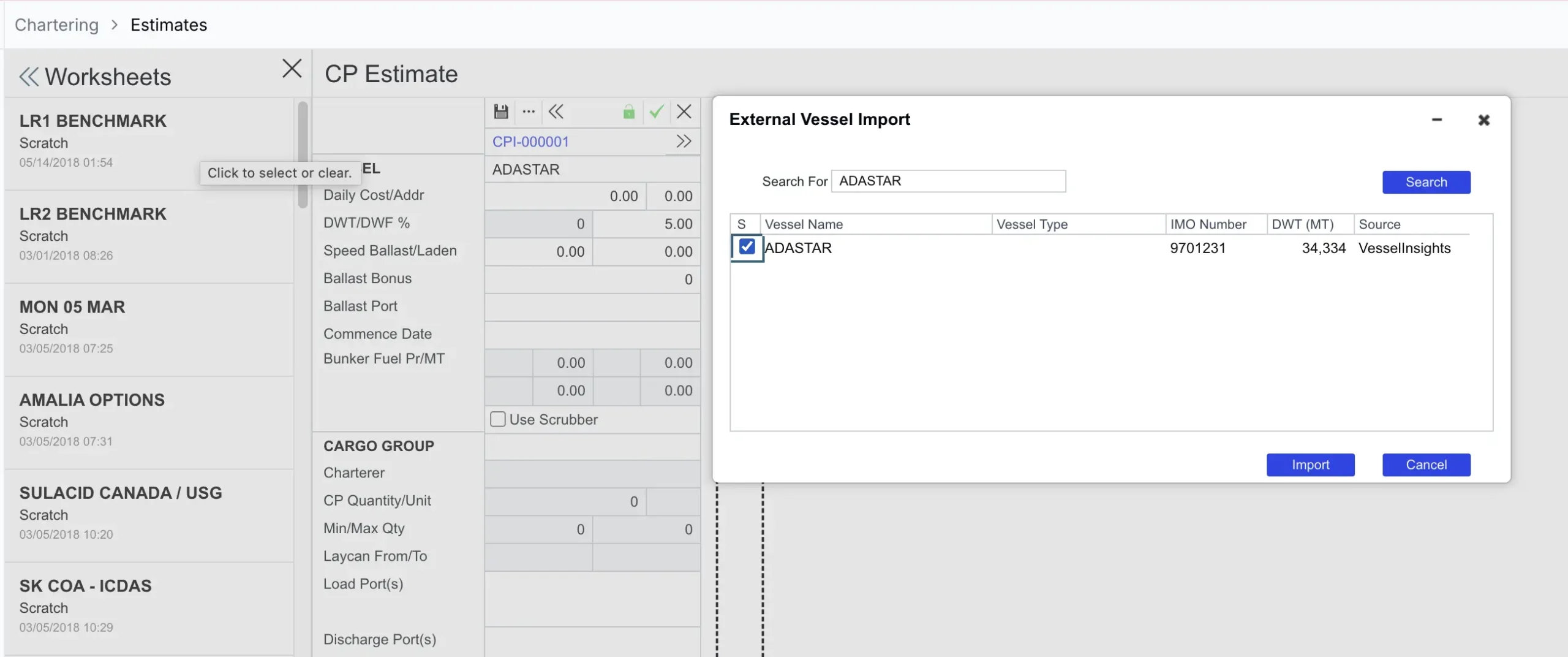
Operations teams onboarding a vessel search by name, pull validated data into the record, and decide field by field what to adopt, replacing a manual process that used to take hours. Records then stay current through daily refresh rather than periodic cleanups.
Beyond IMOS, teams that need to feed downstream systems, data lakes, or internal models can access the full field set via the Vessel Insights API. The data our team has spent years refining — speed and consumption curves, ownership history, environment fields — is available across every system and workflow that depends on it. This means commercial and compliance decisions are always built on the same validated source, regardless of where they are made.
Speed, consumption, and compliance built into every fixture
Speed and consumption is one of the hardest data points to get right and one of the most expensive to get wrong at the fixture stage. We have spent the last five years refining a model that produces full consumption curves for every vessel across HFO, LFO, and MDO. These categories map to the fuel grades commercial teams actually price against — VLSFO, MGO, and IFO — so estimates are built on validated data, helping teams move swiftly from bunker pricing to voyage estimates without translating between fuel types.
On the compliance side, teams increasingly need CII, EEXI, and ownership information early in the fixture process, and we wanted Vessel Insights to support that without adding friction. Vessel Insights delivers 24 environment fields covering CII, EEXI, and NOx, providing the estimates teams need to screen vessels before committing to a fixture.
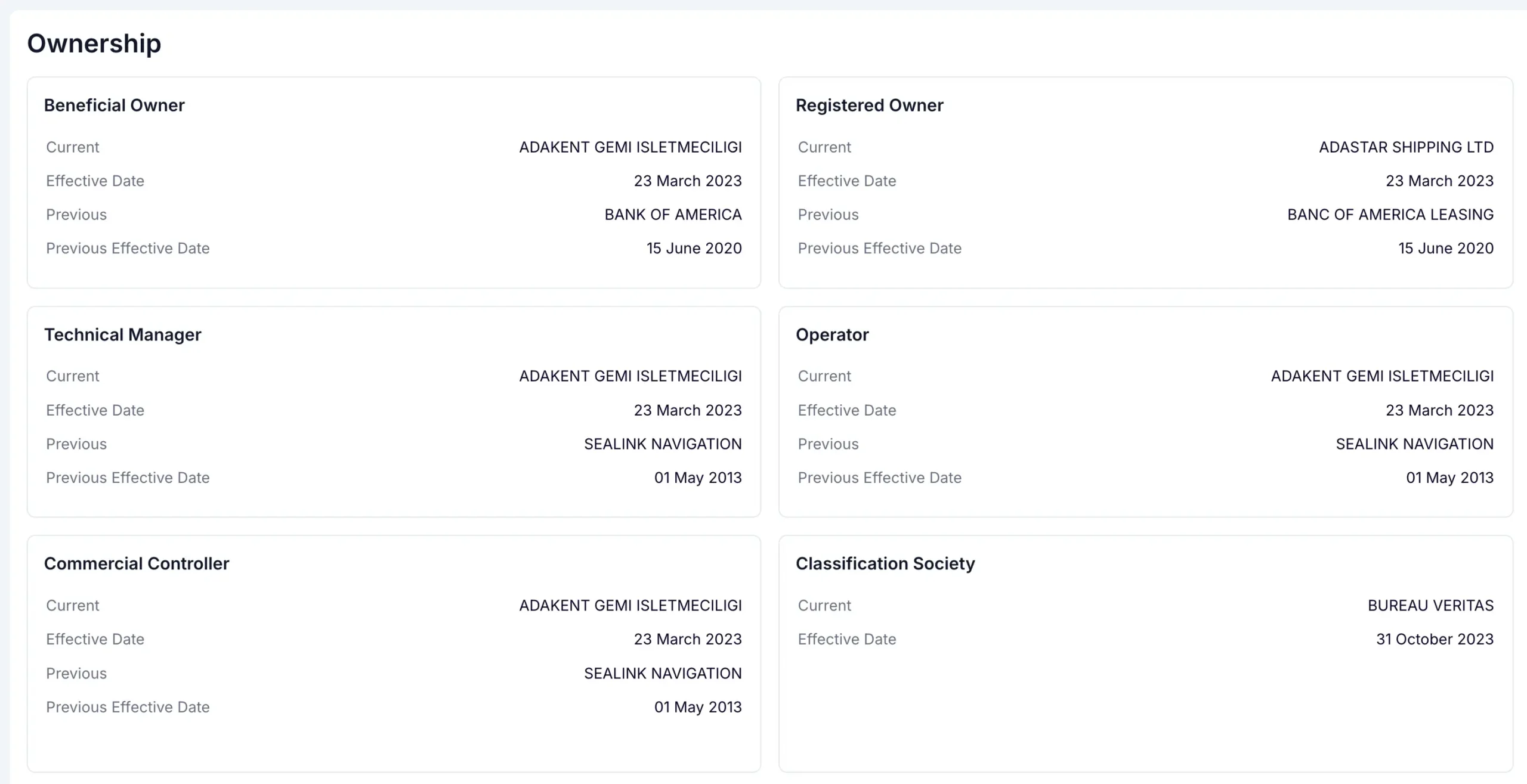
Vessel Insights tracks full ownership history with effective dates across eight different roles, covering beneficial owner, commercial controller, operator, ISM manager, and technical manager among others. With this information already built into the platform, compliance and legal teams have the context they need to sign off on a fixture or defend a historical position.
A better foundation, built on accurate vessel data
Vessel Insights was built to eliminate manual reconciliation, fragmented data sources, and compliance gaps that slow down commercial and operational decisions in maritime.
With a validated, always-current database accessible natively in IMOS, via API, and through analytics dashboards, teams can estimate voyages, maintain fleet records, and meet regulatory requirements with confidence.
As part of the Veson Platform, Vessel Insights is one piece of a broader connected experience designed to support every stage of the commercial voyage lifecycle.
Learn more about leveraging Vessel Insights within the Veson Platform or request a demo to get started.