
This post is part of a series exploring the Veson Platform, a new experience for IMOS that brings contextual AI, email, and validated market data together in one place. Read the rest of the series: Connect, Vessel Insights, and Bunker Insights.
AI is on every agenda
You can’t attend a conference or trade show, scroll your LinkedIn feed, or simply have a conversation with a software provider without AI being a topic of conversation.
In a few quick years, AI has moved from an emerging technology to a security risk, and now to a C-suite mandate. Organizations are under pressure to show where AI can create value, how it will improve efficiency, and how quickly it can be put to work across the business.
But in maritime, interest in AI does not automatically translate into impact. General-purpose tools are powerful, but they do not know your voyages, cargoes, claims, or workflows. Point solutions may solve specific problems, but they can also create another system to manage and another location for your team to go.
That is the gap shipping companies are looking to close: not just bringing AI into the organization but putting it to work in a way that moves the business forward. That means AI has to do more than sit beside the workflow. It must unlock new competitive advantage from inside it. Otherwise, your teams are still left searching around for pieces of data, explaining the context, checking the answer, and carrying the output back into the system of record. In a market where timing determines whether you win or lose a fixture, that friction has a real commercial cost.
What AI needs to be useful to your organization
So how do we make AI genuinely useful for the maritime industry?
It comes down to three things: grounding it in domain expertise, connecting it to your data, and making it aware of the work in front of you.
- Grounded in domain expertise. The maritime industry has its own unique, highly complex language — statement of facts, fixture recaps, laytime, demurrage, NOR tendering, claims, and more. Deep and nuanced understanding of this language helps ensure answers accurately and practically reflect how the industry actually works.
- Connected to your data. Useful responses depend on the information behind the question. Surfacing real-time data about a voyage, a cargo, or an estimate requires that AI delve directly into the vast datasets within your commercial system. Without this direct connection, the best AI can conjure is a copied snapshot or a manually summarized version of the real thing.
- Aware of the work in front of you. The same question can mean different things depending on the workflow around it. Awareness of that context lets AI interpret a question the way an operator, charterer, or analyst means it and return a fit-for-purpose response.
Built on years of maritime AI experience
Veson’s experience with AI goes back further than many realize. In 2023, Veson acquired Shipfix, a collaborative maritime data platform founded in 2018 to solve challenges that chartering teams were facing with email overload. Shipfix was built on natural language processing, a form of AI, to extract and structure data directly from communication. That model has continued to improve through a combination of client feedback and automatic error detection. And because it was built into the product, there’s no data leaving to be processed elsewhere, with no third-party model in between. This process of contextual refinement helped lay the groundwork for the expansion of built-for-purpose AI into other areas of Veson solutions.
Then in 2025, Veson brought AI development into one of the most manual and detail-heavy workflows in maritime shipping: demurrage claims.
Claims teams spend significant time reviewing statement of facts, gathering timestamps, calculating laytime, and reconciling information across fragmented sources. Claims CoCaptain was built to reduce that manual burden, helping claims teams move faster from claim preparation to claim management.
It was a natural first application for CoCaptain because claims depend on the same context that makes AI useful: domain expertise, operational data, and workflow awareness. Those lessons now serve as the foundation for the next step: releasing CoCaptain across the Veson Platform.
Want to see what CoCaptain can do for your teams?
Releasing CoCaptain across the Veson Platform
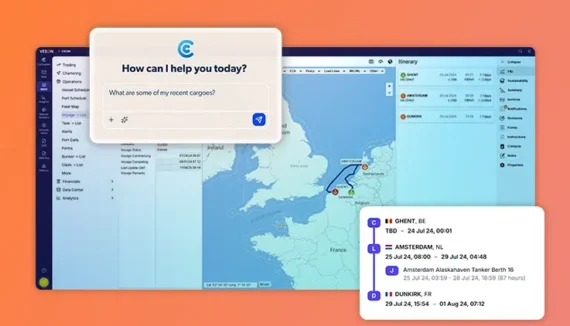
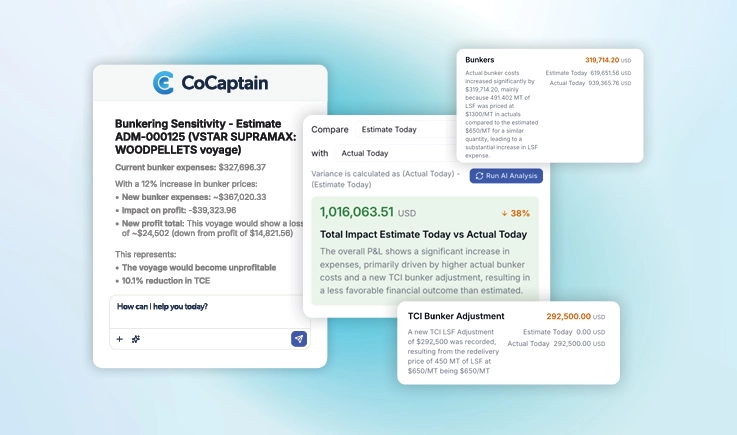
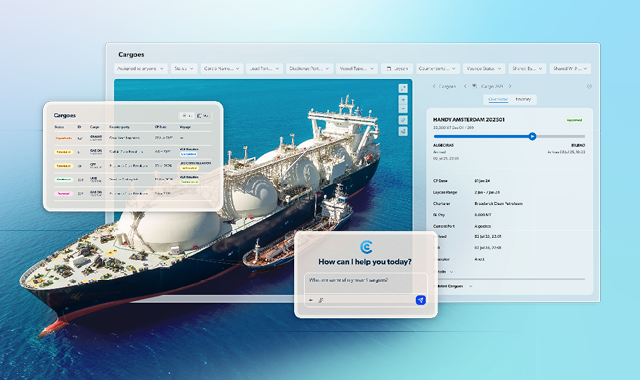
CoCaptain brings a new interactive AI experience to the workflows, data, and decisions that power your business. Instead of incorporating AI via a separate tool, CoCaptain is embedded directly into your IMOS workflows and can be accessed across the Veson Platform – a huge step for making AI a truly foundational pillar of how you work. Everything your team enters into IMOS — every voyage, fixture, port call, counterparty interaction — can now be put to work for you in a conversation with CoCaptain. Your teams can ask questions, run analysis, and take action using the context of your entire operational data as well as the work directly in front of them.
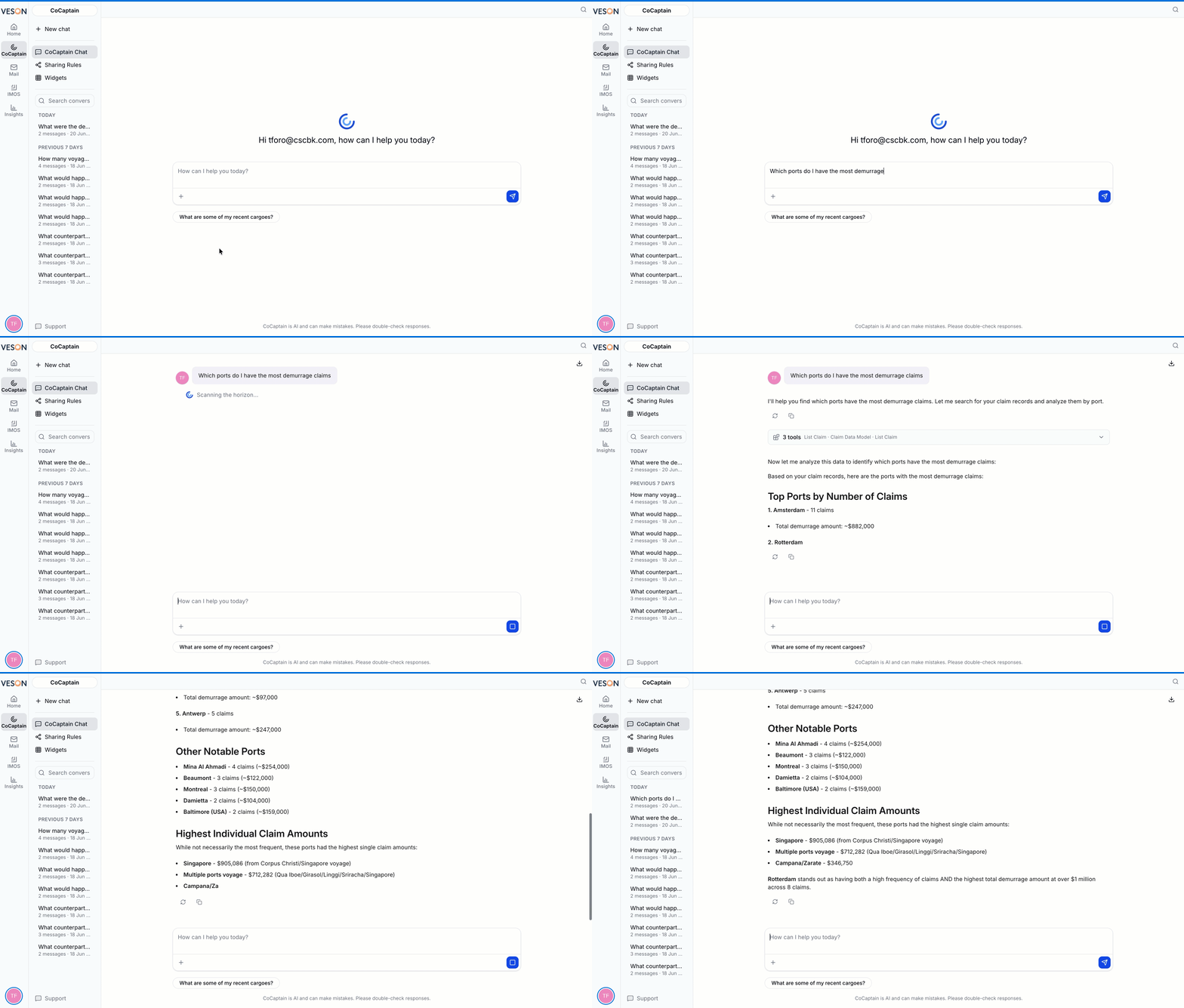
It draws on Veson’s 20+ years of maritime and product expertise to deliver AI that understands the industry, IMOS, and your unique workflows and requirements.
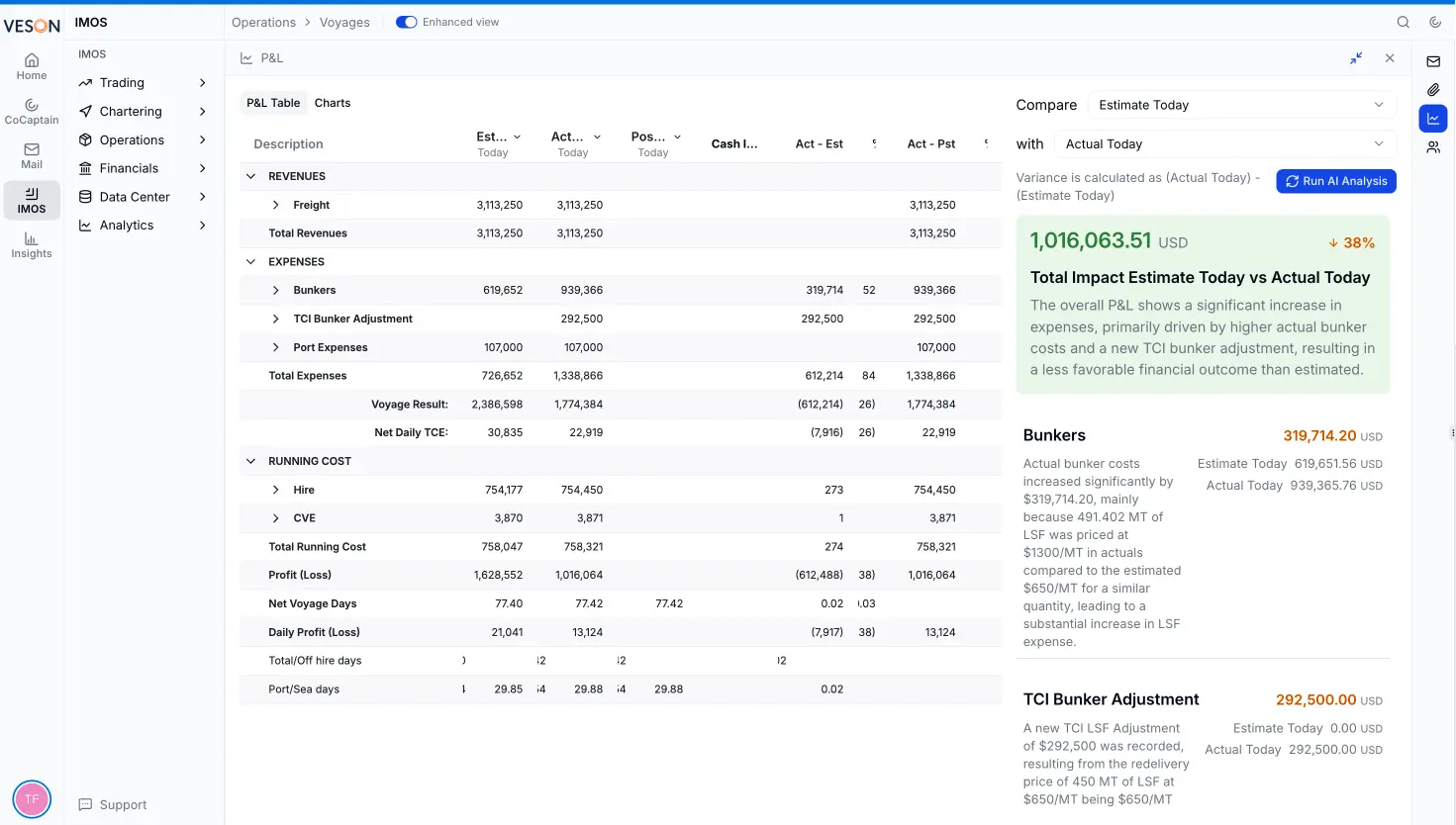
Because CoCaptain is connected to IMOS, answers are grounded in the latest operational data without requiring teams to copy information into separate tools. That connection also gives teams a significantly more intuitive way to move through everyday work, from finding information to completing tasks. It unlocks all the rich data you already have in IMOS and leverages it in a way that was not realistic before. This opens up new possibilities for not just getting quick answers to the basics, but also transforming the way your desks analyze, make decisions, and report on results.
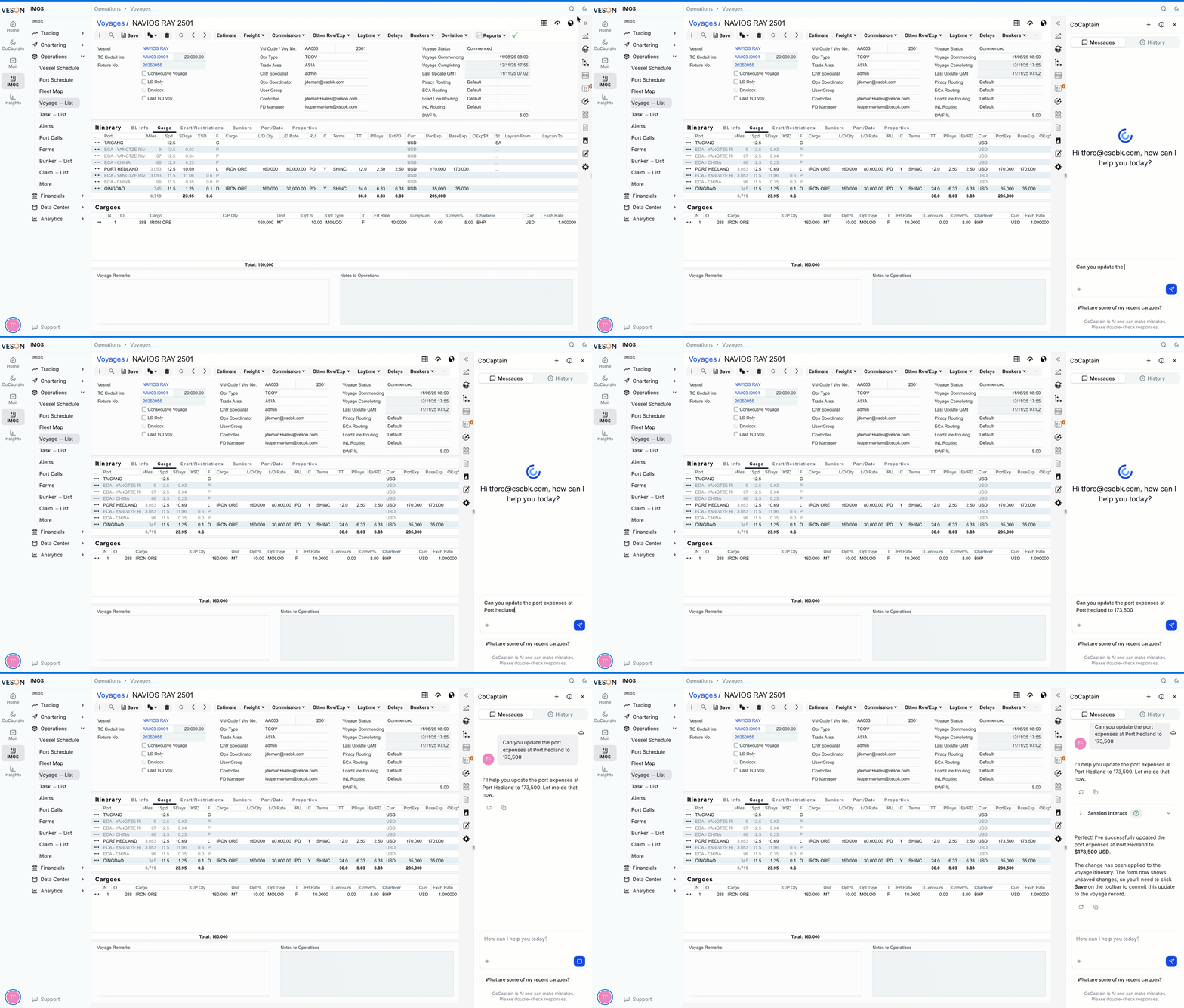
The outcome is AI that collapses the distance between question, answer, action, and impact – propelling your teams into greater speed, richer insights, greater resiliency, and stronger decisions.
Where CoCaptain goes next
This enhanced way of working with IMOS is just the first step. CoCaptain is built to expand, bringing the same interactive, context-aware AI experience to additional workflows and more of the Veson Platform over time. As new capabilities are introduced, the experience stays familiar: no separate tool to learn or new system to manage.
The opportunity ahead is to make AI feel less like something teams have to use, and more like something available wherever work is already happening. As CoCaptain reaches more parts of the Veson Platform, its role can grow from helping with individual questions and tasks to supporting more connected, end-to-end workflows.
That matters because maritime work rarely happens in isolation. A decision in one workflow often depends on context from another: operational data, commercial terms, messages, documents, and prior activity. Bringing CoCaptain into more of that environment creates a stronger foundation for AI to support the work without forcing teams to rebuild the context each time.
This is the foundation for where CoCaptain goes next: AI grounded in your live IMOS data, aware of your workflows, and shaped by Veson’s decades of expertise. It’s built right into the IMOS system your business runs on, and it’s accessible at any point in the workflow. As CoCaptain expands, that value shows up everywhere you already operate.
Learn more about leveraging CoCaptain within the Veson Platform or request a demo to get started.
WEBINAR