
As we enter a new quarter, shipping markets remain gripped by an escalating geopolitical crisis. The US-Iran Memorandum of Understanding (MOU) lapsed in mid-August without renewal, and by early September the two sides had intensified a series of strikes and counterstrikes around the Strait of Hormuz.
The threat has now spread to the Red Sea, where Houthi attacks are blocking Saudi oil exports through the Bab el-Mandeb Strait. Our current analysis assumes some improvement in Middle East oil flows through Q4 2026, but full restoration is unlikely before at least mid-2027. Separately, the continued absence of a return to Suez Canal transits keeps voyage distances elevated for Vehicle Carriers and Containers — a dynamic still expected to reverse from 2028.
Tanker markets have pushed to record highs despite the loss of Middle East barrels, as ship-to-ship operations, Suez diversions, and long-haul Atlantic voyages tie up tonnage faster than volumes are lost. Bulkers remain firm on strong Chinese commodity demand, though supply growth is set to outpace demand from 2027. Container earnings have ticked up modestly amid early talk of a partial Red Sea return, while the LPG market remains severely disrupted; Middle East export volumes are forecast to fall 48% in 2026 with Saudi Aramco confirming a further propane export suspension in H1 2027. Vehicle Carriers have continued to outperform, with PCTC rates up sharply again on the back of another quarter of blistering Chinese vehicle exports, though a return to shorter Suez transits from 2028 still threatens to unwind the current tight supply-demand balance.
Across all five markets, the interplay between an escalating Middle East conflict, persistent Red Sea and Hormuz disruption, a surging newbuilding orderbook, and China’s structural economic transition will continue to define the trajectory through 2029.
Tankers
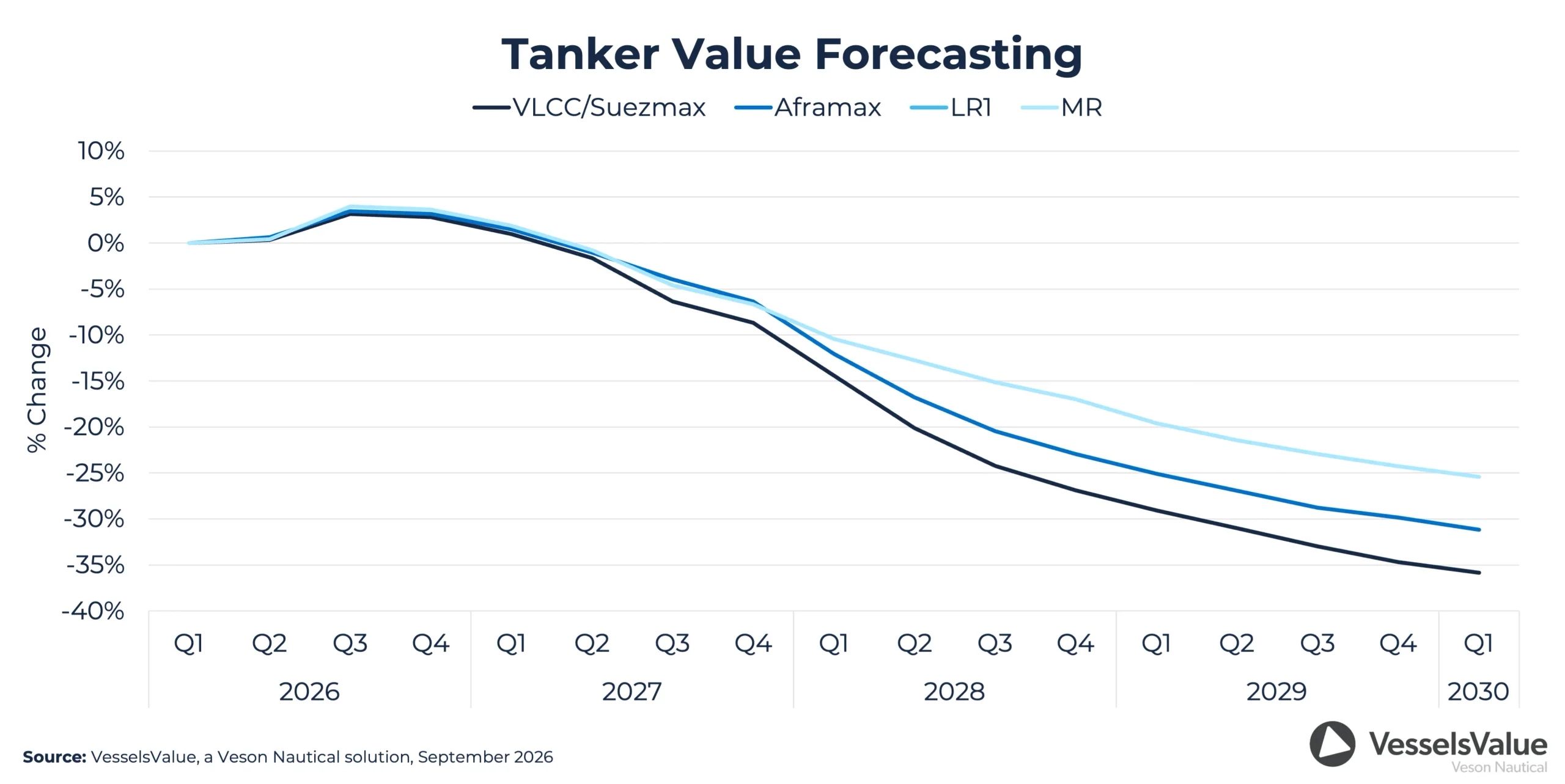
- Q3 spot earnings for VLCCs came in above 200,000 USD/day, while MR product Tankers averaged around 40,000 USD/day as extreme inefficiencies, including ship-to-ship transfers outside Oman and Suez diversions around the Bab el-Mandeb Strait, tied up tonnage and pushed rates to record highs despite the loss of Middle East barrels.
- Both Hormuz and Bab el-Mandeb chokepoints are now under active threat, with the East-West pipeline serving Yanbu also damaged; an improvement in Middle East oil flows is expected through Q4 but full restoration is unlikely before at least mid-2027.
- Global oil demand growth is set to turn positive again in 2027, with commercial and strategic inventories seeking replenishment beyond pre-war levels, pointing to solid seaborne Tanker demand into 2027.
- Ordering has nearly quadrupled year to date: 198 VLCCs contracted so far in 2026 vs. 89 for all of 2025, pushing the orderbook-to-fleet ratio to 37%. Crude carriers now account for 80% of all new Tanker orders.
- Asset values have surged alongside earnings: five-year-old VLCC values are up 70% YTD to USD 196.3 mil, and newbuilding VLCC prices are up 8.4% to USD 138 mil. From 2027, supply growth is expected to outpace demand, with the gap widening through the remaining forecast years.
Bulkers
- Capesize earnings averaged around 41,000 USD/day in Q3, up 66% on Q3 2025; Supramax rates averaged almost 20,000 USD/day, up from around 15,000 USD/day a year earlier, driven by strong Chinese demand for iron ore and bauxite.
- Chinese exports posted 19.3% year-on-year growth over the first eight months of 2026, with iron ore imports running at an annualised 1.28 bil tons in July and August even as steel output contracted 3.1%. This growth points to robust port stockpiling rather than end-use demand.
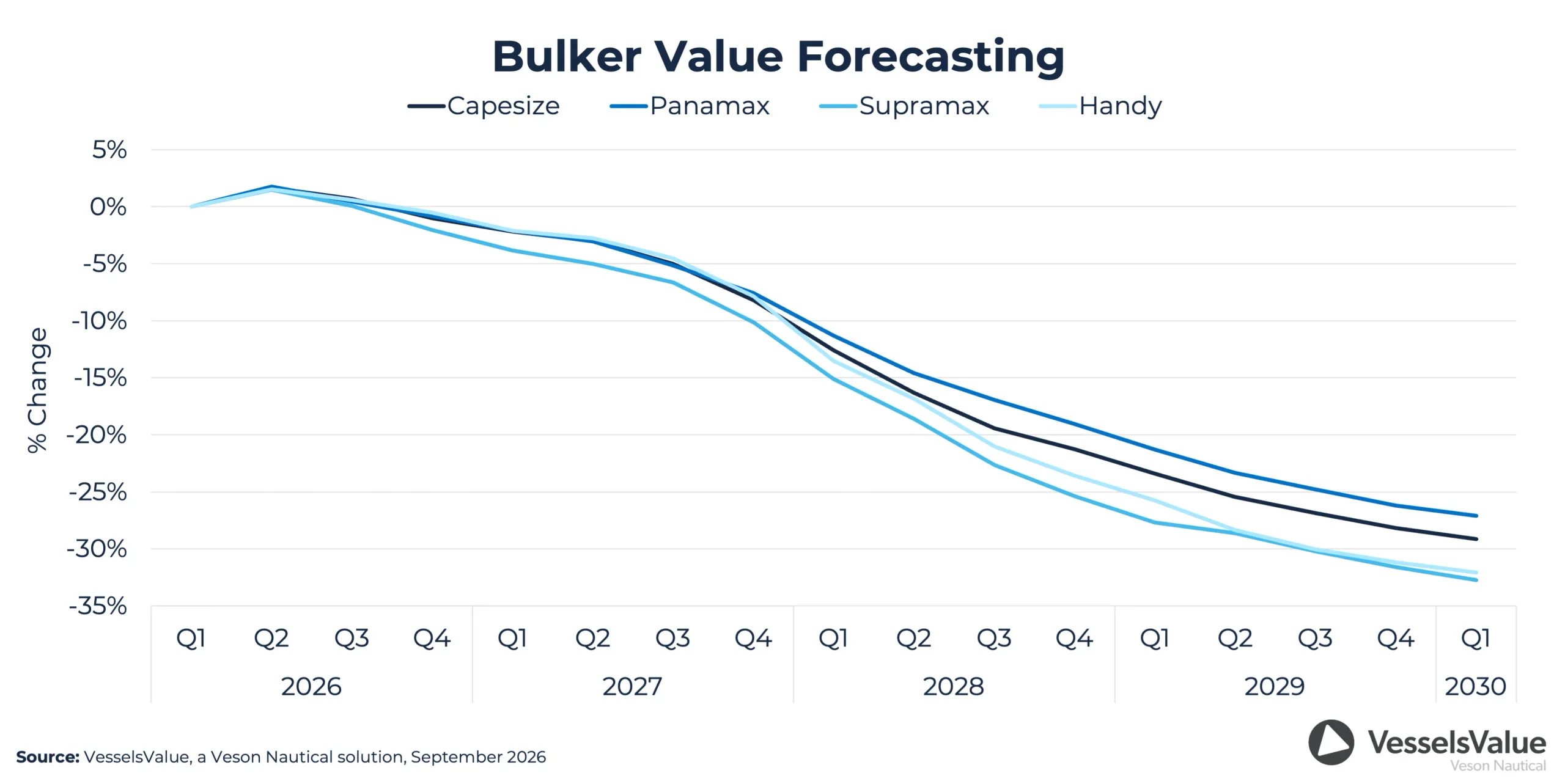
- Demand growth of approximately 2.6% per year is forecast through 2029, outpaced by fleet supply growth of 3.8%, pointing to progressive downward rate pressure as the orderbook delivers into 2027 and 2028.
- The Simandou ramp-up is set to lengthen average haul distances as long-haul Guinean bauxite and iron ore progressively displace shorter-haul Australian supply, providing structural ton-mile support even as Chinese steel demand softens further.
- Secondhand values firmed further in Q3: five-year-old Capesizes gained 6.5%, Panamaxes 3.5%, Supramaxes 5.2%, and Handy Bulkers 2.9%. Net fleet growth is expected to average approximately 4.2% per year over 2026-2029, with a moderate scrapping pickup likely toward period-end as 42% of the fleet ages into the 10-15 year bracket.
See how the markets are shaping up in the Shipping Market Outlook: Q4 2026 Executive Summary.
Containers
- Container earnings ticked up approximately 4.1% across vessel sizes in Q3, with talks emerging among major liners about a partial return to the Red Sea route, though the shift remains fragile given continued security concerns further south in the region.
- Asia-North America volumes improved 3.2% YTD following the tariff truce, while global volume growth of 4.9% YTD keeps demand at healthy levels, led by Asia-Europe (+9.1%) and intra-Asia (+6.5%).
- TEU-mile demand growth is forecast at 4.9% in 2026, averaging 4.1% per year in 2027-2029 as Chinese export expansion continues, though ongoing energy disruption could weigh on H2 2026 volumes.
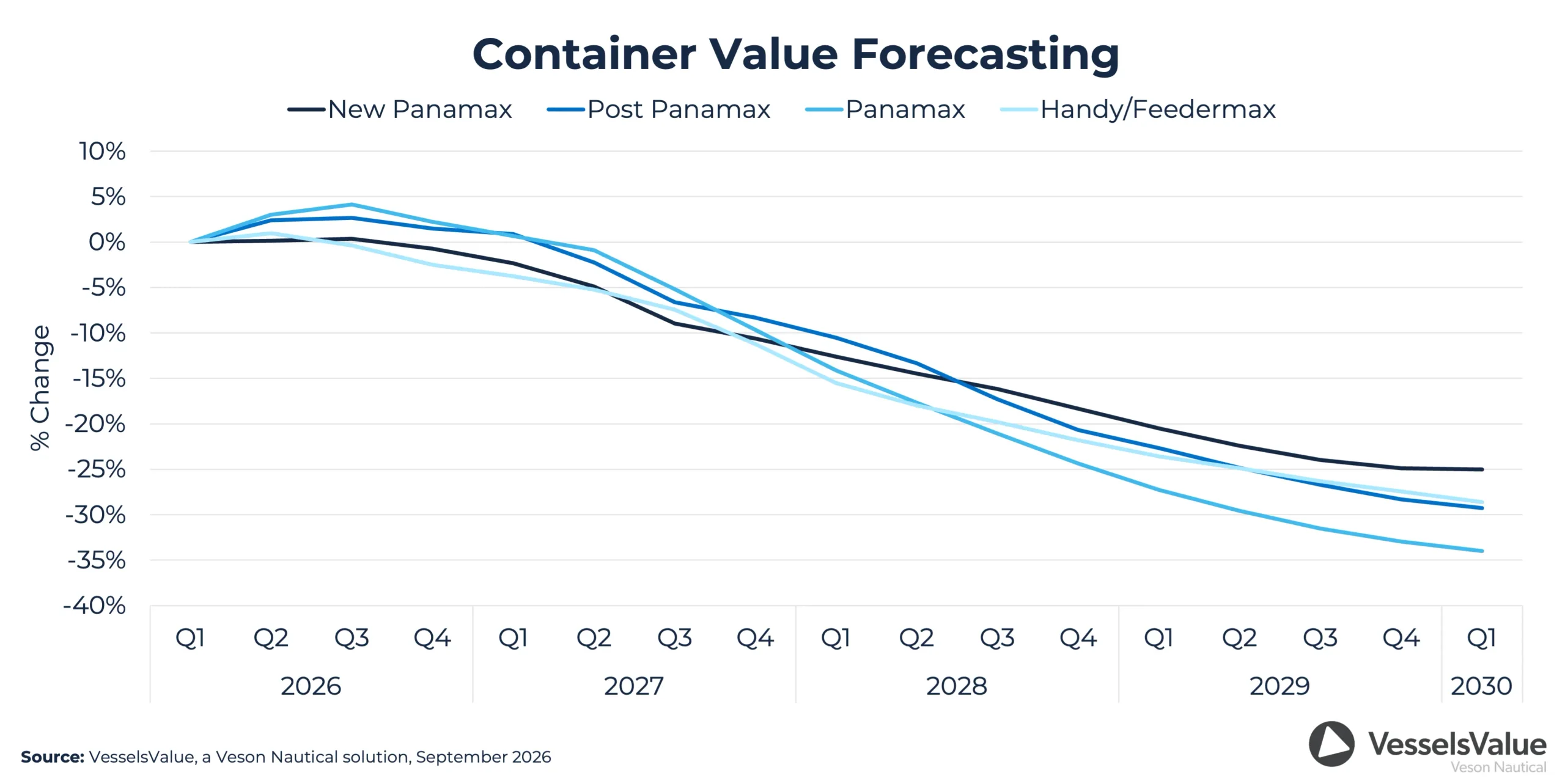
- The orderbook now exceeds 14 mil TEU after more than 3 mil TEU was ordered YTD; net fleet growth is forecast to average 10.9% per year over 2026-2029, materially outpacing TEU-mile demand.
- Freight rates are forecast to decline approximately 32% on average over the forecast period as supply outpaces demand; scrapping is expected to pick up moderately; most pronounced in the sub-3,000 TEU segment where the fleet is oldest.
LPG
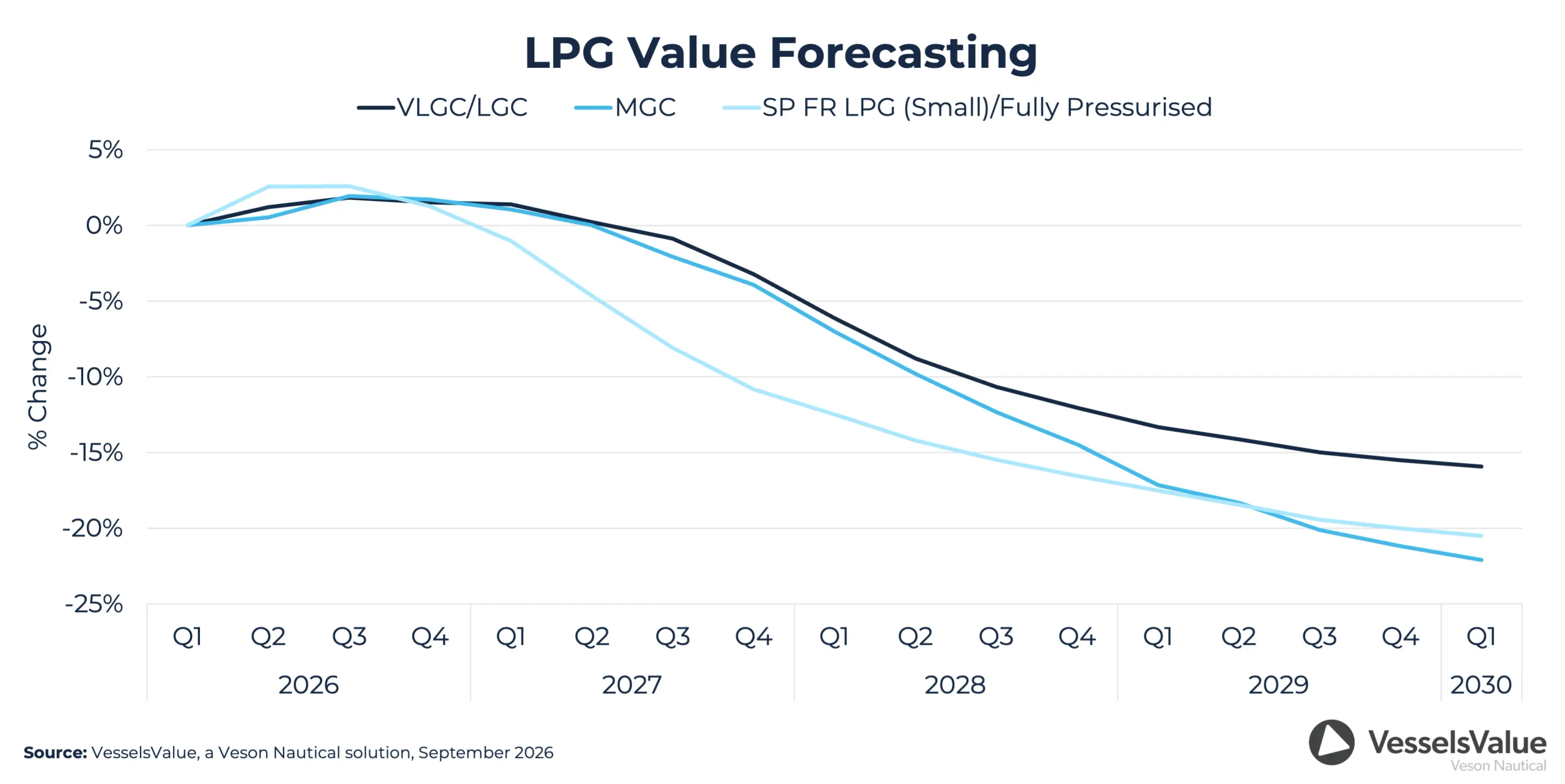
- LPG, petrochemical gas, and ammonia volumes declined further in Q3, but earnings held firm on a wide arbitrage spread, Panama Canal congestion, and wider market inefficiencies; US propane exports rose approximately 9% YTD, partially offsetting lost Middle East volumes.
- Saudi Aramco has notified customers it will suspend propane exports in H1 2027, which will weigh on total LPG flows next year even if the Strait of Hormuz sees a full reopening.
- Panama Canal transits are running at full capacity amid high US activity and rising competition from Tankers and LNG carriers, with El Niño-related draught restrictions now imposed as a precaution for the coming months.
- US LPG exports are forecast to grow approximately 13% in 2026, accelerating from 3.2% in 2025; Middle East export volumes are still forecast to decline 48% in 2026, recovering by around 55% in 2027 but remaining roughly 20% below 2025 levels.
- The VLGC/VLAC orderbook-to-fleet ratio stands at approximately 38% (48% for the medium-sized segment); net fleet growth is forecast to average approximately 9.2% per year, putting market balance under pressure from 2027 given a young fleet that offers little scope for scrapping relief.
Vehicle Carriers
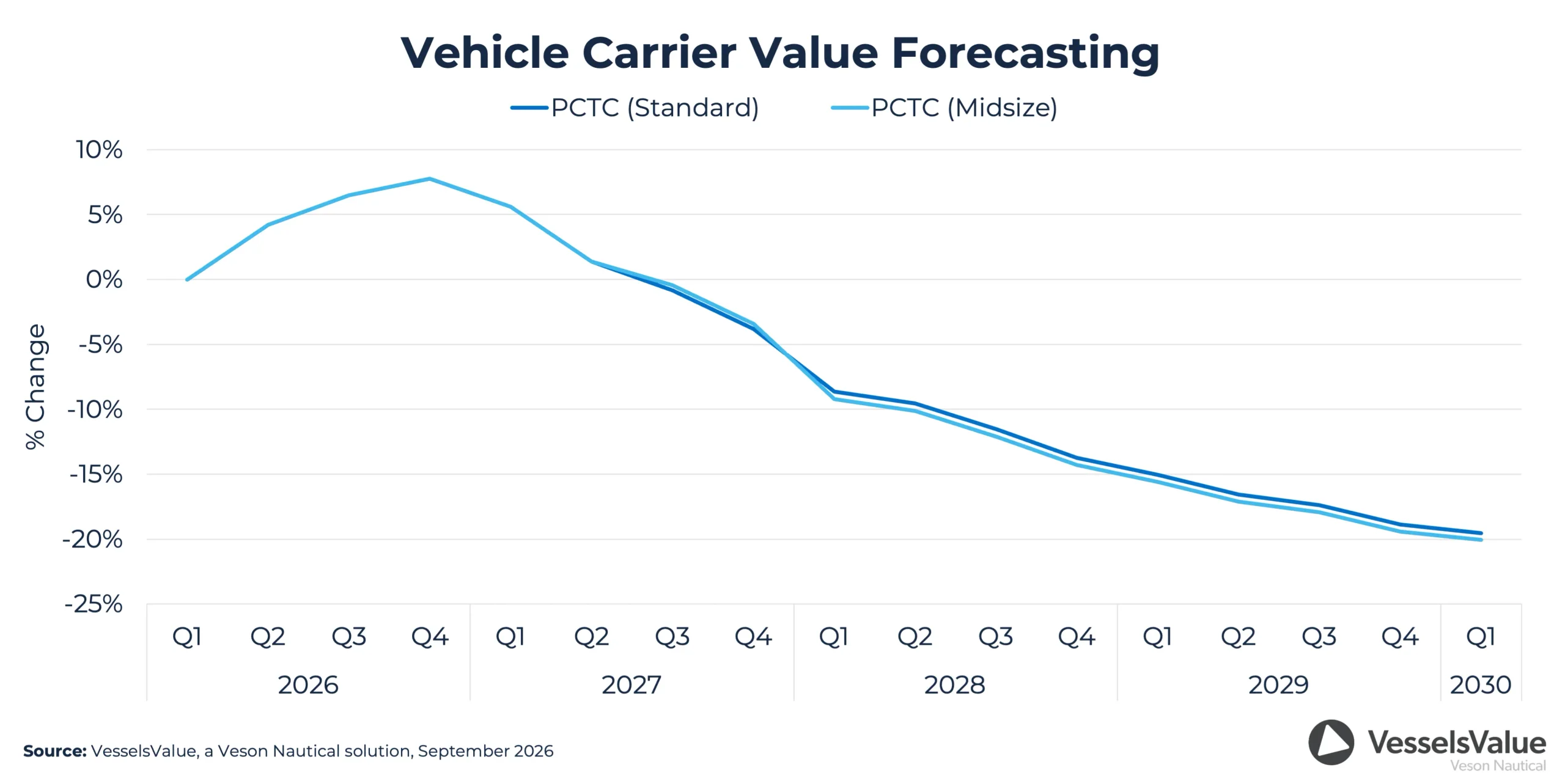
- One-year Time-Charter rates for PCTC Standard averaged 73,300 USD/day in Q3 (+36.9% quarter-over-quarter), with PCTC Midsize at 48,450 USD/day (+31.4% QoQ), as new operators serving Middle East trades alongside deep-sea majors rerouting via the Cape of Good Hope kept the charter market exceptionally tight.
- Chinese light vehicle exports rose 68% year-on-year to 7.1 mil units in Jan-Aug 2026 (EVs up 114% YoY to more than 2 mil units), more than offsetting an 11.6% year-on-year decline in China’s domestic vehicle sales.
- Newbuild contracting has jumped approximately 850% year-on-year, with 57 new orders (386,720 CEU) placed year to date — all at Chinese yards for delivery between 2028 and 2030.
- Capacity is set to grow 8.1% this year and 6.4% in 2027, with scrapping virtually non-existent since 2021; more than 2 mil vehicles out of China are expected to be diverted to alternative shipping modes this year simply because not enough ships are available.
For a more in-depth analysis across the five major market sectors, download the free Shipping Market Outlook: Q4 2026 Executive Summary, or learn how VesselsValue, a Veson Nautical solution, can support your decision making with daily valuations across 76,000+ vessels.
All information provided is for informational purposes only. To the extent that any provided information is based on Veson Data, Veson excludes to the extent permitted by law all implied warranties relating to fitness for a particular purpose, including any implied warranty that Veson Data is accurate, complete, or error free. Veson Data are collated and processed by and on behalf of Veson in accordance with methodologies and assumptions published and updated by Veson from time to time which do not take into account particular circumstances applicable to individuals and therefore; (i) are made available on an ‘as is’ basis; (ii) are not intended as a substitute for formal valuations; (iii) should not be used solely as trading, investment, or other advice; and (iv) are not intended as a substitute for professional judgement. To the extent permitted by applicable law, Veson shall have no liability to party for any errors or omissions in the content of the information provided.