
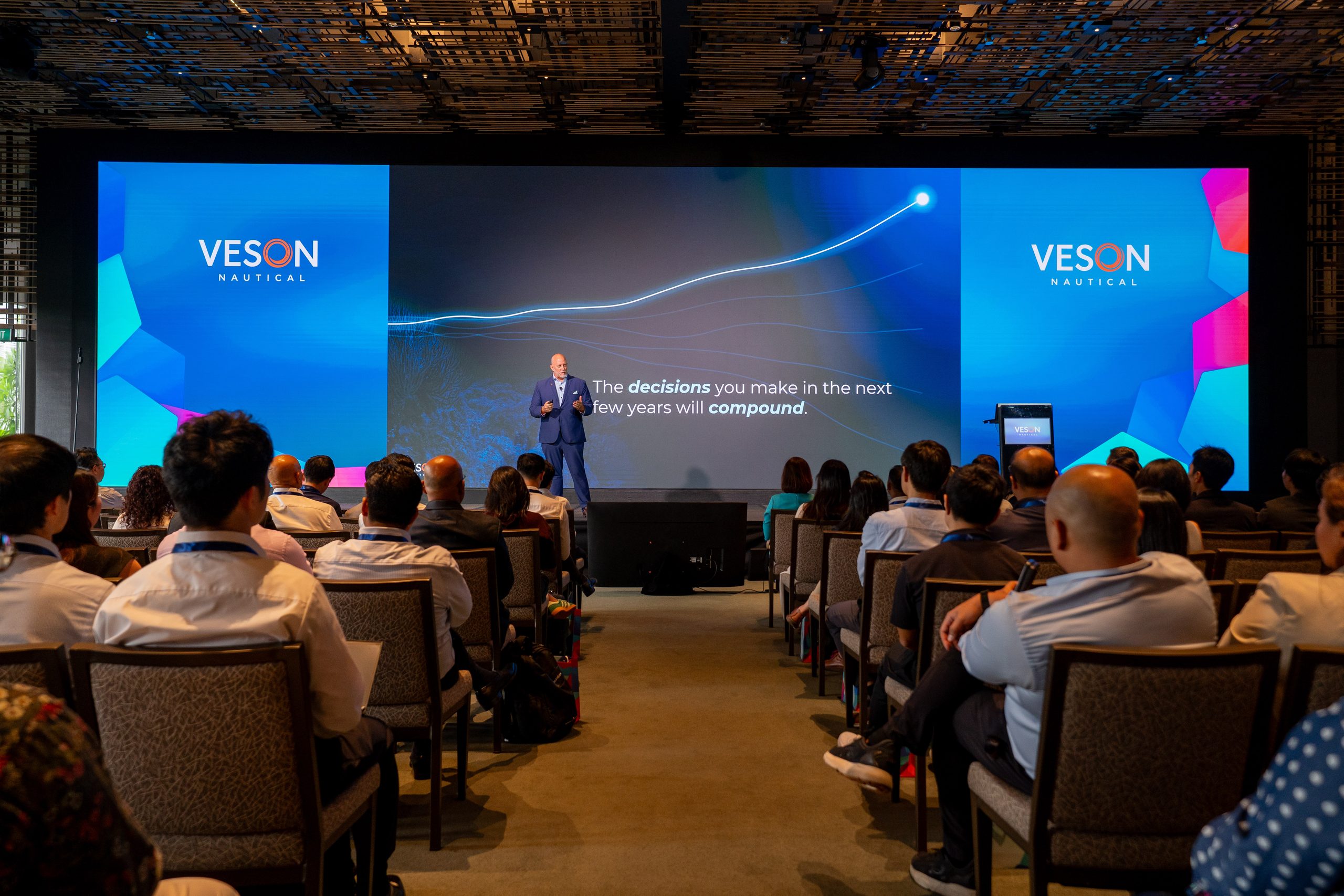
Veson Nautical’s global summit series continued this month in Singapore, gathering leaders from the region’s biggest maritime names to discuss how teams can get real value from AI.
AI adoption is now commonplace across maritime, yet as of February 2026, 89% of companies said AI has not impacted productivity over the last three years. Veson executives and industry experts spent the day addressing that gap, and how Veson is building an AI foundation meant to scale for the long term.
The day opened with remarks from two esteemed voices from Singapore’s maritime community: David Foo, Deputy Chief Executive (Operations and Technology) at the Maritime and Port Authority of Singapore, and TS Teo, President of the Singapore Shipping Association.
Foo’s message set the tone for the summit: AI is only as useful as the information behind it.
“If your single source of truth is still a data file that’s called Final Draft version 13, my guess is that you still have some more work to do,” Foo said. Teams need to trust that the system of record they’re working from is validated, accurate, and secure.
This kind of trust is essential for change management, a challenge Teo picked up in his own remarks.
“The organizations that succeed may not necessarily be those with the most advanced technology. More often, they will be the ones that are most prepared to transform themselves,” Teo said.
Highlights from the Summit:
- Effective AI must be backed by trustworthy, validated data.
- Digital transformation takes more than just AI solutions. Teams need the right mix of human expertise, data, and governance to create a strong foundation for change.
- Data pulled from thousands of transactions gives teams a nuanced view of how the market is changing on a daily basis.
- Maritime leaders can learn from one another about how to navigate change management, integrating AI without overwhelming their teams.
How Do You Create a Foundation for Transformation?
Veson Chief Commercial Officer Russ Hubbard built on that idea in his keynote, emphasizing that AI isn’t a silver bullet on its own. Teams need the right mix of human judgment, contextualized data, and strong governance to create a solid foundation to build on.
“Your system of record and what you are basing your decisions upon become more foundational now than they’ve ever been before,” Russ said.
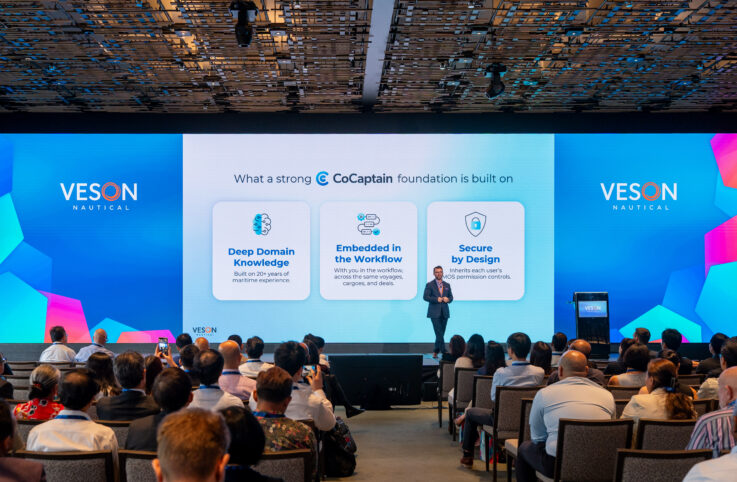
The Veson Platform was built on a system of record that’s been shaped over the past two decades, featuring a unique combination of standardized and structured data, real-time operational data, configurable business logic, access control and security, and the ability to scale and connect with other systems.
This foundation enables the Veson Platform to bring CoCaptain AI, Connect, Insights together into one unified, single source of truth that is faster and smarter- to act upon.
As the platform’s built-in AI, CoCaptain offers contextualized answers in seconds based on a company’s own voyage and P&L data.
“An off-the-shelf LLM is a powerful tool, but you have to continuously provide it with information as to what a charter party is, what a laytime calculation is, what routing options are,” said Director of Product Josh Luby. “You want AI to be actually providing workflows and assisting your users.”
Why Is It Important to Put Data in Context?
One advantage of the Veson Platform is the range of data sources it pulls from — including Q88, Milbros, VesselsValue, and Shipfix — grounding decisions in tested, current market data.
VP of Valuation & Analytics Matt Freeman showed how this dataset feeds Bunker Insights, giving users a detailed view of how market conditions are moving bunker prices worldwide, across fuel grades.
Built on hundreds of thousands of aggregated, anonymized transactions, Bunker Insights covers 20 bunkering hubs with historical time series, daily pricing for more than 1,300 ports, and forward price curves.
In a live example, Freeman showed that a 300,000 DWT VLCC bunkering 4,000 MT of LFO and 300 MT of VLSFO on September 1 priced out to $3.45 million sourcing at Singapore versus $3.59 million at Fujairah, against crude averaging around $90/bbl with high volatility.
More broadly, VLCC one-year charter rates continue to climb sharply, while tanker newbuilding orders and options are up 358% year-to-date versus the same period last year.
To learn more about the state of the market across major vessel segments, check out the Q4 2026 Market Outlook.
How to Get the Most Out of AI
For many companies, the question isn’t whether to invest in AI, but how to make sure that investment pays off over the long term.
Professional Services Directors Donovan Muller and Myo Kyaw Oo offered practical guidance on how to scale AI in a way that creates meaningful ROI. Their top piece of advice was to get the foundation right first. That means focusing on the crucial basics of sound data, clear processes, and strong governance before introducing AI.
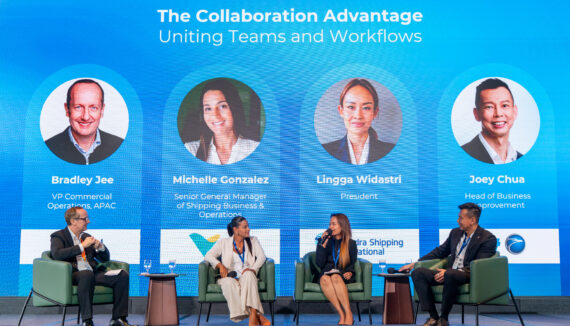
But the most crucial factor of all in making AI a success is people. To discuss the dynamics of strong collaboration, Veson VP Brad Jee sat down with a client panel featuring Michelle Gonzalez, Senior General Manager of Shipping Business and Operations at Vale; Joey Chua, Head of Business Improvement at AET Tankers; and Lingga Widastri, President Director at PT Chandra Shipping International.
One way that Veson honors this spirit of collaboration is maintaining an open platform and forming strategic partnerships with other key tech providers. One such platform partner is Veracity by DNV, which integrates with IMOS to streamline emissions reporting. Veson VP of Professional Services Vishal Khattri and Dominic Ng, Head of DNV Asia Pacific, held a session to discuss how verified data can unlock new value in commercial operations.
To close out the day, Co-founder and CEO John Veson gave an inside look at where Veson is headed next and how the team is experimenting and innovating.
As AI continues to reshape maritime, the teams with the greatest advantage will be those that pair the technology with powerful, contextualized data. Building an AI ecosystem from the ground up pays off not just in efficiency, but in more strategic decisions, clearer visibility, and stronger collaboration.