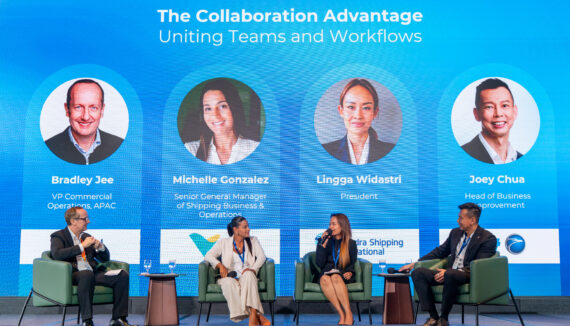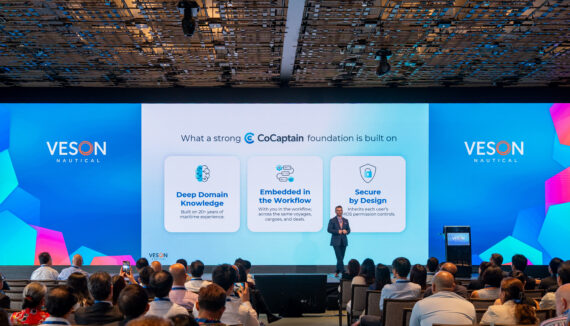

During a panel on digitalization and AI at Geneva Dry this past April, I asked the audience a simple question: “Do you trust your data?”
Not a single person raised their hand.
The moment was a telling example of where our industry stands when it comes to the use of data. We want the AI intelligence and speed it powers, but we lack faith in its validity.
This leaves us at a crossroads – one we’re working to navigate at Veson.
I spoke about this issue with Paul Gunton during a recent episode of the Lloyd’s List Shipping Podcast, discussing how teams can better understand, structure, and leverage their data to build an AI foundation that creates true competitive advantage.
Why we don’t trust our data
Why is it no one raised their hand in Geneva?
It comes down to the standards to which people hold data and AI compared to humans. While most of us can accept that humans will make mistakes, we don’t extend that courtesy to data and AI.
And in maritime, handing over more trust to AI can run counter to many people’s trust in themselves. Leaders in the industry still believe that their own skills outperform AI when it comes to capturing and structuring data, and that is simply not true anymore. I’ve spoken with senior executives who receive 500 emails a day and are convinced they’re able to read and capture everything themselves. The data tells a different story.
When we apply our AI-first model to reading and structuring all the data in those emails, we’ve seen from our internal benchmarking that it’s very possible to achieve reliability and accuracy in the high 90s percentile. And yet, it can still be hard to convince people unfamiliar with the technology of this fact.
It’s difficult for many people to admit that computing power can outperform humans in some aspects of their job. When it comes to the most critical parts of the maritime workflow though – nurturing relationships and making critical decisions – AI cannot compete. We need humans to remain at the center of this work, bringing their unique perspectives and skills to the job, now equipped with more data to inform their decision-making.
What a trustworthy system looks like
Tackling this challenge starts with first understanding what it means to trust your data and how to build an ecosystem that fosters accuracy.
It begins with building the right foundation. We want to source and structure data from across maritime that can give companies a clear and up-to-the-minute view of what’s happening across their value chains.
Humans are constantly taking in an array of both conscious and subconscious data — from knowing the local holiday calendars that could impact port hours to understanding the working styles of counterparty professionals — that influence how they make operational decisions. AI systems built with that same level of intelligence are ones that can offer the greatest competitive advantage.
This is in part because the particularly challenging aspect of adopting AI for maritime is that up to 90% of operationally critical data arrives in unstructured formats such as broker emails, agent updates, and port notifications. This information is incredibly useful but difficult to standardize and integrate at scale, and often not captured by generic LLMs.
For this data to deliver meaningful value, it needs to be extracted from unstructured sources, mapped to the system of record, and governed. Purpose-built AI that is built with this nuanced information in mind is then better suited to provide intelligence that can elevate our judgment and strategic decision-making, not just expedite existing workflows.
And to truly do all this, AI needs to be woven into the structure of maritime workflows, not bolted on top. That’s because tailor-made, industry-specific tools can better understand the complexity of maritime and evolve with market changes.
Maritime companies need an AI and data foundation that is purpose built and deeply embedded in the core of their operations, not a generic LLM that they’ve bolted on top of existing workflows. Unlike these generic tools, purpose-built AI solutions are trained on the language and complexity of maritime, so they can fully understand the intricacies of things like demurrage claims and post-fixture analysis.
Built and governed by human experts, this is a structure built on data you can trust.
At Veson, we’ve focused on crafting a unified AI-powered platform solution that brings data together from across operations, puts it in needed context, and structures it so teams have information where they need it and when. This is what enables teams to make smarter, faster decisions.
How to bridge the gap
We know that when powered by reliable, contextualized data, AI can tangibly improve outcomes for companies.
So how do we build systems that gather and govern this data?
Teams first need to investigate why they don’t trust their data. Looking under the hood can help determine the root cause, whether it’s a lack of clarity in the data source or the quality of analysis, and when addressed, lead to increased transparency and validation.
Once we have a data foundation in place, it comes down to how it’s applied.
Teams that can move with intention and creativity when it comes to AI are the ones staying ahead, opting not to just simplify tedious tasks by layering on AI, but to fully reimagine workflows with AI at the base. This is what creates a lasting advantage.
We’re at an inflection point in maritime as companies learn how to integrate AI in meaningful ways. And as I told Paul during our conversation, once everyone has adopted AI, how will we redefine ourselves? What will be the unique human advantages that set us apart?
The answer to this is what will define competition in the next era of work. At Veson, this combination of long-term competitive advantage based on foundational data quality and human ingenuity is what guides our vision for the years ahead.
It’s up to us to be deterministic in our application of AI. We don’t need AI tools that are applied shallowly across an entire enterprise. We need solutions that are intentionally embedded into the foundation of our work, taking into account that even in the age of AI, maritime teams have limited time, money, and people.
Maritime is moving aggressively on AI. At Veson, we’re determined to do so in ways that ensure faith in our tools at every stage, so that when we ask if you trust your data, every hand goes up.