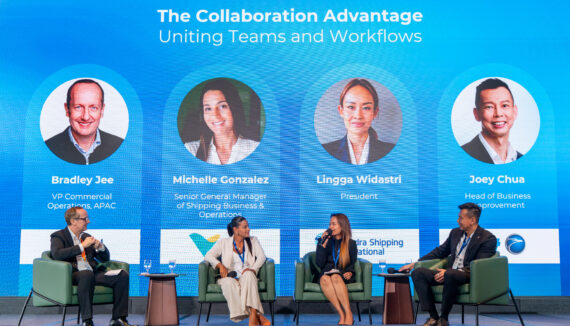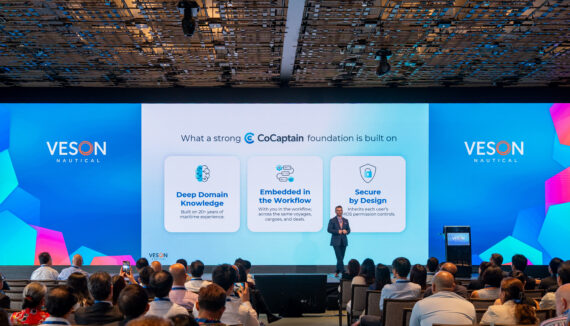

A couple of weeks ago, I had the pleasure of participating in our AI in Maritime webinar alongside Ana Margarida Lima of Moeve, Michalis Michaloliakos of TMS, and Sean Riley of Veson. The conversation was thought-provoking and insightful, yet it was impossible to do the topic justice in a mere 60 minutes.
Towards the end of the discussion, one audience member asked for practical advice on getting started with AI adoption in maritime. At this point, most of us have read the guidance to establish an AI committee, figure out an AI governance framework, and create a plan for equipping employees with appropriate tools. All easier said than done! There are so many pitfalls, subtle mistakes and unintended side effects to be aware of when embarking on significant organizational change coupled with the advent of immensely powerful technology. Not to mention that the cybersecurity landscape is shifting beneath our feet as we go.
We can’t speak for the entire maritime industry, but Veson is positioned at the leading technological edge in our space, and consequently we have some first-hand experience to share. We believe our claim to lead on AI in maritime is only as strong as our own use of it, so we have leaned in hard: not just with AI in our products, but with general-purpose AI tools in the hands of every employee. Our approach is grounded in Systems Thinking.
Systems Thinkers see a world constructed of stocks, flows and feedback loops. The late Donella Meadows, whose Thinking in Systems remains the best introduction to the discipline, made a career of showing that we routinely intervene in systems in the wrong places. How do we apply this paradigm to AI adoption in maritime?
Stocks
A stock is a resource or asset that accumulates or shrinks over time, depending on various inflows and outflows. In the context of our AI adoption journey, there are several intangible stocks:
- Employee skill
- Institutional knowledge
- AI-powered workflows
- Unmanaged risk in the form of shadow AI (not all stocks are desirable)
The critical realization in relation to stocks is that they change slowly and the rate of change is limited by the pace of inflows and outflows. Put simply: a company cannot push a button and “catch up” on AI adoption. It takes time for desirable stocks to accumulate, and it takes time for employees to embrace the organizational change that comes along with it.
This is the key reason why we decided to start our AI adoption journey as early as possible.
Flows
Attempting to understand the flows in a system can yield extremely valuable insights and, more importantly, sometimes save you from policy blunders that are not entirely obvious at first glance. In the context of our AI adoption journey, there is a strong flow of company data to large language models, driven primarily by the desire of employees within Veson to optimize their day-to-day work. We recognized this flow and understood that trying to block it would have adverse consequences.
The blunder, had we made it, would have looked perfectly sensible on paper. Block the tools, protect the data, and wait until the technology matures. But when you try to block a stream with a pile of rocks, water just goes around it. The same principle applies here – company data would have ended up in personal ChatGPT and Claude accounts, or copy/pasted into unsanctioned systems. Instead, Veson provisioned an Anthropic Claude license for every employee, and empowered our people instead of hindering them.
Policymakers often set out with intentions of managing risk, but instead end up losing the ability to measure it when creative people start painting outside the lines. Meadows referred to this phenomenon as the “Policy Resistance System Trap”. This is a valuable consideration for anyone contemplating organizational change with new technology in the mix.
Feedback Loops
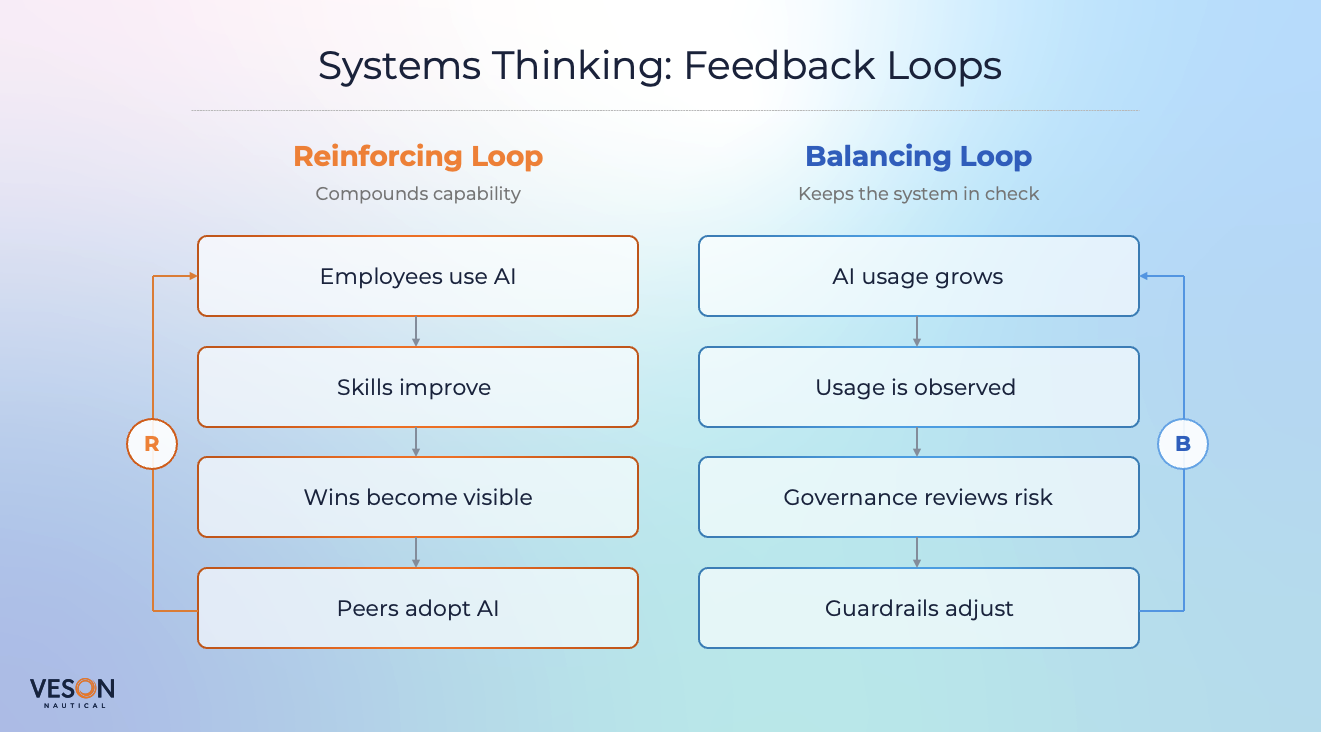
Feedback loops are where AI adoption is truly won or lost. The loop that matters most is a reinforcing one: employees use AI, they get better at it, they tell their colleagues, wins become visible, and the efficiencies start to snowball. Once this reinforcing loop is up and running, capabilities start to compound in a surprisingly short amount of time. The need for a reinforcing feedback loop is a strong argument against cautious pilot programs, restricted rollouts, or creating a two-tier population of haves and have-nots. Whilst those approaches might give the impression of managing risk, they come at the cost of starving that vital reinforcing loop. Approximately 85% of Veson employees now use AI on a daily basis, a figure we can state with confidence because we instrumented our rollout from day one. We are well beyond critical mass on our adoption journey.
By now, some readers will have concluded that we are simply reckless, and that putting powerful AI in the hands of every employee is a recipe for disaster. Belay those concerns, because this is where the second type of feedback loop comes in. Whilst reinforcing loops compound, balancing loops keep the system in check. A well-designed governance mechanism acts as a balancing loop and keeps the entire system in equilibrium.
Because we have achieved deep observability into how and when AI is used internally at Veson, our governance balancing loop can operate with a high degree of efficacy. On a regular basis, we review which data assets are available, how they are being leveraged, and what actions are being taken by humans and agentic systems alike. Contrast this approach with a traditional AI policy encoded in a rarely updated document: incapable of keeping up, and incapable of changing in response to a dynamic system.
Meadows observed that missing information flows are one of the most common causes of system malfunction, and that restoring them is often the cheapest, most powerful intervention available. A policy document adds no information to a system. Observability does.
Our advice to that audience member and to organizations starting their AI adoption journey: don’t start with a policy. Start by understanding your stocks, meaning the skills, capabilities, and risks that are accumulating whether you like it or not. Then understand the flows and the goals of the actors within your system. Try not to legislate against flows, lest you accidentally create a policy resistance system trap.
Finally, construct your feedback loops. One that compounds capabilities and grows exponentially as AI knowledge is passed from one colleague to the next. The other, the balancing loop, acts as a dynamic set of guardrails and manages risk in a constructive manner.
This approach is working well for Veson. We didn’t write a perfect AI policy; instead, we built a feedback loop.