
From fragmented communication to on- demand visibility across global shipping.
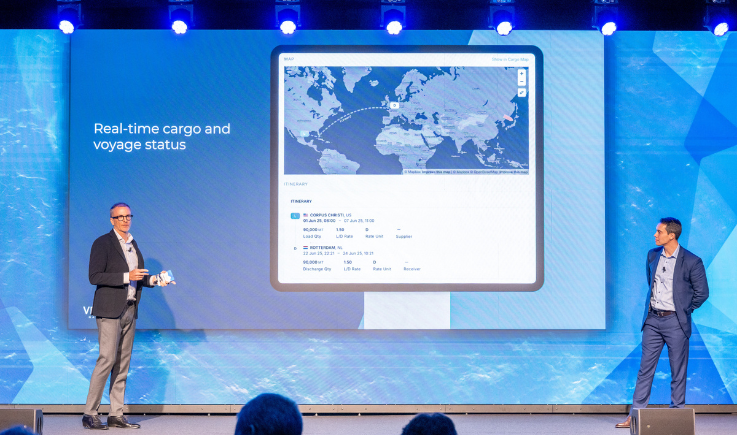
At our recent Geneva Summit , I had the opportunity to share the stage with Patrick Jourdain, VP, Business Development Lead at Cargill Ocean Transportation, to discuss a challenge most of us recognize but rarely address head on: how we communicate shipment updates with our counterparties.
Shipping has evolved in scale, speed, and complexity, and customer experience expectations have changed alongside it. But the way we collaborate across counterparties and other stakeholders has not changed much.
For an industry that moves 90% of global commodities by volume — worth millions of dollars per cargo — much of our communication still relies on siloed email threads, phone calls, and fragmented updates. As Patrick put it during the session, it’s striking that in 2026 we still exchange thousands of emails to answer basic operational questions.
This isn’t simply inefficient; it limits how effectively organizations can make decisions and serve customers.
Shipping is overdue for a breakthrough into stronger counterparty communications via a standardized network — read on for how Veson and Cargill are making it happen.
An industry moving at speed, but communicating like it’s 2010
Shipping is inherently interconnected. Even a straightforward freight movement involves cargo owners, operators, brokers, agents, and internal teams — each needing different slices of the same underlying information.
That has traditionally meant endless rounds of back-and-forth updates. Someone searches for the latest ETA. Someone else confirms contract quantities. Updates are forwarded, copied, and clarified.
In other industries, standardized systems solved this long ago. On-demand access to information is common practice in airlines, parcel delivery, and financial markets. Those systems don’t eliminate competition — they support participation.
But up to this point, shipping has operated without that shared collaboration layer. The industry has made do with a siloed and patchwork approach to counterparty communications that is both dated and high effort.
In partnership with Cargill, we set out to change that with IMOS X.
Testing a different model
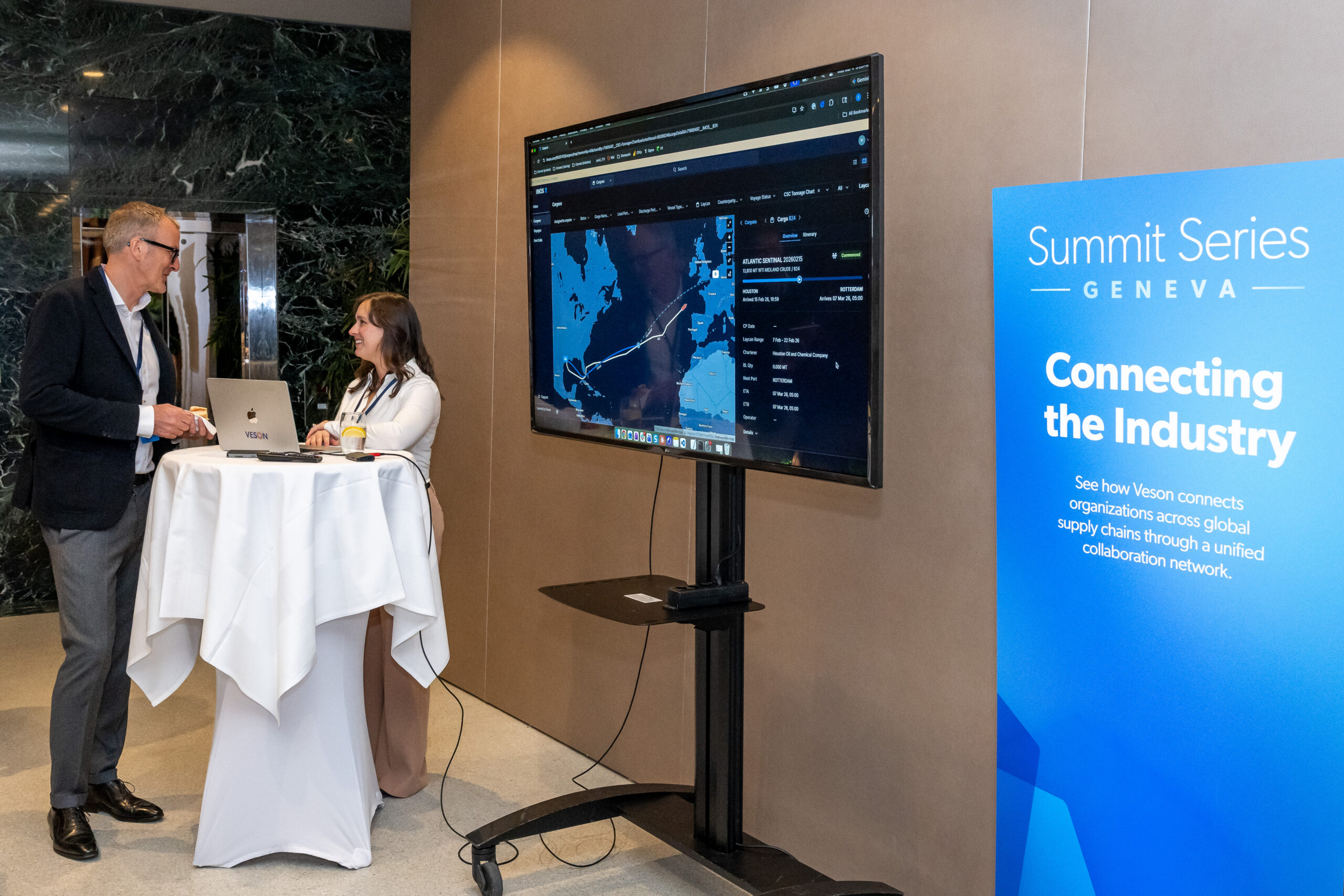
Cargill started this journey a few years back by piloting a simple idea on their own: give customers direct visibility into their cargo and voyage information in one shared interface.
The feedback was immediate and consistent. Customers valued having everything in one place and receiving on-demand updates that enhanced their visibility into each step of the supply chain.
This test also highlighted two important obstacles: Cargill needed a technology partner to help them securely scale the infrastructure. Secondly, customers wanted an industry solution that could be used with all their counterparties, not just one.
As Patrick emphasized during our discussion, this is not a zero-sum proposition. Greater transparency strengthens the ecosystem. It improves decision-making for everyone.
For that reason, the solution needed to be neutral, secure, and designed for industry-wide participation.
That is where Cargill’s long standing partnership with Veson came in.
Veson shared this vision of a unified network, making this the perfect partnership to work on cargo and voyage sharing functionality within IMOS X. This solution resolved both Cargill’s main obstacles and served as the best path forward.
Creating a shared operational reality
It’s important to be clear about what cargo and voyage sharing in IMOS X enables.
This is not simply another AIS view. The visibility includes structured, permission-based access to dynamic voyage and cargo information — incorporating contract information, operator updates, ETA estimates, and more.
The defining shift is alignment: information is in one place for both Cargill and their customers to see.
That shared reality creates a single source of truth. It shortens clarification cycles. It allows commercial decisions to be made with confidence, rather than follow-up emails.
Behind what appears simple is careful governance. Permissions in IMOS X determine who sees what. Data sharing is controlled and configurable. Security and accuracy are rigorous and foundational.
But the experience itself is straightforward, because it needs to be.
From pilot to operational network
As Patrick noted, the hardest part of this journey was not the technology, it was change management.
The efficiency gains enabled by IMOS X are easy to understand: fewer duplicated communications, less errors, and more hours saved across operational teams. But real change requires retiring old habits, not simply adding new tools alongside them.
Today, approximately 80% of Cargill’s customer base and nearly all active customers — are participating in this shared model.
Importantly, IMOS X adoption has not been driven by hype. It has been driven by practicality and the value gained from on-demand customer access and reduced internal friction. What began as a pilot is now operational at scale.
Building the shared network
The larger opportunity here extends well beyond one company.
The value of a collaboration network compounds as participation increases. Customers are already asking for broader visibility across their counterparties. That request reinforces the central point: this works best as a shared infrastructure, not a closed system — and one that users can access at no cost.
IMOS X was designed to remove barriers to participation. IMOS clients can activate sharing capabilities directly, and non-IMOS users can access the collaboration layer without commercial friction.
Cargill has demonstrated that this model is both practical and scalable. The foundation is in place.
It’s a relief to see that modernizing collaboration in shipping does not require a radical leap. It just requires a shared place to meet.
That work is underway, and we are excited to see how it grows.
If you are curious about getting involved, please connect with the Veson team to learn how to get started with IMOS X.