Executive Guide
Maritime’s AI Foundation:
Building the Infrastructure for Intelligent Trade
Successful AI adoption in maritime shipping isn’t defined by speed. It is defined by building your strategy around the right structure.
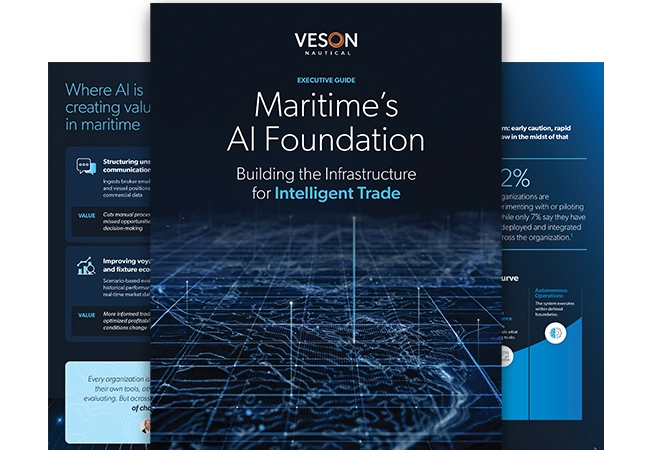
What separates the organizations building scalable, platform-embedded intelligence from those experimenting with disconnected AI tools? This guide explores how data and infrastructure relate to maritime complexity and nuance in successful AI adoption.
The right foundation matters more than ever before

What you’ll get
Understanding AI adoption in maritime
Here’s what you’ll be able to achieve after reading Maritime’s AI Foundation.
1
See how AI adoption is evolving in maritime
Understand how organizations move from fragmented experimentation to embedded intelligence — and what distinguishes those building a scalable advantage.
2
Understand the architecture behind successful maritime AI adoption
Explore the three-layer maritime tech stack and learn why AI only delivers lasting value when these systems operate together.
3
See why maritime data foundations can limit AI initiatives
Walk through real operational data to understand why unstructured, contextual information is so difficult for AI, and what it takes to make it usable at scale.
4
Learn what defines AI-ready infrastructure
Explore the principles of human oversight with machine execution, unified ecosystem, and intelligent core architecture, and see why most environments fall short without them.
5
Understand what separates scalable AI from stalled efforts
Recognize patterns that distinguish organizations building durable, embedded intelligence from those stuck in fragmented, short-term use cases.
6
See why the industry is shifting toward deeply embedded AI
See a detailed comparison between fragmented tool AI and platform-integrated AI across the dimensions of governance, trust, data quality, interoperability, and total cost.
“Every organization is at a different point in their AI journey. Some are building their own tools, others are enhancing existing systems, and some are still evaluating. But across the board, there’s a shared realization that the speed of change is becoming a competitive factor.”

Sean Riley
President & COO, Veson
Access the executive guide
Complete this form for instant access to the full PDF.
Frequently asked questions on AI in maritime
The AI Adoption Curve is a five-stage framework describing how organizations progress through AI maturity: Observation (monitoring what’s possible), Experimentation (running pilots in isolated use cases), Workflow Augmentation (deploying AI in specific workflows with human oversight and validation), Platform Intelligence (AI embedded within a unified platform with context-aware, proactive assistance), and Autonomous Operations (AI executing tasks within defined boundaries, with humans in an oversight role).
The maritime industry currently sits between the Experimentation and Workflow Augmentation stages of the AI adoption curve. Most companies are applying AI tools to isolated use cases, such as specific workflows in chartering or operations, but very few have embedded intelligence into their core commercial platform in a way that spans the full voyage lifecycle.
Up to 90% of operationally critical data in maritime shipping exists in unstructured formats — emails from agents, broker communications, NOR tenders, port notifications, and voyage updates. Each of these carries real-time signals that drive laytime calculations, scheduling decisions, demurrage exposure, and downstream planning. But this information arrives disconnected, contextual, and manually interpreted, which means the same data often exists in multiple places with no single authoritative view. For AI to deliver meaningful value in maritime, this unstructured information must be extracted, understood in context, and mapped into a governed system of record. Only 2 in 5 organizations feel their data management strategy is highly prepared for AI adoption, and only 1 in 3 feel prepared on risk and governance.
An AI-ready maritime infrastructure is built on three foundational principles. An Orchestrated Experience guides operators through workflows with AI-augmented decision support, moving teams away from manual coordination toward guided execution. A Unified Ecosystem ensures native interoperability across internal systems, third-party data sources, and external counterparties, so AI has access to a complete, consistent view of the operation. An Intelligent Core Architecture provides the data and technology foundation that handles both structured and unstructured data, with the domain-specific business logic maritime requires. Organizations that build AI into this infrastructure — rather than layering it on top — are the ones positioned to move from incremental improvement to operational transformation.
The primary risk of rapid, fragmented AI adoption in maritime is not falling behind. It is moving forward in the wrong way.
Organizations that layer AI onto disconnected systems and inconsistent data see rising total cost of ownership, compounding technical complexity, and eroding data quality over time. Trust in AI outputs degrades because the underlying data cannot be reconciled across chartering, operations, and finance.
In an industry where reliability, regulatory compliance, and contractual precision are non-negotiable, AI that produces outputs requiring constant human course-correction adds cognitive load without adding value. The companies that will build a durable AI advantage in maritime are those that invest in the foundation before they scale the capability.
Want the full picture?
These FAQs draw directly from Veson’s industry guide, Maritime’s AI Foundation: Building the Infrastructure for Intelligent Trade. Download the full guide to review the full analysis, including the AI Adoption Curve, tech stack breakdown, and five-criteria readiness assessment.
Would you rather speak to a Veson expert?
We work with maritime organizations at every stage of their AI journey. If you’re evaluating how to build a scalable AI foundation, our team can show how leading maritime organizations are embedding intelligence directly into their commercial platform.