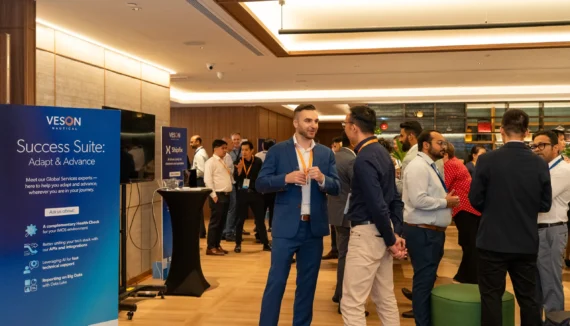
Veson Nautical kicked off its 2026 summit event series this month in Geneva, bringing together leaders from across Europe’s maritime industry to discuss how digitalization, AI, and collaboration are reshaping the industry. The event set the stage for candid conversations about where maritime is headed as we continue to navigate increasingly complex global challenges and changes.
When it comes to emerging technologies like AI, speakers kept returning to a similar conclusion: AI alone isn’t a strategy. It must be embedded intentionally into workflows, trained with domain nuance, and be flexible enough to evolve with the market. Above all, AI needs to serve as practical support in the day-to-day decisions that define maritime performance.
A platform built for what’s next
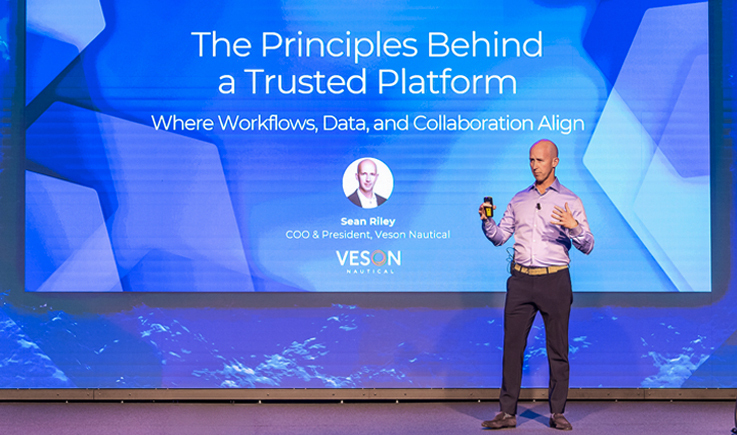
President and COO Sean Riley opened the conference by framing the industry’s current moment. The pace of AI development is compounding rapidly — and shipping, once seen as a laggard in technology adoption, is now making new gains. Riley outlined how Veson has prioritized building a strategy based on how data, workflows, and collaboration can best give clients a decision advantage in the market.
Central to Veson’s vision is creating a user experience that is intuitive to navigate, flexible for their needs, and enables swift decision-making as conditions change. These values contribute to the mission to deeply embed AI into the Veson platform, accounting for the industry’s operational and regulatory nuances.
Expanding purpose-built AI
A dedicated session on how Veson is enhancing and building new AI capabilities within Claims illustrated how training a model deeply on demurrage workflows and real scenarios produces fundamentally different results than a general-purpose tool. In just over a year since launching, Claims has evolved from optimizing workflow efficiency to having the capacity to analyze claims and chat directly with CoCaptain about a specific claims or all your claims.
Product Director Josh Luby’s session on Shipfix reinforced how deeply Veson’s AI philosophy is being embedded across the Veson platform. Continuous investments have extended Shipfix well beyond just an email management tool. The WhatsApp bot allows tonnage and cargo opportunities to be forwarded via chat to flow directly into the same market screens as email-sourced data — meeting users wherever they are and enabling continuity. Shipfix also has a native mobile application that can surface live IMOS voyage data on the go.
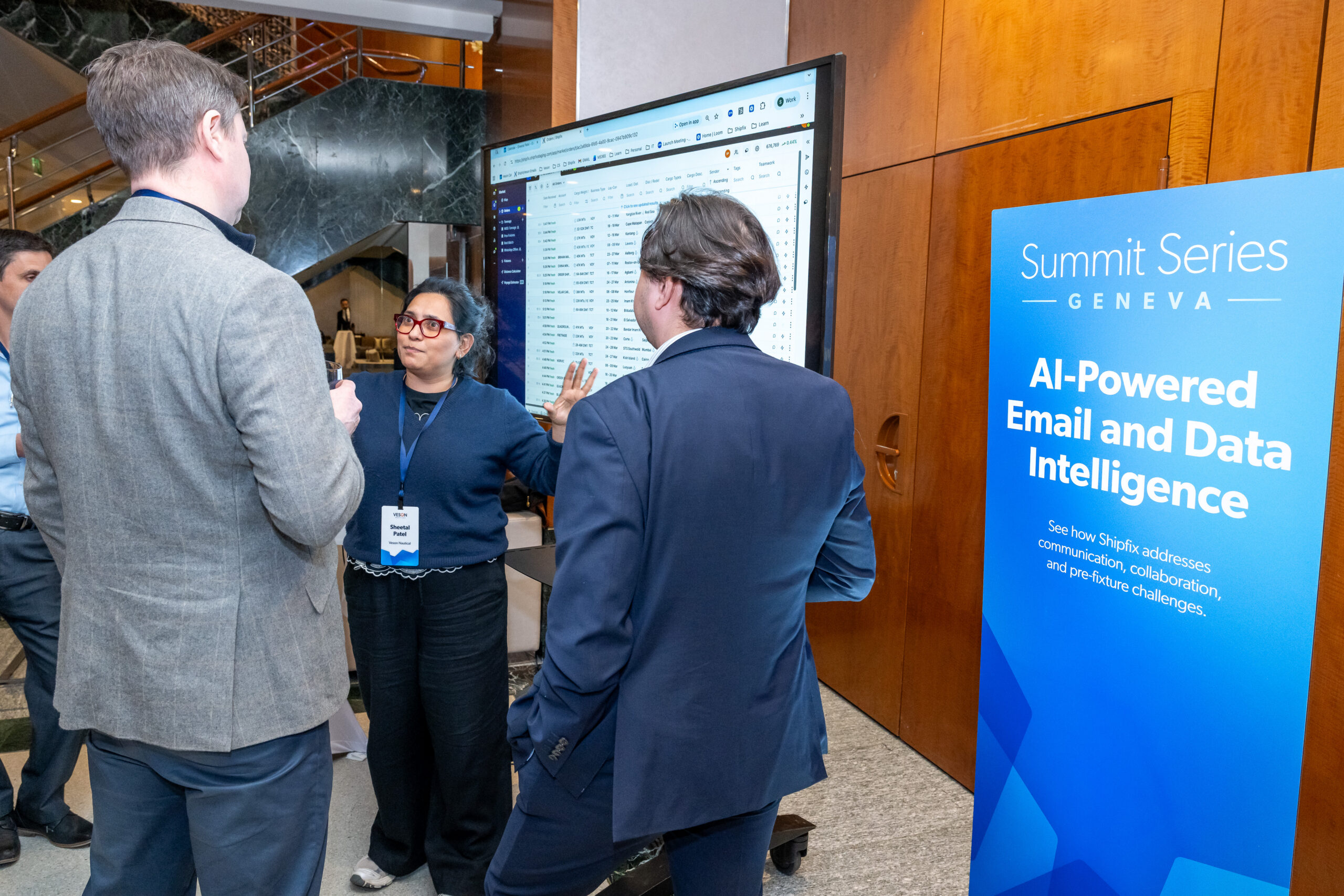
Perhaps most compelling was the “best match” capability, which identifies which vessels and cargoes are most compatible, including lightweight estimates for each pairing in real time. Underlying all of it is an AI-powered engine that takes unstructured data and classifies, maps, and updates Shipfix. Making it seamless to act on the latest information within your workflows.
Co-founder and CEO John Veson’s closing session expanded this vision to the platform level, highlighting three transformative shifts when it comes to digitalization in maritime. The first is the ability to normalize unstructured data from diverse sources, whether email, WhatsApp, or a PDF. Secondly, clients now have greater capabilities to plug their own data feeds, such as risk or fuel models, into IMOS without the need for custom development. Finally, the user experience is increasingly dynamic, adapting to a person’s role rather than forcing them into rigid navigation structures.
Collaboration in action: Cargill and IMOS X
A major aspect of Vison’s strategy is the launch of new capabilities in IMOS X that centralize communication and dating-sharing on one trusted platform. By streamlining workflows and creating a real-time, common network, IMOS X allows companies to easily share voyage and cargo updates directly through a centralized hub, expediting collaboration and decision-making.
A key partner for Veson in building and scaling this platform has been Cargill Ocean Transportation. Cargill Ocean Transportation VP and Business Development Lead Patrick Jourdain joined Veson VP of Product Solutions & Client Advocacy Graham Piasecki onstage to discuss how IMOS X enables Cargill to share real-time voyage and cargo information directly with its customers, replacing a process that previously relied on siloed email, phone calls, and WhatsApp.
Positive feedback from counterparties on IMOS X has moved Cargill toward a significant next step: phasing out email for routine customer updates entirely to further streamline and centralize communication across its ecosystem.
Rethinking bunker procurement
On the bunkering side, Minerva Bunkering CEO Tyler Baron and Advanced Delivery Platform Head of Technology Simon Lock introduced ADP’s new Bunkering Services Initiative, a collaboration between buyers, suppliers, and laboratories to enhance operating standards and increase transparency. ADP’s platform offers an integrated hardware and software solution that automates quantity measurement directly from mass flow meters, eliminating manual entry and calculation entirely and helping to tackle systemic challenges regarding quantity shortages and quality mismatch. Attendees also received a preview of how Veson and ADP are working together to optimize bunker procurement.
Reading the market: dry bulk in focus
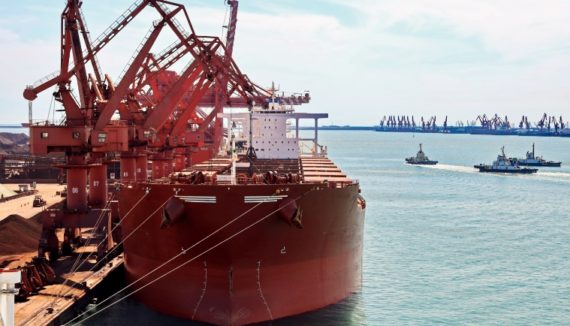
Matt Freeman, VP of Valuation and Analytics, offered a review of the dry bulk market using Veson’s Oceanbolt and Shipfix data. Something that stood out from this session was the power of aggregated, trustworthy data in giving stakeholders a critical view of the market that helps them make smarter, faster decisions as conditions change. Using Veson data, Freeman offered a look at the recent performance of dry bulk segments including iron, bauxite, coal, and grain and soybeans, as well as a forecast for the months ahead. The presentation also provided a preview of Matt’s newly released market insights report on the state of dry bulk demand in 2026.
The bigger picture
The hardest part of deploying AI in maritime isn’t the technology, it’s the data beneath it, the workflows it needs to run seamlessly, and how teams must adapt to best leverage the tool.
The shipping industry has no shortage of AI tools promising overnight transformation. What Veson’s summit illustrated is that durable progress is made of trust, domain knowledge, and connected data. The companies making the most meaningful headway aren’t just adopting technology, nor are they waiting to see what happens — they’re taking intentional, incrimental actions, making adjustments, and expanding their organization’s ability to adapt.