
Vessel market values sit at the center of critical decisions across the shipping industry. A shipowner evaluating whether to divest a 10-year-old MR Tanker, a lender reviewing collateral exposure on a Container portfolio, or an investor assessing fleet performance all rely on the same thing: a market value grounded in real-world transaction levels.
Market participants need confidence that published values reflect achievable prices in the open market, not theoretical assumptions or untested models. That confidence is built on measurable alignment between a vessel valuation model and verified sale transactions over time.
What market alignment really means
Market alignment goes beyond producing a data-driven estimate and requires consistently tracking observed transaction prices across vessel types, ages, and market cycles.
For example, when a Capesize bulker is sold, the relevant measure is not simply whether the final price falls within a broad range but instead whether the valuation, as it stood prior to the sale date, reasonably reflects the level at which the willing buyer and seller agreed.
This is where disciplined backtesting becomes essential. Backtesting involves testing a model’s outputs against real-world historical data to assess how reliably and accurately it performs. When applied across a full dataset, it provides the evidence base needed to validate the vessel valuation model and demonstrates that its outputs can be trusted for informed, forward-looking decision-making.
A backtesting model should:
- Compare daily valuations to verified sale prices using values published prior to the transaction
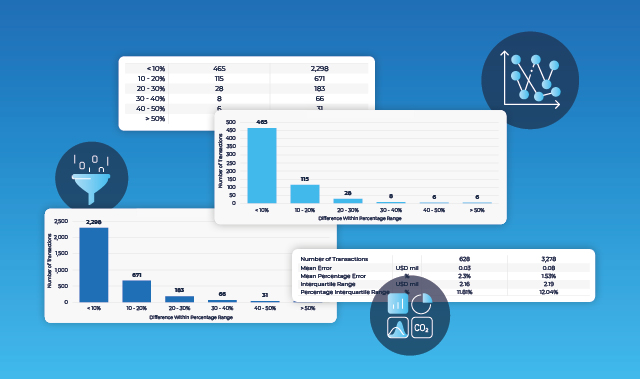
- Measure deviation using transparent valuation error metrics, including mean error and mean absolute percentage error (MAPE)
- Monitor bias and performance across vessel types, ages, and features
Without this transparency, it becomes difficult for shipowners to benchmark achievable prices or for banks to assess whether collateral values remain aligned with market behavior.
Why consistency matters across cycles and regulatory contexts
Shipping markets are cyclical, and asset values can shift rapidly in response to freight rates, regulations, and broader macroeconomic forces. Volatile markets naturally draw scrutiny to valuation levels, but stable periods can present a different kind of risk.
The ability to provide documented evidence that external vessel valuation models are independently tested, monitored over time, and supported by objective performance data is a government requirement for financial institutions subject to European Central Bank (ECB) or European Banking Authority (EBA) guidance, or applying IFRS fair value standards.
Across both commercial and regulatory contexts, long-term consistency in valuation performance provides a stronger foundation than isolated point accuracy.
Explore how VesselsValue performs against real market transactions.
Supporting real-world decisions
Market-aligned valuations play a tangible role in day-to-day shipping decisions:
- Sale and purchase strategy
When published values consistently differ from achieved sale prices, negotiations can stall or sellers may leave value on the table. Comparing values to recent sales or market negotiations helps ensure pricing reflects achievable transaction prices which can materially influence decision-making.
Market volatility creates both opportunity and risk in the sale and purchase market. Accurate, up-to-date values help owners and investors identify whether assets are over or underpriced relative to market conditions, enabling better-timed transactions.
- Lending and risk exposure
For lenders, repeated differences between published values and achieved prices can affect portfolio assessments and exposure calculations. Ongoing performance tracking helps ensure secured asset values remain grounded in transaction evidence.
Documented performance metrics allow institutions to assess whether a vessel valuation model is reliable, consistently monitored, and appropriate for use in internal frameworks.
In each of these scenarios, confidence stems from transparency — from knowing how values are produced and how they perform against the market.
How VesselsValue supports market-aligned confidence

VesselsValue provides daily, automated market values across major shipping segments, including Tankers, Bulkers, Containers, LNG, and LPG carriers. These values are used globally by shipowners, lenders, investors, and brokers to support commercial negotiations, portfolio monitoring, reporting, and risk oversight.
To maintain market alignment, VesselsValue continuously backtests its vessel valuation model against verified sale transactions. Performance is assessed using objective valuation error metrics and monitored across vessel types, sizes, ages, and features. This systematic process helps ensure that VesselsValue’s market values remain accountable to real transaction outcomes, even as market conditions evolve.
The VesselsValue Market Value Accuracy Report compares our vessel valuations against verified transaction prices measured over one- and five-year periods. Download the report below or contact our team to learn how VesselsValue can best provide a validated market perspective.