
This is a regularly updated blog of Veson analysis related to ongoing developments in the Strait of Hormuz. Last updated April 2, 2026
Are Long‑Haul Crude Flows Expanding? March Tonne‑Miles Drop Amid an Upending Market
By Graham Close | April 2, 2026
March was not a normal month for oil markets. The US-Israeli strikes on Iran and ensuing de facto closure of the Strait has dramatically impacted the month’s tonne-mile data.
Against that backdrop, the scale of the decline is perhaps less surprising than the question it raises: what does it tell us about where crude flows go from here?
Across Aframax, Suezmax, and VLCC segments, total tonne‑miles fell 13.7% year‑on‑year in March, and ‑16.4% when normalised by the live fleet — lower than anything recorded during the COVID-19 pandemic.
VLCCs are the primary vessel for Persian Gulf crude exports, so the Hormuz closure hit them hardest. Total VLCC tonne‑miles fell 20% YoY, and ‑27% per vessel. That per-vessel figure strips out any flattering effect from fleet growth, as it shows existing tonnage going largely unused as Gulf liftings collapsed.
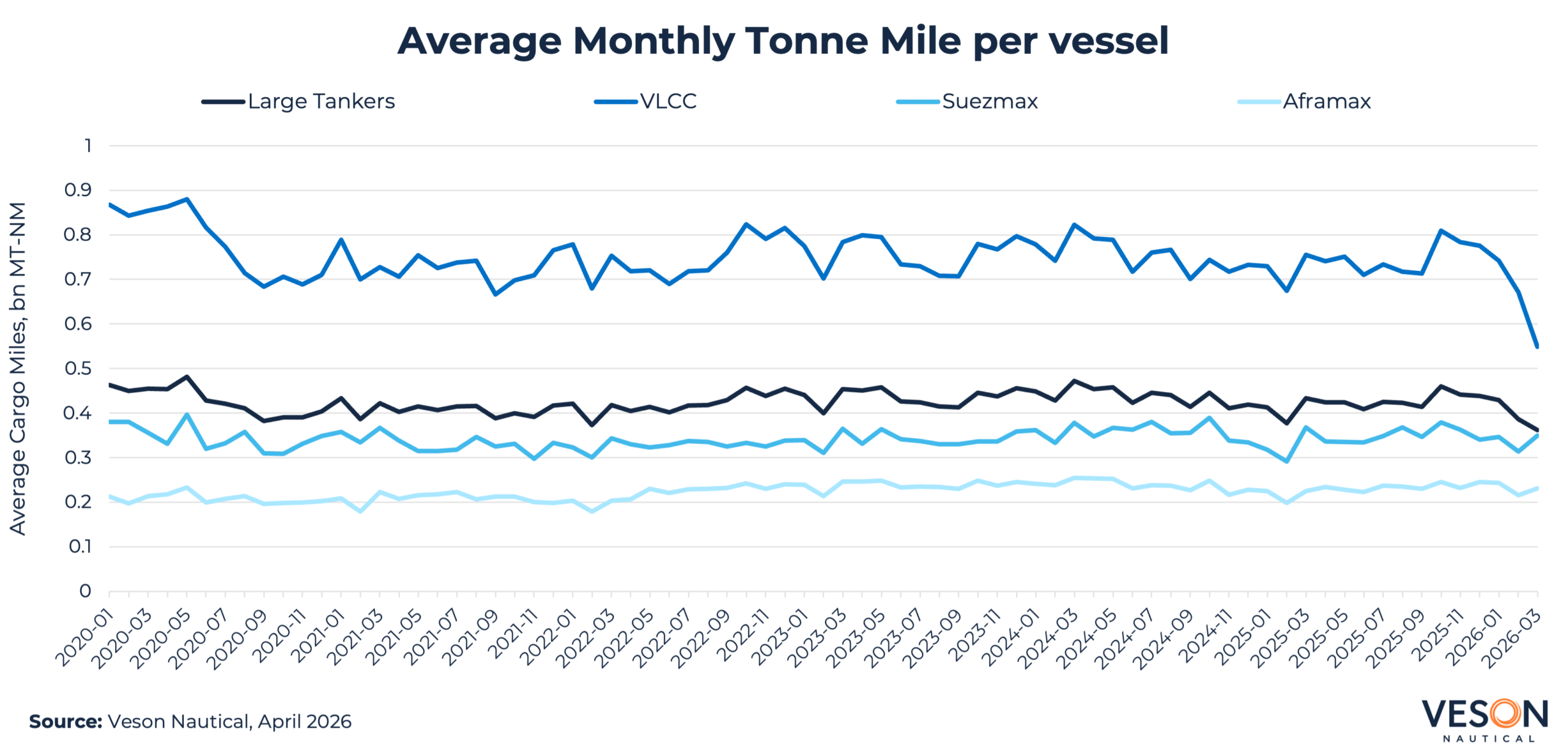
Aframax tonne‑miles were actually up 7% YoY (+3% per vessel), while Suezmax was broadly flat at ‑1% YoY (‑5% per vessel). This likely reflects non-Gulf trade routes continuing to function — shorter and medium-haul flows that don’t depend on Hormuz transit.
Before the war, there was growing discussion about Asian refiners reaching further into the Atlantic Basin for crude — a trend that, if real, should eventually show up as rising VLCC tonne‑miles on long-haul routes. March can’t tell us whether that was happening, because the Hormuz closure overwhelmed any such signal.
April is the first month where we might start to see whether Asian refiners are genuinely compensating for lost Gulf supply by pulling harder from the Atlantic. If they are, VLCC tonne‑miles should begin to recover — and on longer average voyage lengths than before. If they don’t, it would suggest either that alternative supply isn’t flowing at the scale the narrative implies, or that demand destruction is offsetting any rerouting effect.
March tonne‑miles tell us the market absorbed a significant shock. What they can’t yet tell us is how trade flows are adapting to it.
A Fifth of the World’s Offshore Vessels are at Risk in the Persian Gulf
By Peter Edwards | March 25, 2026
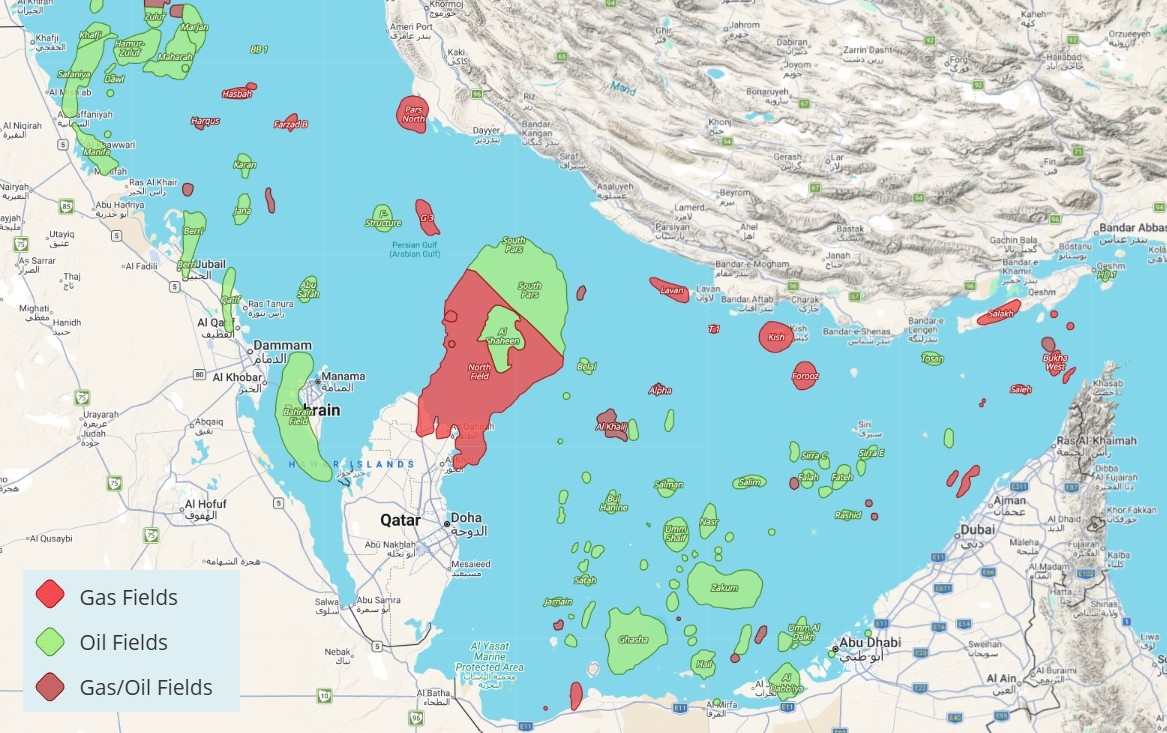
The Middle East conflict has delivered an immediate shock to the offshore market. Saudi Aramco, QatarEnergy, Kuwait Petroleum and ADNOC have all reduced, suspended or declared force majeure on production, with Gulf oil exports falling over 60% to around 9.7 million barrels per day for the week ending March 15. The closure of key offshore fields including Safaniya, the world’s largest offshore oil field, alongside Marjan, Zuluf and Abu Safa has contributed to an estimated 2 million to 2.5 million barrels per day reduction in Saudi production.
QatarEnergy has also shut down all gas production at its offshore North Field in the Persian Gulf and declared force majeure. With repairs to the Ras Laffan LNG terminal expected to take up to five years, it puts one of the region’s most significant long-term OSV and OCV demand programmes on hold. OSVs and OCVs supporting drilling, logistics, subsea and field maintenance across the region are now without active operations and with no clear timeline for resumption.
The scale of the fleet exposed to disruption is also significant. The region currently hosts 1,440 OSVs, 432 OCVs and 156 jack-up rigs, representing 19% of the global OSV fleet, 18% of the global OCV fleet and 27% of the global jack-up market, according to VesselsValue data. Across all offshore asset classes, roughly one in five of the world’s vessels are based in a region that has effectively stopped operating. Oil and gas fields across Saudi Arabia, Kuwait and Qatar are all impacted by the closures.
As the conflict continues, the market could begin to split across global regions in the medium- to long-term, though much remains uncertain. Inside the Gulf, a large proportion of the stranded fleet is built for benign, shallow water operations and lacks the specifications to compete in more demanding markets, leaving these vessels effectively trapped.
Outside the Gulf, Brent crude above $100 per barrel makes previously marginal projects in West Africa, Brazil and the North Sea more attractive, which could drive increased OSV and OCV demand in those markets. Should higher specification vessels begin to reposition to meet this demand, global supply in those markets could tighten further, adding upward pressure on rates and presenting a broader upside for the offshore market outside the Gulf.
Iran Conflict Sends Mixed Signals for Dry Bulk
By Mikkel Nordberg | March 24, 2026
While the dry bulk segment is not as exposed as oil and gas tankers to the impacts of the conflict in the Middle East, it will not go unscathed. The situation may prove to be a double-edged sword for the segment: short-term inefficiencies and rerouting could support the market, while longer-term economic effects risk turning negative.
Rerouting, inefficiencies & coal-switching support demand
The most immediate impact stems from the de facto closure of the Strait of Hormuz, which has brought Arabian Gulf exports to a near standstill. According to VesselsValue Trade data, roughly 3% of total dry bulk trade passes through the strait, including aggregates, iron ore, fertilizers, and cement. Sourcing these materials from alternative origins introduces longer sailing distances and operational inefficiencies, which support freight rates.
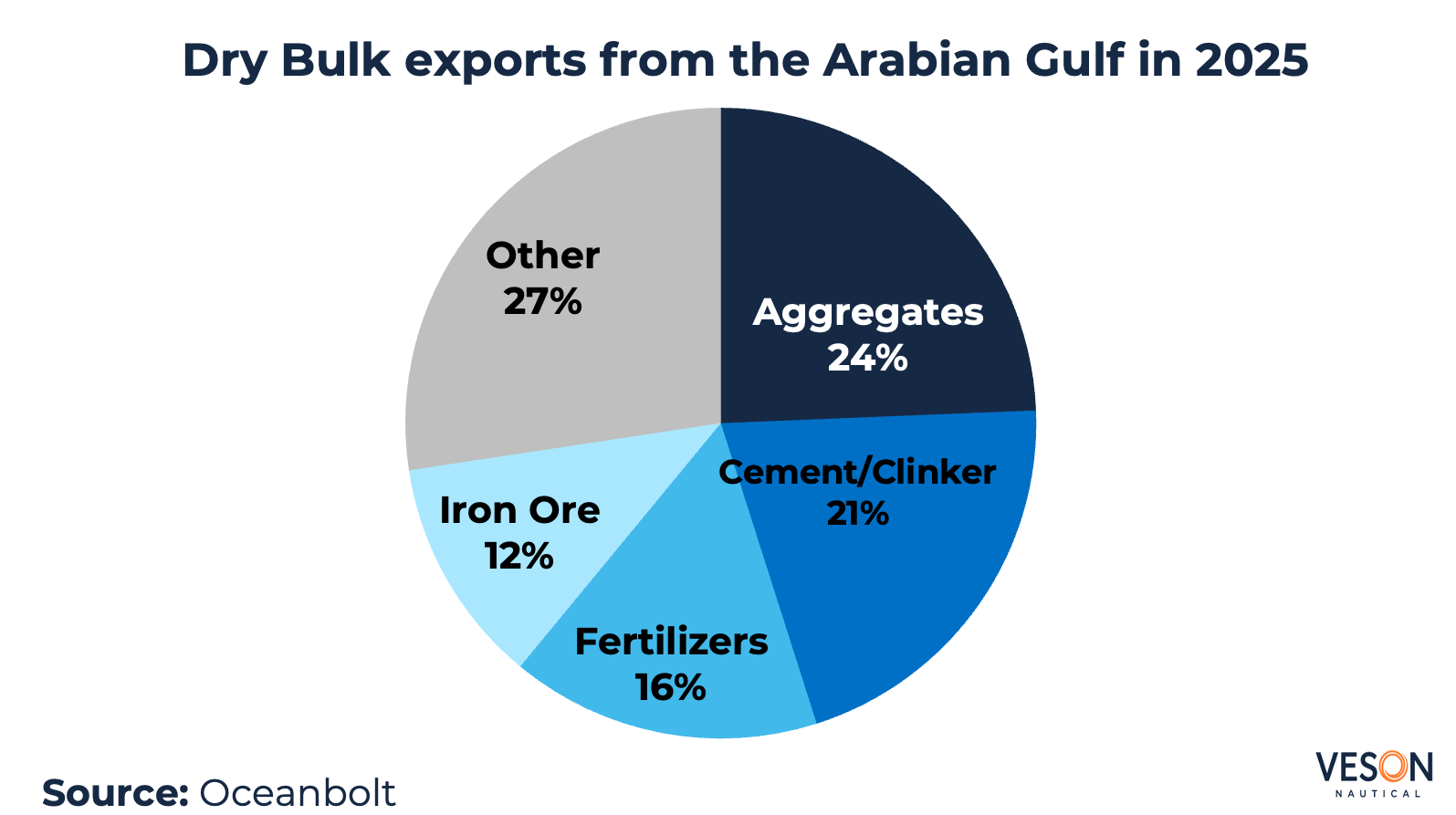
Additionally, approximately 1.4% of the global dry bulk fleet is currently trapped within the strait, constraining vessel availability and limiting supply. Meanwhile, the Houthi militant group has pledged to continue its attacks in the Bab-el-Mandeb Strait in solidarity with Iran. Rerouting away from the Red Sea is expected to persist, with Red Sea transits for dry bulk vessels already down 50% compared to pre-attack levels. These factors are contributing to tighter vessel supply and firmer freight rates.
Higher gas prices and limited availability could prompt a switch from natural gas to coal in energy production. Moving to a cheaper energy source may help contain energy prices, but it could equally become a necessity from an energy security perspective. This would boost coal trades and prove positive for the bulker market.
High energy costs weigh on long-term dry bulk outlook
However, this more optimistic scenario for dry bulk carries a significant caveat: high oil and gas prices. Elevated energy costs are a drag on global economic activity, which would ultimately weigh on dry bulk demand.
With roughly 15% of the world’s seaborne fertilizer trade originating from the Arabian Gulf, a meaningful ramp-up of production elsewhere would be required to cover the shortfall. This gap is unlikely to be filled in the interim, given that natural gas is a key input in fertilizer production, with availability constrained by the closure of the Strait of Hormuz. This would not only reduce fertilizer trade volumes, but could also limit grain production in the coming harvest season.
Concerns over oil availability have driven a sharp rise in bunker prices, with Singapore VLSFO roughly doubling from approximately 500 USD/t in February to around 1,000 USD/t towards the end of March. Higher bunker costs significantly increase overall transportation expenses, which could suppress demand for dry bulk shipping.
The longer the conflict persists, the greater the potential damage to energy infrastructure, the higher energy prices could climb, and the more negative the effects on the global economy and dry bulk trade will become.
Despite Persian Gulf closures, vehicle carrier demand may rise in short-term
By Andrea De Luca | March 20, 2026
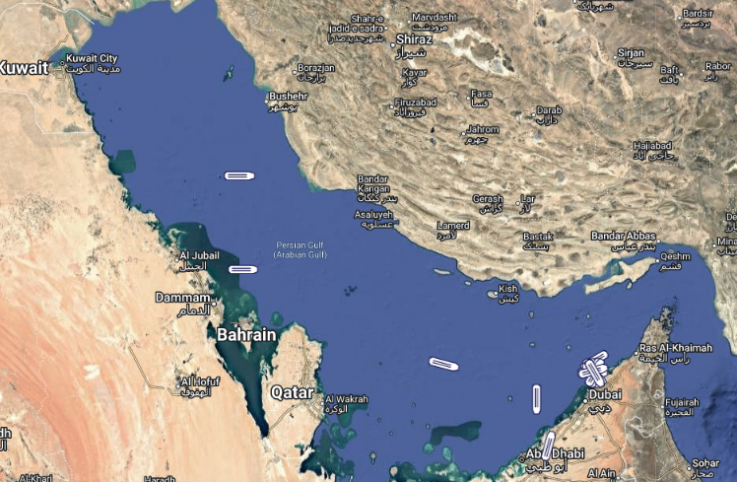
The Persian Gulf remains de facto closed today, with 17 Vehicle Carriers anchored awaiting further instruction, noting all liner services are currently suspended. Inbound car deliveries continue into Saudi Arabia via the Jeddah Islamic Port — either through a significant Cape of Good Hope deviation from Asia to avoid the Bab al-Mandeb Strait, adding substantial voyage cost, or direct from Asia depending upon the carrier.
The scale of the market exposure is significant: the UAE, Saudi Arabia and neighbouring Gulf states collectively imported over 900,000 Chinese light vehicles last year, and a sustained Hormuz closure could remove c.15% of China’s seaborne vehicle exports and c.10% of global Vehicle Carrier demand.
That said, the demand picture is more nuanced than the headline figures suggest. Lost Gulf-bound volumes could be partially offset by containerised cars returning to RoRo modalities from China, estimated at c.1 million units shipped around the globe. Additionally, China is likely to target the European market more aggressively, which would support car-mile demand. This dynamic suggests that, contrary to the broader demand contraction narrative, charter rates may face upward pressure in the short term before an eventual correction materializes. VesselsValue 1-Year TC Index for 6,500 CEU is currently 50,000 USD/day, up 13% vs the Jan-Feb average.”
Global LNG supply at risk as Middle East conflict grows
By Jarl Milford | March 20, 2026
The Middle East conflict introduced fresh uncertainty to global energy markets this week after reports of damage to the Ras Laffan LNG terminal in Qatar raised significant supply concerns. As the world’s largest LNG export hub — with a production capacity of 77 MT per year and a share of roughly 20% of global LNG supply — any disruption at Ras Laffan carries major market implications.
QatarEnergy confirmed damage on its LNG infrastructure with repairs expected to take three to five years. 12.8mtpa, representing approximately 17% of Qatar’s total LNG output, is now sidelined. A meaningful share of global supply has effectively been removed from the market for the foreseeable future. Gas markets have responded sharply, with TTF prices more than doubling since the conflict began, including a 20% surge since Wednesday alone.
What we are unfortunately beginning to witness are domino effects of a sustained disruption to the global energy system. According to the BBC, nearly 400,000 workers in Morbi, India’s ceramics hub that accounts for roughly 80% of the country’s tile and sanitaryware output, have been idled after factories shut down due to propane and natural gas shortages as a result of regional disruptions. A more than $8bn industry that exports to the Middle East, Africa and Europe has ground to a near halt. And Morbi is unlikely to be the last example.
Strait of Hormuz tensions drive up used vessel prices
By Rebecca Galanopoulos | March 17, 2026
Rising tensions around the Strait of Hormuz have had a significant effect on the used VLCC segment. Disruption to normal transit routes has prompted cargo owners and operators to reassess fleet positioning, with some loadings from the Arabian Gulf rerouted via the East-West pipeline to the Red Sea port of Yanbu. This rerouting has altered ton-mile demand dynamics, and periods of elevated freight rates have fed through into stronger asset valuations as owners capitalise on improved earnings.
The situation has also buoyed secondhand Tanker asset values, due to the disruption in trade flows and fleet positioning. This adds to other factors driving up used Tanker prices, including the large-scale sanctioning of vessels into the so-called dark fleet, which has progressively removed compliant tonnage from the trading supply pool and created a structural imbalance where legitimate demand has consistently outpaced available supply. Finally, the recent aggressive acquisition campaign by Korean operator Sinokor has included the purchase of 56 vessels in 2026 alone, an unprecedented level of buying activity that has further tightened supply and pushed values higher. For example, 15-year-old VLCCs of 310,000 DWT have appreciated by approximately 31.74% year-to-date, rising from USD 59.57 mil to USD 78.48 mil.
Iran conflict could send shockwaves across LPG shipping, ammonia, and energy supply chains
By Jarl Milford | March 12, 2026
Ongoing disruptions in the Strait of Hormuz continue to worry energy markets, particularly after six commercial vessels have been targeted in recent days. Vessels are still waiting for a safe passage through the strait, and the recent escalation does not point towards imminent safe transit.
This development has already led to increased energy prices, and with LPG, LNG and ammonia volumes running through this critical chokepoint, the ripple effects across global energy, petrochemicals and food production could worsen significantly the longer the situation persists.
The escalating disruptions will have significant implications for the LPG global supply chain. C.30% of global LPG is exported from the Middle East, almost all of which is headed to Asia. A major proportion of this LPG is used as a feedstock for producing other petrochemical gases used to power a variety of household consumer goods, including clothes, carpets and dishwashers.
If the transit disruption continues, we could see not only higher prices on a variety of these goods but could ultimately risk supply shortages. We are already seeing Asian crackers reducing operating rates and some declaring force majeure because of the ongoing conflict.
Ammonia trade is also facing disruptions, with c.25% of global ammonia exported from the region, half of which goes to India. C.70% of global ammonia production is used for producing fertilizers. With higher natural gas prices in Asia, we could see less ammonia produced and available for global trade, which could hurt food production in India and other Asian countries.
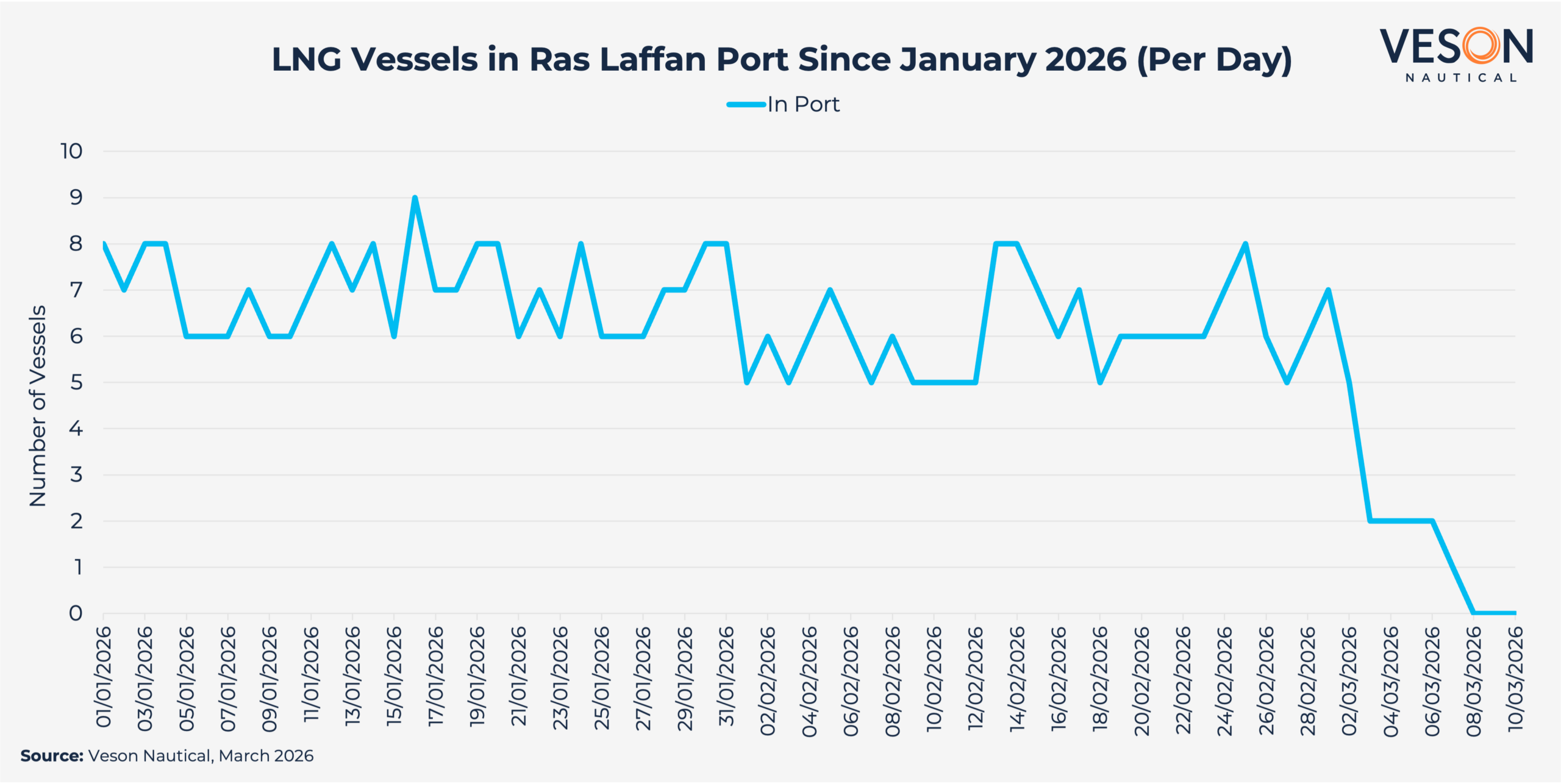
LNG shipping is also heavily affected, with c.20% exported from the Middle East with c.90% headed to Asia. The gas is mainly used for power generation, and with competition from Europe for US LNG supply, we might see increased use of other energy sources, such as coal. For countries with less fuel-switching flexibility it could pose a serious energy security concern.
Vessel tracking data from Qatar’s Ras Laffan port illustrates the dramatic impact of the Middle East conflict on LNG exports. Daily LNG vessel calls at the terminal averaged 6-8 calls per day through January and February, before collapsing to near zero earlier this month following attacks on the facility.