
Global coal demand has been rising over the last couple of years, with new record highs reached in both 2024 and 2025 at around 8.8 billion tonnes, according to the International Energy Agency (IEA).
However, growth has slowed and speculation regarding “peak coal” has emerged as the world continues to decarbonize. Advanced economies are phasing out coal in favour of cleaner energy sources, while China, the world’s largest consumer of coal, has expanded its renewable energy capacity significantly.
Last year, renewable energy capacity surpassed coal power capacity in China, and coal electricity generation declined by 1.5%, marking the first such decline since 2015. At the same time, with energy security high on the agenda, China is seeking to source more coal domestically to become more self-sufficient in meeting its energy needs and is sourcing more land-borne volumes from neighbouring Mongolia.
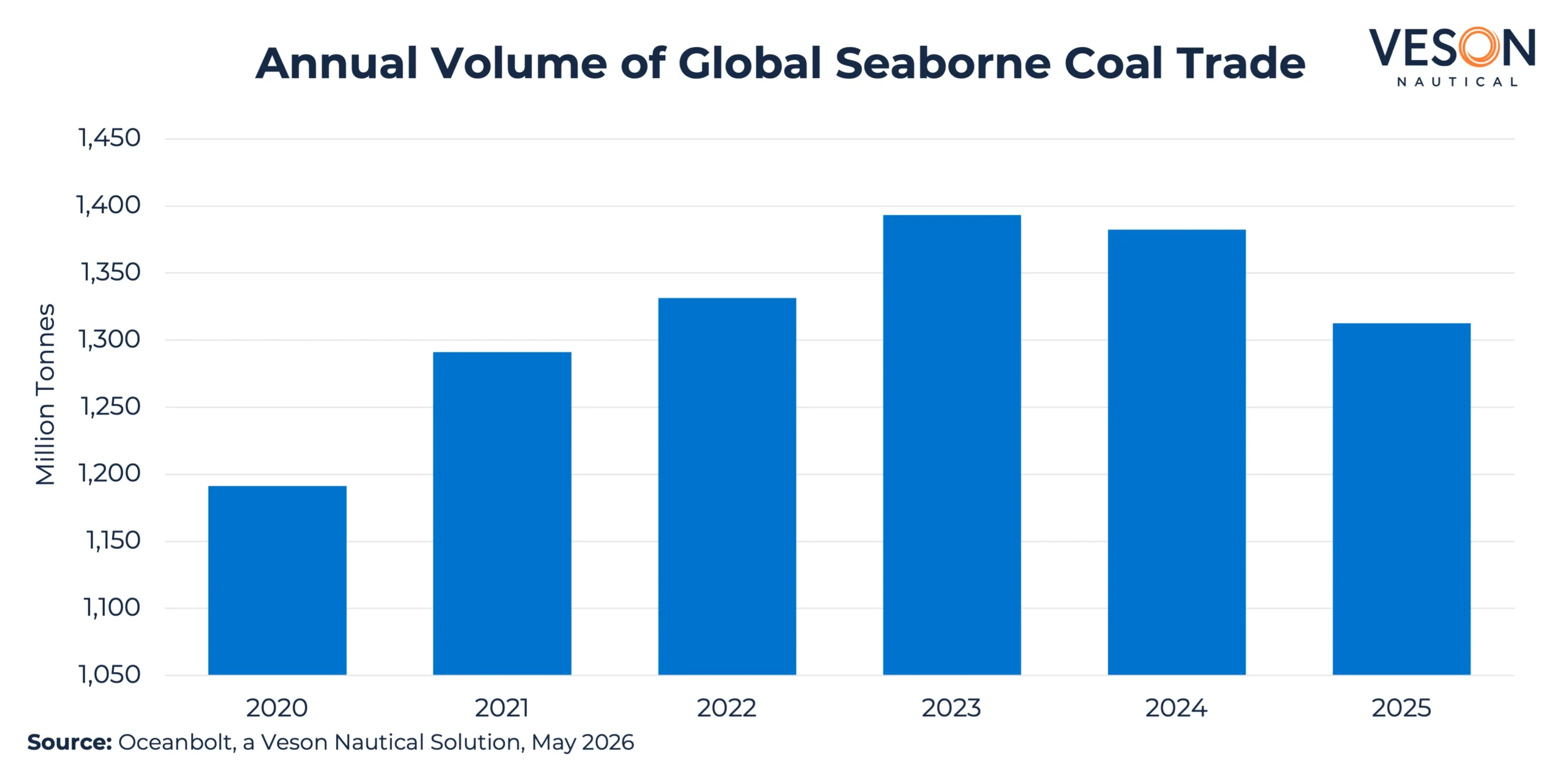
Using Oceanbolt data, we can see that global seaborne coal trade has declined by 5% over the course of the year as a result. This trend has continued into 2026, with global seaborne coal trade declining a further 0.5% so far this year. Nevertheless, several distinct drivers may coincidentally converge to create a perfect storm in the coal markets in 2026.
These drivers are war, weather, and accidents, which could potentially reverse the current declining trend.
War
The war in Iran and the subsequent closure of the Strait of Hormuz has caused a sharp jump in oil and gas prices, as roughly 20% of the world’s oil and gas supply passes through the strait. Facing energy shortages and elevated prices, governments are turning to coal as an alternative fuel source to meet their countries’ energy needs. This shift is already visible in the data. According to Oceanbolt, the global seaborne coal trade jumped 4% year over year in April.
However, we are still early in the conflict and given that energy shocks take time to work their way through the supply chain, the full effect has likely not yet materialized. Furthermore, the longer the conflict persists and the more acute the energy crisis becomes, the greater the demand for coal will be. As a result, Iran conflict is expected to provide significant support for coal demand throughout 2026.
Weather
The World Meteorological Organization (WMO) is expecting an El Niño weather pattern to develop between May- July 2026, with models indicating it could be a strong one.
El Niño is characterized by a warming of ocean surface temperatures in the central and eastern Equatorial Pacific. Its effects on weather vary from region to region, but it typically leads to a hotter and drier climate. Of particular interest to the coal trade is its potential to reduce monsoon rains that typically hit India and southern China during the summer months. Reduced rainfall in India and in the key hydropower producing regions of Sichuan and Yunnan in China could have a severe impact on hydropower production in the two most populated countries on earth.
At the same time, El Niño will likely drive higher temperatures across the same areas, increasing air conditioning usage and pushing energy demand sharply higher. This inconvenient combination of soaring energy demand and lower hydropower production will likely translate into greater coal demand this summer, as southern Asia burns more coal to stay cool.
Tragedy
China’s domestic coal production has been growing as the country seeks greater energy self-sufficiency, given its historical reliance on imports. Last year, output rose 1.2%, reaching 4.83 billion tonnes.
A persistent limiting factor, however, has been mine safety, with accidents posing a recurring challenge to sustained production growth. China has made significant efforts to raise standards through automation, intelligent mining, and consolidation.
These efforts may now face a setback following a deadly incident on May 22nd, when a gas explosion at a coal mine in the northern province of Shanxi killed over 90 people, making it the deadliest mining accident since 2009. The mine was owned by Shanxi Tongzhou Coal Coking Group, whose mines have since been closed and whose executives have been detained.
In the aftermath, authorities are enforcing a wave of stringent safety inspections across coal mines in the region. Several Shanxi mines have halted production for three to five days, and broader output is expected to be dampened going forward. Coking coal prices have already surged to two-week highs as market participants anticipate a tightening in supply. As domestic production comes under pressure, China will likely turn to increased seaborne imports to compensate.
Dry Bulk Shipping Benefits
While the structural trajectory of global coal demand points downward in the long run, 2026 may prove to be an anomalous year.
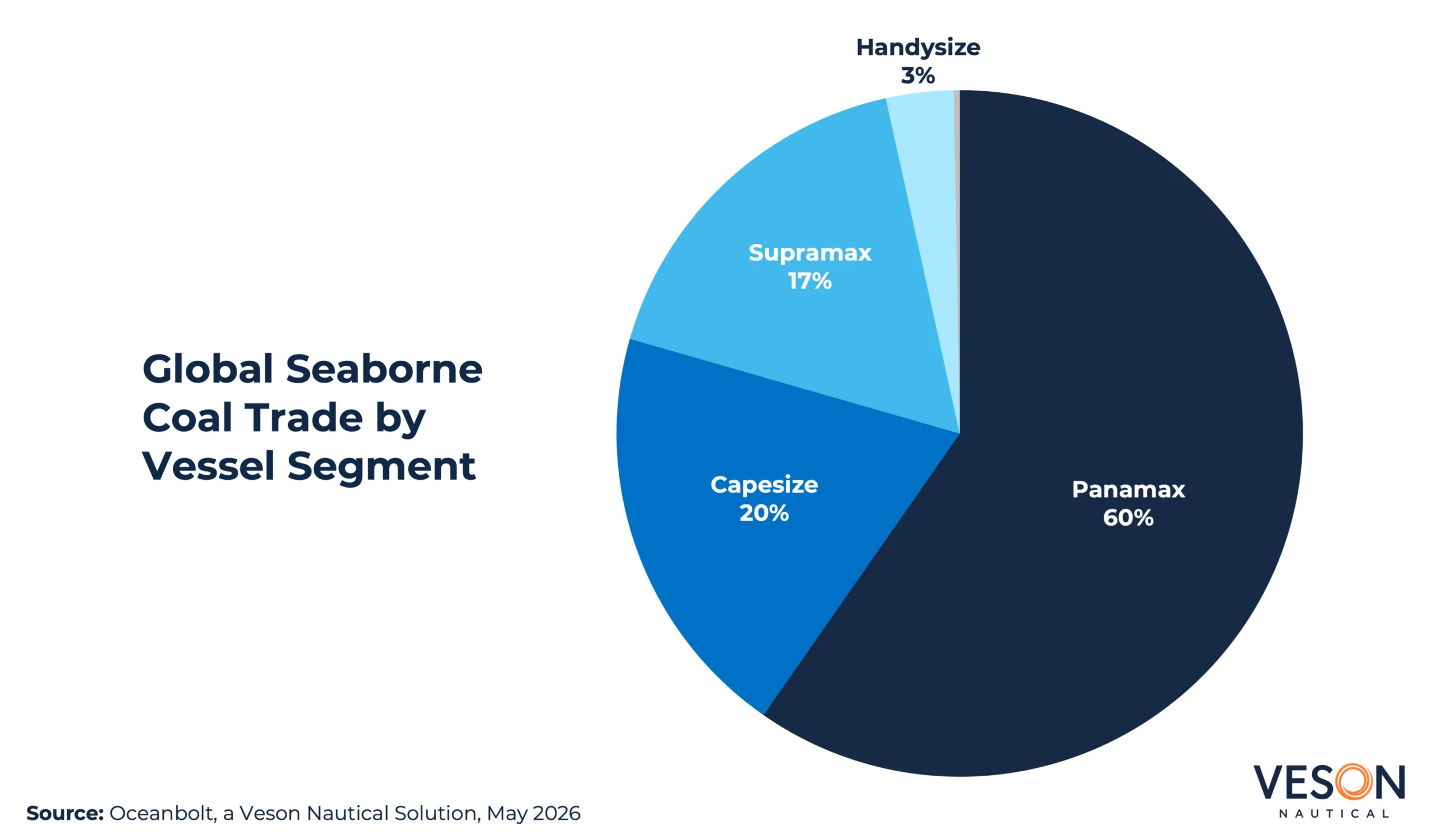
The convergence of three largely independent forces — the Iran conflict, the El Niño weather pattern, and the tightening of Chinese domestic coal production — could potentially boost coal markets this year. Not only could this increase global coal consumption, but it could also translate into higher seaborne coal volumes. This bodes well for the dry bulk shipping market, particularly for Panamax vessels.
Risks to both the downside and the upside remain, as the extent of any impact will depend on the severity and duration of each of these separate events.