InterActive Guide
Commercial maritime decarbonization: A story still evolving
How to turn regulations into carbon-smart, compliant, and commercially sound decisions.
- Carbon’s central role in the maritime contract
- Beyond EU ETS: A trend of rising carbon regulation
- The five pillars of carbon-conscious decision making
- How to navigate carbon regulations with Veson solutions
- Looking for more on maritime sustainability?
Carbon’s central role in the maritime contract
Sustainability in maritime shipping is no longer just a secondary objective—new and evolving regulations have cemented its place as a central variable in every contract. While the introduction of EU ETS and FuelEU for Maritime marked a turning point for the shipping industry, these regulations do not represent a single moment in time. Instead, they mark the beginning of a new era of continuous compliance and carbon-centric contract management.
As carbon pricing, fuel standards, and reporting mandates continue to expand across regions and voyage types, the most successful organizations won’t be those who simply meet existing regulatory requirements—they’ll be the ones who are ready for the next.
Organizations that embed emissions, exposure, and compliance into their everyday workflows will protect margin and move faster as new frameworks emerge. It’s about much more than adding another layer of reporting—it’s about bringing together environmental and economic intelligence in a single decision infrastructure.
Keep reading to discover what is needed for this new era of carbon-conscious decision making, and how Veson’s unified solutions empower you to address them.
See how Veson helps you navigate these sustainability shifts:
Beyond EU ETS: A trend of rising carbon regulation
EU ETS and FuelEU are just two examples in a trendline of rising carbon regulation around the globe. From early emission standards to the fuel intensity mandates of today, a clear pattern emerges: carbon continues to move closer to the center of commercial shipping contracts, making regulatory agility more important than ever.
Explore the timeline below to see how maritime carbon regulations have evolved since 2000—and how each milestone has pushed the industry towards a more measurable, accountable, and sustainable future.
Change in the Industry
2005
IMO begins developing the EEDI
Energy efficiency introduced as a design metric for new ships.
2006
First IMO GHG Study
Establishes shipping’s share of global CO₂ emissions (~2.7%).
2008
MARPOL Annex VI revised
The oil crisis brings skyrocketing fuel prices that trigger route changes, slow steaming, and new vessel designs.
2010
EEDI and SEEMP adopted
First mandatory global CO₂ rules for new and existing ships.
2013
IMO Data Collection System (DCS) groundwork begins
Moves toward standardized global fuel and emissions reporting.
2015
2015: EU MRV regulation adopted
Requires CO₂ monitoring, reporting, and verification for voyages touching EU ports.
2018
IMO initial GHG strategy
Sets target to reduce total GHG emissions by 50% by 2050 (from 2008 baseline).
2020
IMO 2020 global sulfur cap
Limits fuel sulfur content to 0.5%, improving air quality and operational efficiency.
2021
IMO adopts EEXI & CII frameworks
Operational and design efficiency ratings become mandatory for all ships.
2023
IMO updates GHG strategy
Commits to net-zero emissions by 2050, with checkpoints in 2030 and 2040.
2024
EU ETS extends to maritime
Carbon pricing applies to CO₂ from vessels ≥5,000 GT operating in the EU.
2025
FuelEU Maritime enters into force
Sets limits on well-to-wake GHG intensity of fuels and introduces credit trading.
Move left
Move right
The five pillars of carbon-conscious decision making
Getting ahead of carbon considerations is not just about compliance—it’s about preparation. The ability to proactively integrate each new rule, region, and requirement into your operating system will define how you adapt to the next era of sustainable maritime trade.
Let’s look at the five pillars needed to support carbon-conscious decision making.
Success principle 1
Unify carbon and commercial intelligence
Link emissions and economic data within the same decision flow. When carbon considerations are viewed in context with cost, sustainability becomes integral to how the organization views, evaluates, and optimizes performance.
Success principle 2
Enforce thresholds throughout the workflow
Integrate carbon thresholds throughout the voyage lifecycle—from planning to settlement—so compliance is continuous, not reactive. By automatically checking each stage of the voyage against EEXI, CII, and FuelEU intensity limits, while managing annual FuelEU compliance pooling, fleet-level performance remains within target as conditions change.
Success principle 3
Adapt seamlessly to new requirements
As new global regulations, operational choices, and counterparty requirements emerge, systems must evolve without disruption. Configurable workflows and data structures make change manageable and measurable.
Success principle 4
Harness the highest quality data
Combine verified emissions, operational, and financial inputs into one, context-aware source of truth. Data integrity enables accuracy, not just in reporting but also in strategic, carbon-aligned decision-making.
Success principle 5
Collaborate across the ecosystem
All sides of the contract have a stake in raising the bar for sustainability and reducing barriers to compliance. Connected systems, communication tools, and shared knowledge support cross-ecosystem collaboration and accelerate progress.
How to navigate carbon regulations with Veson solutions
Veson enables compliance across the full carbon regulation landscape while preparing organizations to readily adapt to new regulations and requirements in the future. Let’s take a closer look at how Veson’s solutions support adherence to major maritime carbon regulations.
EU ETS: Managing allowance exposure at the voyage level
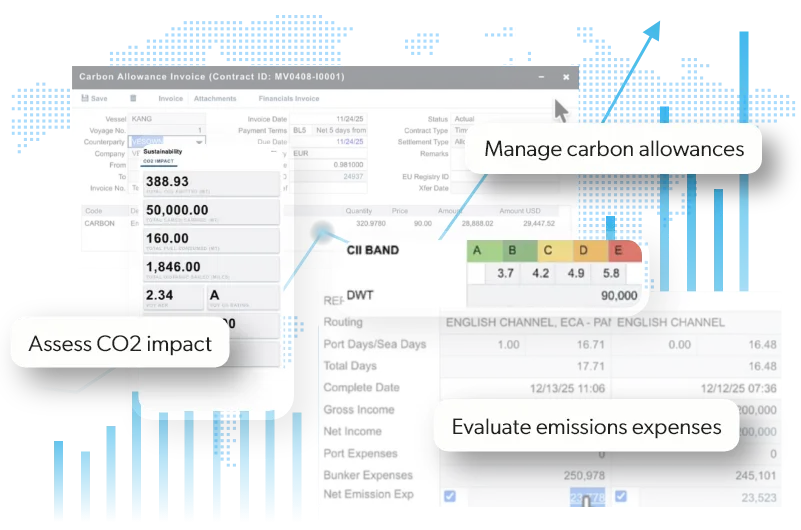
The EU ETS extends carbon pricing to shipping, requiring operators to monitor CO₂ emissions, forecast allowance needs, and account for exposure across intra- and extra-EU voyages.
Veson embeds ETS logic directly into voyage P&L and settlement workflows so teams can:
- Calculate CO₂ e exposure dynamically by voyage and scope
- Forecast allowance requirements and simulate EUA price impacts
- Reconcile allowances automatically within the voyage ledger
FuelEU Maritime: Calculating GHG-intensity and managing compliance balances
FuelEU introduces well-to-wake fuel-intensity limits and a credit system that requires continuous monitoring and balance tracking across the fleet.
Veson connects voyage, fuel, and emissions data to automate intensity calculation and credit management so teams can:
- Monitor real-time GHG intensity against annual targets
- Generate and trade FuelEU credits with full audit traceability
- Integrate performance directly into voyage profitability analysis
Emerging Fuels: Adapting to new fuel types
Emerging fuels—bio-blends, LNG, methanol, ammonia—bring diverse lifecycle profiles, certification requirements, and regional rule complexity.
Veson’s flexible fuel architecture and integrated fuel / emissions data workflows let teams:
- Configure and compare WtW and TtW emission factors for new fuels
- Run scenario modeling of regulatory schemes and compliance cost structures
- Configure workflows to new lifecycle-based measures as they emerge
Sustainable Chartering: Considering sustainability in chartering decisions
Charterers want vessels that align with their carbon targets, while operators want to showcase verified performance. A solution that provides the data and workflow automation to support both of these objectives is critical in meeting decarbonisation objectives.
Veson enables sustainability data to become discoverable, comparable, and actionable across the commercial workflow with the ability to:
- Expose verified CII, FuelEU, and carbon-intensity metrics directly within the chartering process
- Match cargoes, vessels, and counterparties based on sustainability performance and ESG criteria
- Provide auditable emissions profiles and voyage histories through integrated data
- Enable counterparties to act confidently on the same verified environmental dataset
Ready to see more?
If you’re a maritime stakeholder looking to elevate your approach to carbon-aware decision-making, fill out the form to access our decarbonization demo videos.