
Following last year’s US-China trade truce, China has resumed purchases of US grains and soybeans, a development welcomed by Washington after years of steadily declining volumes. Yet even as Beijing honours its commitments to American farmers, it is simultaneously casting its net wider. This month, Chinese trader COFCO lifted the first Argentinian corn cargo bound for China in 15 years, a move that underscores how food security, rather than trade diplomacy, is driving Beijing’s agricultural strategy.
The urgency of that strategy has only sharpened in recent months, as conflict in the Middle East has forced the near total closure of the Strait of Hormuz, disrupting global fertilizer flows and raising the prospect of smaller harvests and higher food prices in the season ahead.
China slashes US grain imports as Brazil fills the gap
The grain and soybean trade has become a significant flashpoint in the broader trade dispute between the US and China. Historically, China has relied on US grain and soybean imports to compensate for limited domestic production. However, as trade tensions between the two countries have escalated, China has steadily reduced its dependence on US agricultural products.
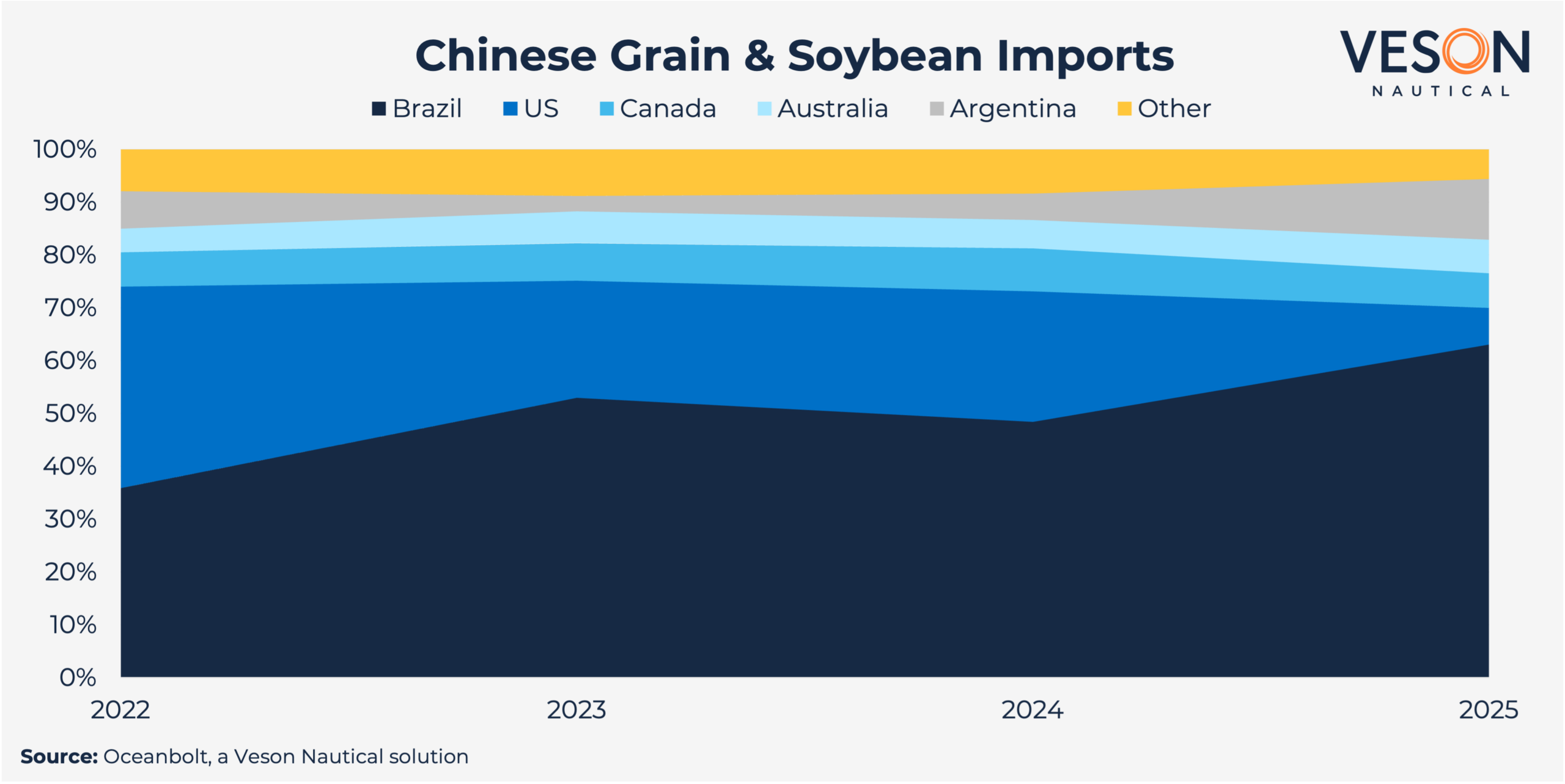
According to Oceanbolt data, China’s seaborne imports of US grain and soybeans stood at 52.5 million tonnes in 2022, representing roughly 38% of its total imports. By 2025, that figure had dropped by 84%, down to just 8.2 million tonnes. China has actively sought to diversify its supply base, increasingly turning to Brazil as an alternative source. Brazil’s market share nearly doubled from 36% to 63% over the same period, with volumes peaking at 75 million tonnes in 2025.
Trade truce brings US soybeans back to China
This development became a key point in the recent trade negotiations between China and the US last October. China committed to purchasing 12 million tons of US soybeans by February 2026 and a further 25 million tons per year from 2026 to 2028.
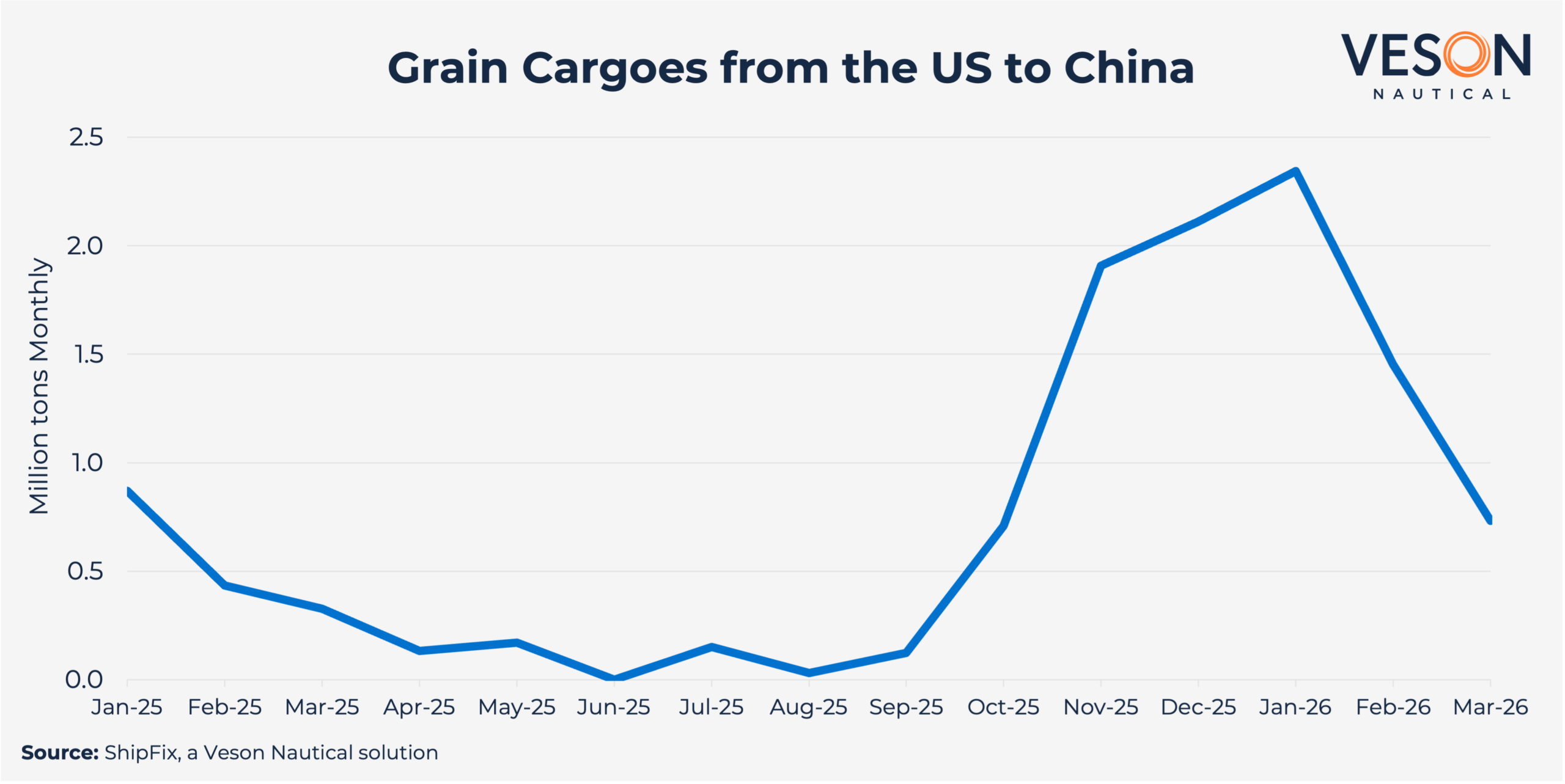
China appears to have kept its word, as purchases of US soybeans began immediately following the agreement. This was reflected in Shipfix data, which registered a noticeable uptick in circulating cargoes after the trade truce. Grain cargoes moving from the US to China went from effectively zero over the summer to a near-term peak of 2.3 million tonnes in January 2026.
Chinese supply diversification continues
Despite the resumption of US-China grain and soybean trade, China appears to be continuing its diversification strategy to reduce its exposure to future trade disputes.
The COFCO lift of China-bound Argentinian corn consisted of 34,000 tons of cargo loaded at the Timbúes port terminal in Santa Fe, representing the first large-scale bulk cargo shipment to China since 2011, according to a Bloomberg report.
This follows China’s 2024 decision to officially clear Argentinian corn for imports, following years of sanitary negotiations. However, poor harvests combined with logistical and economic hurdles delayed the trade from materialising. After a record harvest season 2025-2026 and a significant reduction in export duties, Argentina was finally in a position to get its corn exports to China up and running this year. This is likely to be a growing trade in the years to come, as China seeks further diversification.
Food security a key concern
The resumption of corn purchases from Argentina forms part of a broader Chinese strategy to secure its food supply. Food security has become an increasingly important priority on the Chinese policy agenda, as the country strives towards greater self-reliance in agricultural production.
China achieved a record grain harvest last year of 715 million tonnes, and its new five-year plan targets a further increase of 50 million tonnes by 2030. Complete self-reliance remains out of reach for now, particularly given China’s continued dependence on soybean imports.
Nevertheless, reducing its reliance on US grain and soybeans in favour of South American exporters represents a meaningful step towards a more secure and diversified food supply.
Near-term supply risks
The symbolic purchase of the Argentinian corn cargo comes at an interesting time from a geopolitical perspective. The war in the Middle East and the subsequent disruptions in the Strait of Hormuz have severely impacted the global fertilizer trade. With approximately 20% of the world’s seaborne fertilizer trade originating from the Arabian Gulf, the closure of the strait has led to supply shortages and sharply rising fertilizer prices.
This comes at a critical juncture, as farmers across the northern hemisphere are currently planting for their next crop. The reduced availability of fertilizers could result in smaller harvests in the coming growing season, leading to lower grain supplies and higher food prices globally. Against this backdrop, the resumption of Argentinian corn imports is likely also driven by strategic stockpiling ahead of what could prove to be an uncertain period for global food supply.
As China continues to prioritize its own food security and a diversified supply base, it’s likely to continue to bolster trade with once smaller export countries. The sailing distance from Argentina to China is roughly 11.3% longer than the journey from the US to China. Therefore, the emerging Argentinian trade could be promising for ton-mile demand growth. Additionally, a sudden burst in exports as countries scramble to get grains ahead of a potential shortage could lead to congestion in the Upriver area, adding to vessel inefficiencies.
Given this context, Sino-Argentinian trade should be net positive for the dry bulk freight market, particularly the small- and medium sized segments. However, in the long run as the fertilizer crisis works its way through the supply chain, the grain trade volumes will likely decline. Finally, an increasingly self-reliant China pose long-term market risks as the growing domestic production could eventually reduce import demand.
Key Takeaways
- The US-China trade truce is real, but don’t mistake the deal for dependence on US supply. China has honoured its soybean commitments, but rising volumes reflect a negotiated obligation and not a structural return to US export dependency.
- South America is consolidating its position as China’s agricultural backbone. Brazil’s import share nearly doubled from 36% to 63% between 2022 and 2025 as US volumes fell 84% over the same period, and the first Argentine corn cargo in 15 years signals this diversification is still expanding.
- Food security, not trade diplomacy, is Beijing’s primary policy driver. China’s record harvest and five-year production targets reveal a systematic push for self-reliance, with multi-origin sourcing as a deliberate hedge against over-dependence on any single supplier.
- The Strait of Hormuz disruption adds urgency to near-term procurement. With 20% of seaborne fertilizer trade originating from the Arabian Gulf , China’s strategic stockpiling, including the Argentine corn purchase, is likely in anticipation of tighter global grain supply and higher prices ahead.
EXECUTIVE SUMMARY
Shipping Market Outlook: Q2 2026
Tankers, Bulkers, Containers, LPG